Applications Open! Food Warrior Fall 2011 Internship Program

Real Time Farms is currently hiring interns for the Fall 2011 Food Warrior Internship Program, which will run from September 12th to December 15th. We are hiring Food Warriors in Asheville, Austin, Nashville, Portland and San Francisco.

Description
Food Warrior interns will document farms, farmers’ markets, and food artisans in their areas to work towards the greater goal of bringing transparency to the food system. They will have the opportunity to interact directly with producers, take photos and video, collect information on growing practices and personal stories of producers, and contribute to the Real Time Farms blog.

Food Warriors will work approximately 15-20 hours each week and will be responsible for uploading all the information, photos, and video compiled to the Real Time Farms website. They will check in regularly through email and with weekly Skype meetings. There is possibility of receiving academic credit for completing the internship.

Interns are able to choose their own schedules, but should be available for one meeting each week between 10am and 5pm eastern time Monday through Thursday. Internet access is essential.

Enthusiasm, a strong work ethic, and passion for food transparency are a must. Writing and photography experience are a plus.

How to Apply
Email me at lindsayp@realtimefarms.com with “Food Warrior Application” and your city in the subject line.

Please attach a copy of your resume and answers to the following questions:
1) Why do you care about food transparency?
2) Why do you want to be a Food Warrior for Real Time Farms?
3) Sample blog post on a related topic (be creative!)

Please give me any relevant information on previous experience with blogging, journalism, photography, or other related work. Also please let me know if you have a camera and/or access to a car (Not necessarily required, but we need to make sure at least one intern in each area has a car to travel to farms. We have a limited number of spare cameras that can be loaned to interns who do not have one).

Applications are due by August 27th, and they are being considered on a rolling basis, so the sooner you apply, the greater your chances of acceptance to the program.

Stay Fresh,
Lindsay Partridge
Kernel Colonel: Food Warrior Program

(Thanks to Summer 2011 Food Warriors: Maddy Kiefer and Tom McCarthy for their photos!)
Posted in Food Warrior Interns | Tagged , , , , | 2 Comments

Earthworks Urban Farm

Take a few minutes to watch this compelling short documentary about the Detroit-based Earthworks Urban Farm by University of Michigan students Benjamin Antonio and Salam Rida.

Posted in On the Farm | Tagged , , , , , , , | Leave a comment

City Harvest: Another Piece of New York’s Food Web

This post is from one of the 18 interns in the Real Time Farms Food Warrior Summer Internship Program. These interns are collecting data, pictures, and video on the growing practices of our nation’s farms, collecting food artisans’ stories, and documenting farmers markets. We all deserve to know where our food comes from!

On Real Time Farms, we document food webs – how food travels from farms, to artisans, to restaurants. In my work as an intern this summer, I have been able to see this connection first-hand. About a week ago, I talked to a farmer from Stokes Farms at the Tribeca Greenmarket. Later that week, I visited Sullivan St Bakery, and found out that they use some of Stokes Farms’ produce in their products. Then, I ate at a restaurant that serves Sullivan St Bakery’s bread.

While at Sullivan St Bakery, I saw all of the fresh ingredients being prepared, and I saw the final bags stuffed with bread with delivery labels on them, waiting to be sent out. What I also saw, in a less noticeable corner of the packing room, were a few large, clear plastic bags filled with bread, with bold, green writing printed on them: “City Harvest.”

Although it sometimes seems like food goes in a one-direction flow from farmer to artisan to restaurant, many farmers and artisans do not actually use all of the produce that they grow or product that they make. So where does it all go?

Many farms and artisans in the New York area donate their extra or unusable product to City Harvest, an organization in New York that aims to rescue food for New York’s hungry.

“Now serving New York City for more than 25 years, City Harvest is the world’s first food rescue organization, dedicated to feeding the city’s hungry men, women, and children. This year, City Harvest will collect 28 million pounds of excess food from all segments of the food industry, including restaurants, manufacturers, and farms. This food is then delivered free of charge to nearly 600 community food programs throughout New York City. Each week, City Harvest helps over 300,000 hungry New Yorkers find their next meal. City Harvest also addresses hunger’s underlying causes by supporting affordable access to nutritious food in low-income communities, and channeling a greater amount of local farm food into high-need areas,” writes City Harvest on their website.

Many artisans, farms, and even markets on Real Time Farms take part in the City Harvest program. Sullivan St Bakery and Amy’s Bread donate their bread products. Red Jacket Orchards, which sells apples and fruit juices at various markets in New York City, participates. The Grand Army Plaza greenmarket, which is the second largest market in NYC after Union Square, also takes part.

City Harvest adds another dimension to our food web; the foods produced by farms and artisans are not just going to regular consumers, but also to New York’s hungry. Thanks to this program, less food is wasted, and more people have access to fresh, nutritious food.

Danielle Blake

Summer 2011 NYC Food Warrior Intern

Posted in Food Warrior Interns | Tagged , , , , , , , , | Leave a comment

Eggs Benedict in 6 Minutes

I love Eggs Benedict. I can’t pinpoint the beginning of my love affair, because my love has always been there. As Eggs Benedict features prominently in most menus, I don’t think I am the only one in love.

Borden - Eggs Benedict

For over 20 years, I resigned myself to eating Eggs Benedict in restaurants because I thought the sauce was too darn hard – the classic recipe for hollandaise sauce involves a double burner, a candy thermometer, and a metal bowl (none of which we own). But last Sunday, my partner, trusting as always in the infallibility of The Joy of Cooking and spurred on by my stated desire of what I wanted for our holiday weekend brunch, kept reading. He persevered, finding a recipe for hollandaise that doesn’t require anything special but a blender.

And we own a blender, and we have fresh eggs that need to be eaten, and the entire delicious, plate-licking meal took us 6 minutes to make, and it was the easiest at-home most decadent brunch ever.

Here is our two-person recipe for Eggs Benedict, modified with more lemon juice to ensure a big sparkle of citrus to offset the fat. Four poached eggs, turkey bacon from freezer, leftover 8 grain 3 seed bread from Zingerman’s, Hollandaise sauce made in the blender: 2 egg yolks, 2 teaspoons lemon juice, 1/3 cup melted ghee (clarified butter), salt and pepper – voila!
(Note: This timeline assumes two sets of hands, and we like our eggs runny.)

T-minus 6 minutes: Check coop for fresh eggs, return with 4 fresh new eggs to add to the 2 on the windowsill from yesterday, turn heat on for poaching egg water, melt ghee, slice off 4 chunks of turkey bacon and throw into toaster oven with slices of bread.

T-minus 5 minutes: Separate 2 egg yolks into blender, add 2 teaspoons lemon juice, grind in pepper and salt, press toast on toaster oven.

T-minus 4 minutes: Take a sip of coffee, watch the bread turn into toast.

T minus 3 minutes: Set the table, scratch the dog.

T-minus 2 minutes: Break 4 eggs into the poaching egg water

A brief step-out from our countdown. I learned to make poached eggs years ago. The trick was to create little tornadoes in the water with a spoon and then gently pour the egg into the middle of the tornado. The force of the tornado made sure the egg didn’t spread all over the place. If the egg was being difficult, you could add vinegar to the water. I always liked making water tornadoes with my spoon – so that is what I did.

Or, that was what I did until we started keeping chickens. I don’t need to make a tornado in the water any more. A freshly laid egg has a white that is almost as firm as the yolk. I am able to simply pour it into the warm water. They are so contained unto themselves, they can be literally on top of each other and still be intact when you spoon them out.

Okay, back to the countdown.

T-minus 90 seconds: Turn blender on and start foaming the yolk and lemon juice. After 10 seconds slowly pour in the melted ghee.

T-minus 30 seconds: (This takes some maneuvering to happen all at once). Remove toast and bacon from toaster, place the four pieces onto two plates, stack turkey bacon on top, remove the poached eggs from the water and place on top of bacon, use a spatula to pour the Hollandaise onto the eggs, carry plates to table.

Breakfast! Cut into the perfectly runny eggs, the salty, tangy bacon, the warm dense bread, and spread over it all the incredibly perfect Hollandaise sauce. Smile as your tongue dances with happiness.

Chopstick Crazed,
Corinna

Posted in In the Kitchen (recipes & more) | Tagged , , , , , | 1 Comment

Oh say can you CSA!

At a recent dinner of my parents’ friends, no one at the table knew what a CSA was, and I, still addressing the “adults” as “Mr & Mrs,” attempted to enlighten them.

CSAs are shorthand for Community Supported Agriculture. You purchase a share at the beginning of the season and then receive bushels of whatever is in season every week or so. It is a partnership between the farmer and the eater.”

Mrs X responded loudly, “That is the most un-American thing I have ever heard of, what happened to the idea of self-sufficiency? That reeks to me of socialism!” (It helps to imagine a glass of Sauvingon Blanc being waved around when you hear this.)

My default action when that particular emotional hot button word (aka grenade) is lobbed into the conversation is to hide under the table, or at the very least flee to the ladies room. However, an attack on healthy, local food is too important for me to ignore. Let me see if I can break down Mrs. X’s point of view (after all, she knew me as a babe).

100 strangers and I pay $400 to a farmer. The farmer purchases seeds (capital), pays for gasoline for the tractor, buys a new pair of mud boots for the season (operating expenses), hires some people to help plant the seedlings (labor) and feeds herself while caring for the green shoots growing in the fields under the rain and sun.

My initial monetary investment is transformed into lettuce, beets, chard, kale, bok choy, pole beans, squash, peppers, cucumbers, tomatoes, watermelon, raspberries, strawberries and eggplant (to name a few).

If I were to purchase a CSA share in early March, I’d expect to start receiving food in May, and that abundance would continue till October (timing depends on the farmer). The dividend percentage on my initial investment burns through the capital every year, and thus I will need to reinvest in shares the following year (I have eaten all of the profits).

If the potatoes are hurt by the blight and the squash catches a fungal wilt, my food dividend will be commensurately smaller, as will the shares of the other 100 investors. When the farmer has a productive season, my larder will be filled to bursting as I share in the food profits.

I recommend asking your favorite farmer at the market whether they offer one. Market Managers are good people to talk to as well. The nice is thing is that by saying hello now, you will be able to perhaps get one of the coveted Winter Shares.

Personally, the best thing I have found about CSAs are the relationship between the consumer and the farmers: heck, let us say it – friendships.

Socialism? I don’t think so. For me a CSA embodies the relationship between an entrepreneur and an investor – and the dividends are paid in food – a very American and unique relationship. Oh say can you CSA?

Lettuce Lady,

Corinna

(originally published on AnnArbor.com)

Posted in On the Farm | Tagged , , , , | 3 Comments

Backyard Chicken: Why (and how) we killed one of our chickens

(This is the tenth and final post in a series of Friday posts about Backyard Chickens to give an overview of my experiences these past two years.)

(Note: This post contains very vivid descriptions of chicken slaughter.)

Borden - dead chicken

According to Human Rights Watch, the average speed of dead poultry moving past the inspectors in a slaughtering plant is 70 per minute. That means in the time it took you to read this last sentence you would have been expected to examine six birds for the nearly 20 listed items the Food Safety and Inspection Service list in their 2009 directive. Whether it be “pulling the cut skin and muscle back [to look for a] … yellow scabbed areas between the skin and subcutaneous tissue…enlarged or reddened kidneys that indicate infection of early sepsis, [or] …an overscalded carcass.” One second per bird is optimistic at best.

This fact, along with many others about the state of our slaughtering facilities in this country, is why I wanted to kill my own chicken.

John Harnois, of Harnois Farms, was kind enough to teach us one fine October day — he set up his metal funnel to hang the bird, a tub of water to scald the feathers and a de-plucking machine for after the deed was complete.

Many people I have spoken to about killing birds dispense with the first part of the process, but Harnois explained he felt it more humane to render the brain dead before draining the body of blood.

After placing the chicken upside-down in the funnel, we grabbed its bottom jaw. Quickly before losing my nerve, I drove the point of a sharp paring knife through the upper soft palate into the chicken’s brain. After watching the eyes slowly close, my husband took a pair of double-handed pruning shears and lopped off the head.

While we waited for the body to drain of blood, there was a great deal of movement and activity. The bloody neck emerged once or twice from the headless feathers and the legs scissored back and forth. Watching an animal progress through its death throes is not for the tender hearted.

Once the chicken had stopped moving we took it by the legs and dunked it completely in a large vat of simmering water (hot enough to loosen the feathers, but not so hot as to cook the bird). Deemed ready by Harnois when a few feathers came out to his tug, we held the bird over the rapidly spinning rubber fingers of the de-plucking machine for the majority.

Once the feathers were off, the chicken no longer felt to me like the same animal that pecked and preened and stretched in our back garden. The chicken, without feathers, became a biology experiment.

Cutting around the vent and removing the innards was 100 percent benign in comparison to the emotional bracing it took for me to stab a living chicken through its brain.

Yet without the stab, there is no dinner, which is why I stabbed.

Lettuce Lady,

Corinna

Posted in On the Farm | Tagged , , , , | 4 Comments

Savor the Season: Strawberry Champagne Cupcakes

Please focus on the strawberry and not on my cutting board begging for oil.

I know that summer has really and truly arrived in Michigan when strawberries start showing up at the farmers market. Sadly strawberry season is all too short, and is already nearing an end in our area. My husband and I picked strawberries this past weekend at Rowe’s Produce Farm, and I had bookmarked Love & Olive Oil‘s recipe for Strawberries Champagne Cupcakes for just this occasion. (Eat Like No One Else did a nice round-up of Michigan U-picks that might still have berries left, give a farm near you a call!)

Strawberry puree

I used a very dry champagne to reduce for the frosting, but I’d recommend using a sweet sparking wine. I was focused on what would become of the unused portion of champagne (my hubby and I are partial to dry), and hadn’t thought that reducing the dry wine might result in a bitter taste. I didn’t mind the resulting tang in the frosting, but I think that starting with a sweet base would have resulted in a better frosting.

Yum

blank

blank

My cupcakes were a subtle shade of purple after baking, still very tasty, but less aesthetically pleasing than the recipe author’s cupcakes. Next time I’ll make mini cupcakes like Love & Olive Oil did to help them retain more of a vibrant pink hue due to the shorter cooking time.

Locally yours,

Lindsay-Jean

Posted in In the Kitchen (recipes & more) | Tagged , , , , , , , | 1 Comment

Washington DC’s local food landscape and FRESHFARM Markets

I am happy to report our capital city, the thriving metropolis of Washington DC, shuts down roads and stops traffic for local food – and it all began with FRESHFARM markets.

Shoppers at the Dupont Circle FRESHFARM Market (on the closed down 20th St NW).

The 501c3 organization runs 11 farmers markets in DC, Maryland, and Virginia. One of the two FRESHFARM Directors, Ann Yonkers, recently shared with me the history and the workings of this dynamic organization.

A native Washingtonian, Yonkers purchased Pot Pie Farm with her husband in 1991 in St. Michaels, MD and quickly became confronted by the local food scene. As Yonkers described it, “the Eastern Shore is such a weird setting. It used to be like New Jersey – almost all of the food for restaurants from Philadelphia, Baltimore and Washington came from there. With the advent of chicken farms, it just produces wheat, corn, and soybeans – which are all used to feed chickens. I would go to the farm stands and restaurants and all of the produce was from California. I said this is really crazy. So I started a little business, picking up produce and dropping it off.”

Yonkers was thus fertile and energetic ground for when FRESHFARM Board Member Nora Pouillon, of Nora’s, struck by the dynamic NYC Greenmarkets, suggested to her friend to start similar markets in DC.

Yonkers and her Co-Director, Bernadine (Bernie) Prince, opened the first two markets (Dupont Circle and St. Michaels) under the American Farmland Trust umbrella in 1997. (Farmers markets are often run under the aegis of a larger organization until they decide to take the time and money to become their own 501c3. It is much easier to be a line item in a church balance sheet, for example, during the first few bumpy years of attracting customers and growers.)
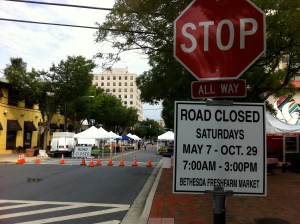
Bethesda FRESHFARM market continues the trend of food stopping traffic.

In 2002-3, FRESHFARM filed for 501c3 status and opened their third market – Penn Quarter. “It was a struggle” Yonkers recalled, “and part of the big struggle was getting that first market open with the permits to shut down the street.” The Penn Quarter FRESHFARM market location is awesome – tents and shoppers are cradled on a closed off block of 8th St NW between the Navy Memorial and the National Portrait Gallery, looking straight down the hill to the National Archives (erected in 1931 on the former site of Washington DC’s Center Market).

FRESHFARM is committed to tracking the numbers to illustrate that the local food movement is not a passing trend. “We count our customers every half hour. We also take a percentage fee of gross sales, which has made it possible to track how we are doing.” As she continued, Yonkers sounded sad. “Most markets have no idea. All over the country there is this giant movement and everyone says – oh it is so great. But it is all anecdotal, not really great in terms of saying this is a serious activity.”

So let us talk 2010 numbers. Over 360,000 shoppers purchased food from the 150 plus farmers and producers selling only what they grow, raise, catch or make at FRESHFARM markets. Over 9000 acres of Chesapeake Bay watershed is farmed to support that local demand. More than $19,000 in free food vouchers was donated to low-income shoppers – several of their markets accept WIC, Senior Coupons, and Food Stamps/SNAP Benefits. (Mark Bittman did a great piece on WIC recently in the NY Times.) Over 50,000 pounds of fresh food were donated to their gleaning partners (DC Central Kitchen among others).
Ann Yonkers at Mountain View Farm at the Penn Quarter FRESHFARM market.

I agree with Yonkers’s statement that: “every market has its own vibe and quality.” Dupont Circle on Sunday is a maelstrom of activity and people. The buildings at Penn Quarter (Thursday) shade the chefs from local restaurants as they roll their carts up and down the street. Saturday Silver Spring’s central fountain spills cheer and community into the pedestrian village. I like markets where you can spend time chatting with the growers – perhaps Michael James, of Blueberry Hill, at H Street (Saturday) or Mary Haskins, of Haskins Family Farm, at Foggy Bottom (Wednesday).

Farmers markets are a distillation of the demand and supply relationship between consumers and producers. As Attila Agoston, of Mountain View Farm, shared with me: “it takes four parts – the market, the restaurant, the grower, and the consumer to support one another. We try to respond to what people want and bring stuff that other people don’t have.”

“We have seen a huge innovation in terms of what comes to market then when we started. Fruit, vegetables, flowers and plants – that was it – and now you can feed yourself.” Yonkers smiled. “The whole diversification – we never had any meat, any cheese, and milk – now we have all of these protein products that come year round.” Whether preserving food through cheese making or sauerkraut, growers are responding to the year-long demand, and FRESHFARM responded in 2010 by extending the market season to year long for Dupont and Silver Spring.

“I am so glad, I can hardly believe it!” Expounded Yonkers, “I wanted to start a farmers market in a town where policy is made. The world is coming around. The little food movement is the most innovative sector, by far.”

Lettuce Lady,

Corinna

Posted in At the Market (farmers market) | Tagged , , , , , , , | Leave a comment

Backyard Chickens: Chocolate Mousse recipe

(This is the ninth in a series of ten Friday posts about Backyard Chickens to give an overview of my experiences these past two years.)

Borden - chocolate mousse

As always on the lookout for a recipe that will use a lot of eggs, I dug out my grandmother’s chocolate mousse recipe. Ten eggs later, it is as decadent as I remember – an easy and delectable treat for you and your guests.

Unlike the plethora of chocolate mousse recipes: from Julia Child to my backyard egg mainstay book, “Eggs” by Michel Roux, this recipe does not call for any sort of dairy or butter. In fact, aside from the eggs, one could consider this vegan.

The recipe is easy and fast. The end result is scrumptious. Imagine eating a luxury dark chocolate bar with a spoon, like it is ice cream.

I procured my baking chocolate from Mindo Chocolates, our bean to bar business in Dexter. The 10 eggs were from our backyard chickens. Water, sugar and vanilla round out the ingredients.

Here is the recipe

• 1 pound best quality baking chocolate

• ½ cup granulated sugar

• ½ cup water

• 10 egg yolks

• 3 teaspoons vanilla

• 10 egg whites

Melt together (in a double boiler) the chocolate, sugar and water. Stir. When smooth, cool, stirring occasionally. Add well-beaten yolks and vanilla.

Beat egg whites until able to hold peaks. Fold egg whites into chocolate mixture. Put in a deep crock or individual serving dishes. Refrigerate at least 12 hours.

(Serves 6-8)

This is what I learned from doing the recipe.

Instead of using a double boiler to melt the chocolate, water and sugar – I used a metal bowl on top of a pot. That worked just as well and was much more economical than purchasing a double boiler. The chocolate is the consistency of icing when you add the egg yolks; there is no need to add extra water to make it creamy. I also learned that egg whites treble in volume when beaten, ending up on the floor. Next time I will use a larger bowl from the outset.Borden - bowl of eggs

As for serving 6 to 8, I cannot imagine wanting to have more than ½ cup of this rich chocolate immersion after a full meal. I divided mine into 10 teacups and six espresso cups (making 16 servings) and refrigerated for 36 hours. I removed the cups from the refrigerator two hours before serving to bring out the flavors.

For those at your table who want something lighter and less intense, I would recommend offering at bowl of whipped cream and perhaps some berry jams. Everyone likes making his or her own dessert, and the chocolate mousse is sturdy enough to be the bass note of whatever dessert compilation is orchestrated.

Lettuce Lady,

Corinna

Posted in In the Kitchen (recipes & more), On the Farm | Tagged , , , , | 3 Comments

Not Safe Enough: One Small Tea Grower’s Story

Today we’re fortunate to have guest blogger Joan Lambert Bailey writing for us! Joan currently lives and writes in Tokyo where she is lucky enough to get her hands dirty at a local organic farm. You can read about her adventures learning about Japanese food from seed to harvest to table at Popcorn Homestead or join her on Twitter.

“Who will buy my tea?” asked Shizue, her normally animated face somber.

The room fell silent as her question ended. Owners of a small tea farm (chabatake) in Saitama, one of Tokyo’s neighboring prefectures and part of the rim of Japan’s breadbasket adversely affected by the March 11th earthquake and resulting nuclear fiasco, Shizue’s family faces a year of lost income. Their tea came in with levels of radiation below the maximum amount allowed by Japanese law, but tainted just enough with fallout from the Daiichi reactors that they believe people will hesitate to buy it.

“We’d hoped for a lower number,” said Shizue. Normally a boisterous, laughing woman her face was uncharacteristically serious. A calligraphy teacher she savors many of Japan’s traditions, especially that of the tea grown at her husband’s family farm. Her stories of foraging for sansai (mountain vegetables) on the mountain that bears the family name and that sits just behind the old farmhouse inspire envy. I’d followed her tales of previous harvests with great interest, and was devastated by her news.

The Sekiguchi chabatake, due west of the plant and more than 200km away, is just one of many small farms affected. The reactor, crippled by the March 11th earthquake and tsunami, sits on the shore of the Pacific Ocean 170 miles north of Tokyo. While levels outside of the exclusion zones have returned to normal, some residual effects still remain for farmers and growers in the surrounding regions. Farmers voluntarily destroyed valuable spring crops when it first became clear the radiation had spread. Since then, growers and producers continue to test crops, soil, and water in an effort to know for themselves the safety of their products and land as well as ensure that they deliver a safe product.

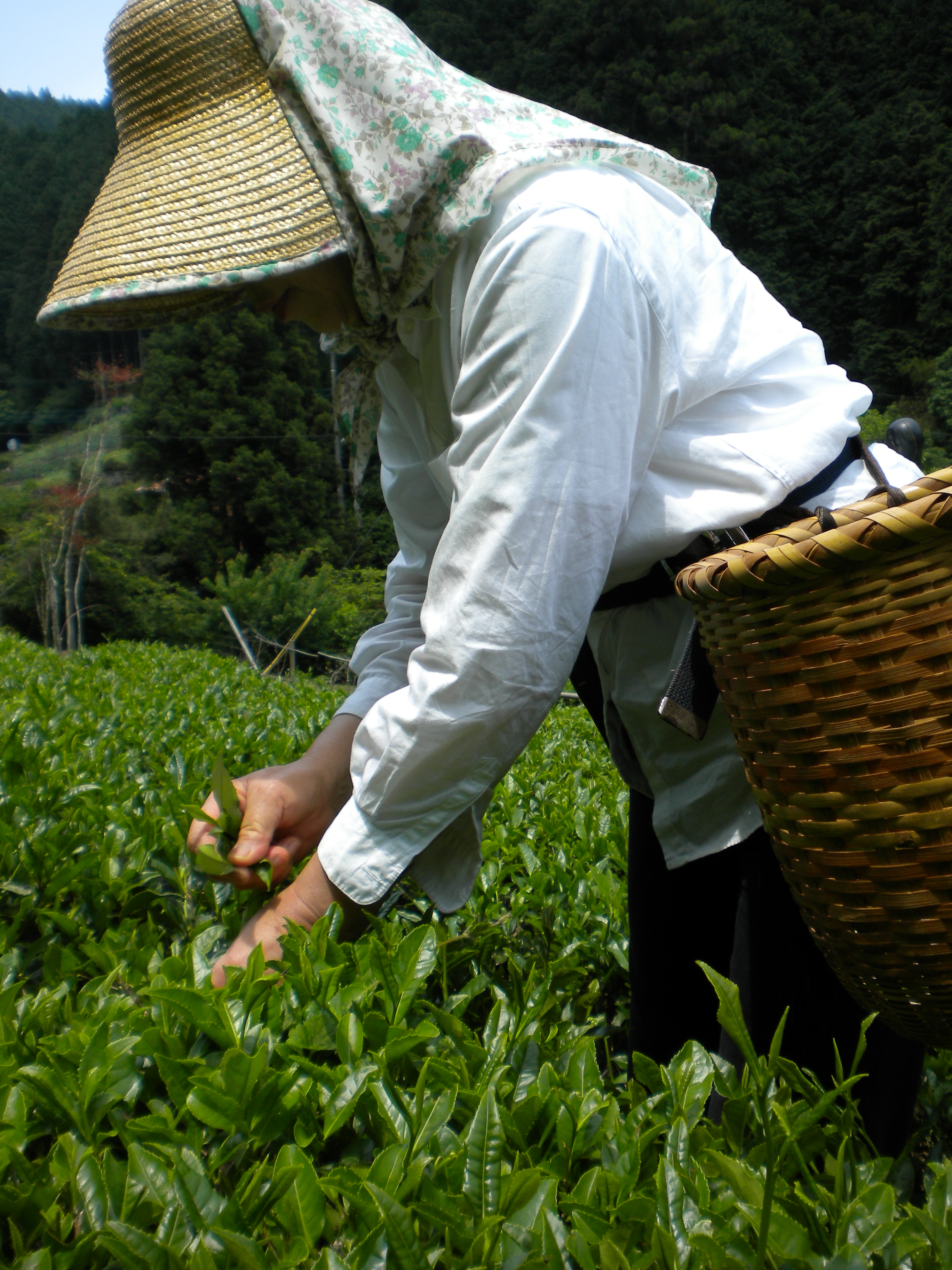
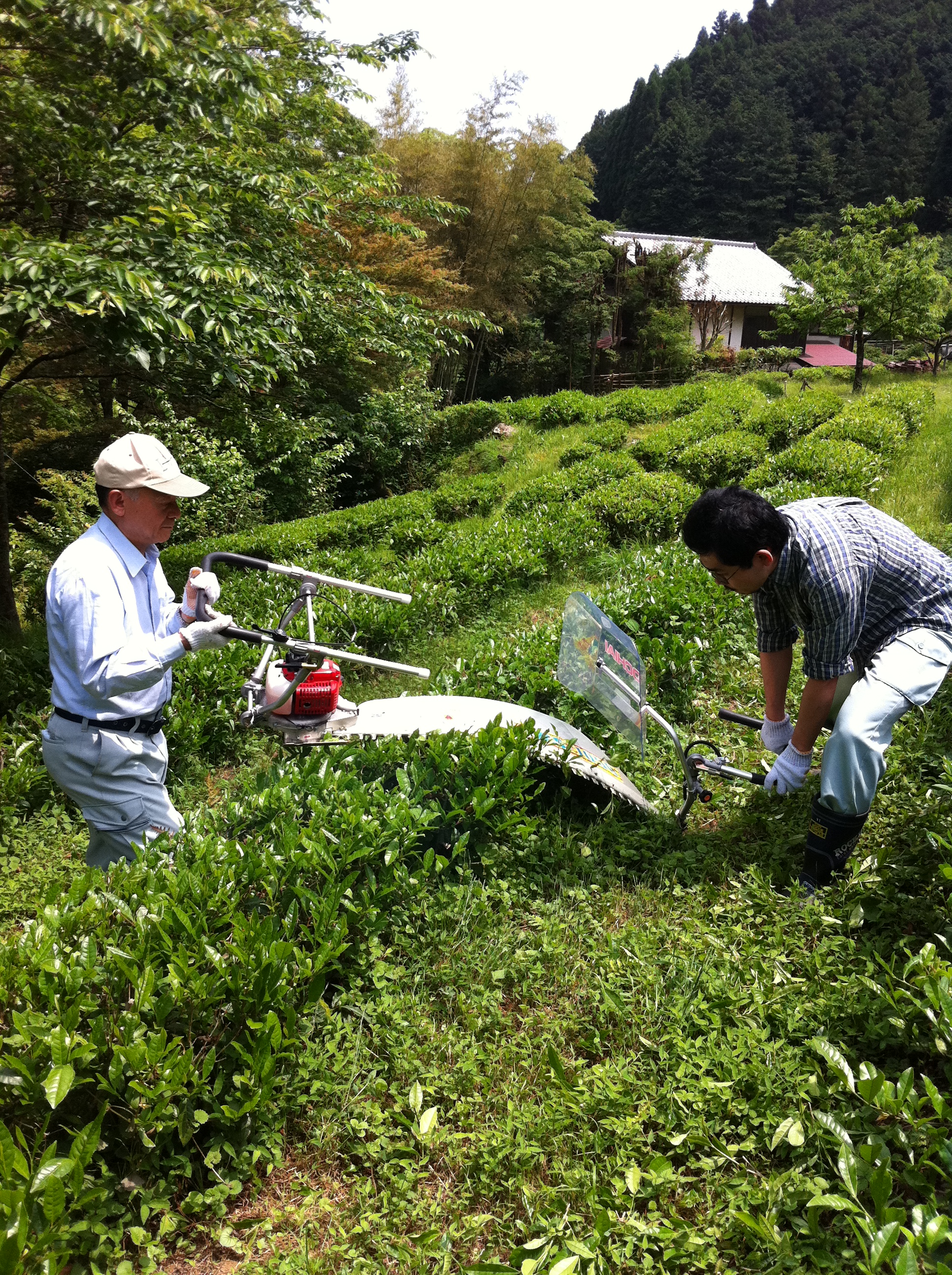
The tea that finds its way to the shelves of supermarkets and tea shops around the country is in reality the leaf of a tree (Camellia sinensis). Kept about waist-high – the perfect height for hand-harvesting each spring – by picking and two annual trimmings the bushes tend to live upwards of forty years. The family’s current tea bushes are a little more than twenty years old, planted when Sekiguchi-san’s mother still lived in the house and when his father was still alive to help. Starting just after the dew dries until late afternoon the picked leaves tumble from a small basket strapped to the waist to a larger basket and finally to burlap bags that will be taken to a nearby drying facility. Roughly one week later, shincha or the new year’s tea, emerges nicely packaged and ready for brewing.

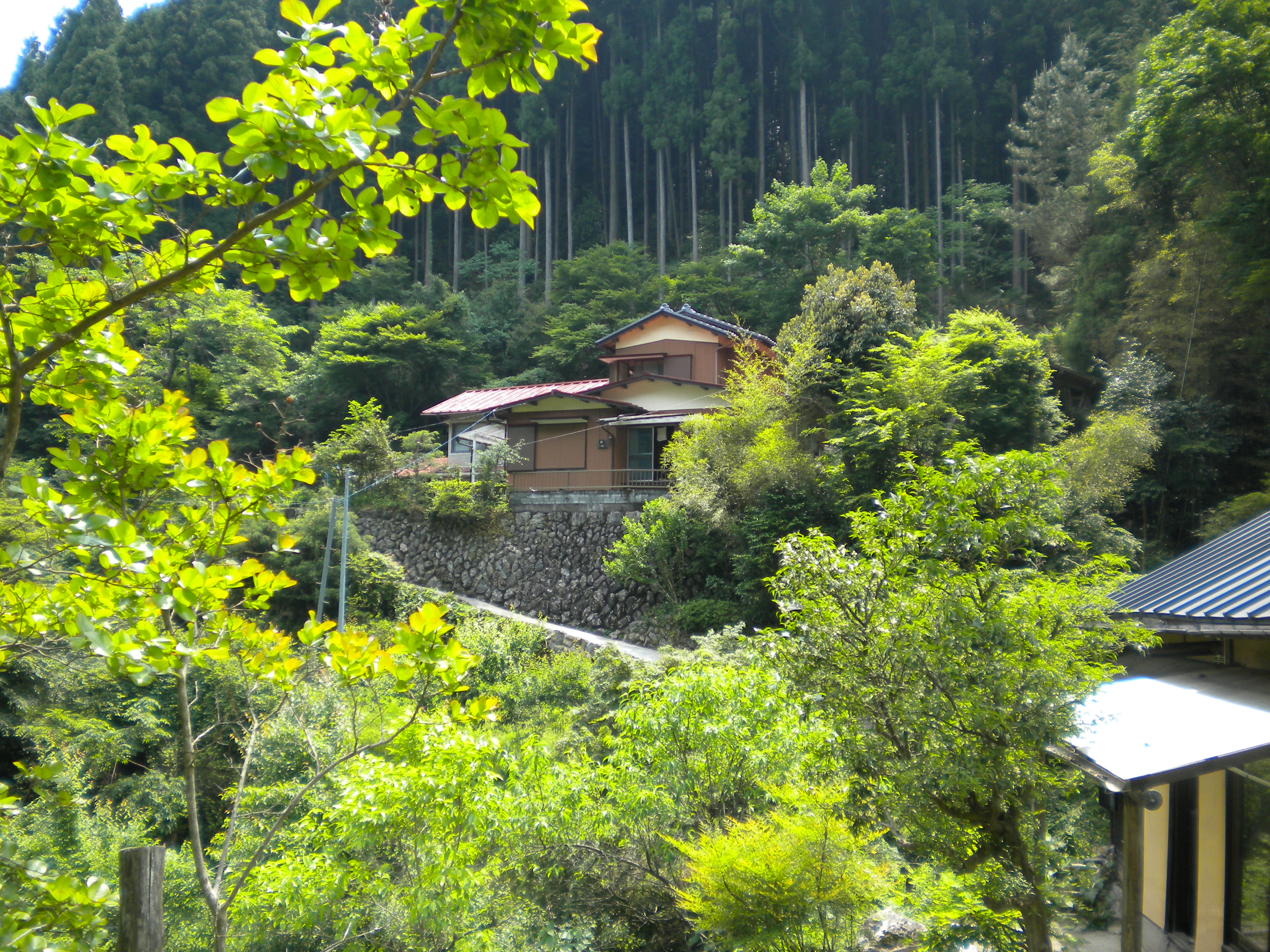
Some of the original settlers in this valley, the Sekiguchi’s arrived about 300 years ago when Tokyo was called Edo and Saitama was just becoming famous for its tea: Saiyacha. Signs of the self-sufficient homestead it once was linger still around the farmhouse. Miyoga (a soft, Japanese ginger) sprouts next to one of the outbuildings while red shiso (a flavorful leaf that tempers the tartness of umeboshi or pickled plums and gives them their distinctive color) pops up everywhere. An aging grove of ume or Japanese plum trees runs along the top of the riverbank and yuzu trees (a unique Japanese citrus with a flavor somewhere between lemon and lime) dot the edge of a field. A small stand of bamboo sways in the breeze at the bottom of the driveway and tamed sansai (mountain vegetables)  fill in empty spots at the base of trees.

Sekiguchi’s father decided to plant tea when it became apparent that the government’s forestry industry idea, implemented just after the end of World War II as a boost to the country’s reviving economy, was felled by the new material on the scene: plastic. Mountainsides freshly planted with sugi or Japanese cedar now signified a failed investment rather than opportunity, and he would have to venture in to the nearest city to work in an office in order to support his family. Time for vegetable farming was suddenly scant. Tea was easy and a sure bet.

The chabatake remains a side income for this generation, as well. The eldest of four, responsibility for the fields and house falls to Sekiguchi-san even though he lives in Tokyo and is only able to venture out one day a weekend. Their daily lives are, literally and figuratively, far away from this little valley farm laced with deer trails and small piles of monkey scat.

This year they harvested 40 kg of fresh leaves, a little less than the annual average of 100 kg. Whether the harvest was low because there were fewer leaves or because of morale, I didn’t have the heart to ask. The Sekiguchi’s will give it away to family and friends, but won’t go through the effort to sell a product they believe customers will reject. Hopeful for next year, they, like the rest of Japan, simply carry on with business as usual while they wait to see what the future . As farmers, though, they know that’s simply par for the course. After finishing our tea, Sekiguchi-san and his son changed into work clothes and headed out to the fields. There was work to be done and no time to lose.

Posted in On the Farm | Tagged , , , , , , , , | 2 Comments