Get Fresh News! Getting Fresh in New Mexico.

We’re sponsoring musicians Coco and Lafe on their 2011 “Get Fresh” 100 Market Tour across the U.S.! You heard right, 100 farmers markets coast to coast! Don’t forget to check out the page dedicated to them on our blog, and today we have an update from them!

If you’d like to listen to a song of ours while you read, here’s the title track from our newest CD:  Big Bang!
Last week we played markets in Los Alamos and Taos, New Mexico, plus Midwest City and Edmond, Oklahoma. We also performed live on KRSN in Los Alamos and KTAO in Taos. We played a house concert at the amazing JC’s Funky Hair Ranch in Edmond and wrote a couple more songs. Fun, busy week.
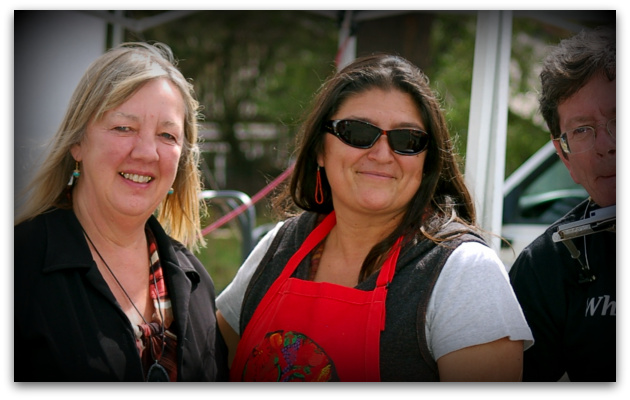
Cindy Talamantes, Manager, Los Alamos FM - the market in the trees...

Cindy is a whirling dervish, moving from one vendor spot to the next during setup at the Los Alamos Farmer’s Market, making sure everything was weighted down against strong winds and that everyone had what they needed. She made us feel very welcome, and has collected some great vendors.
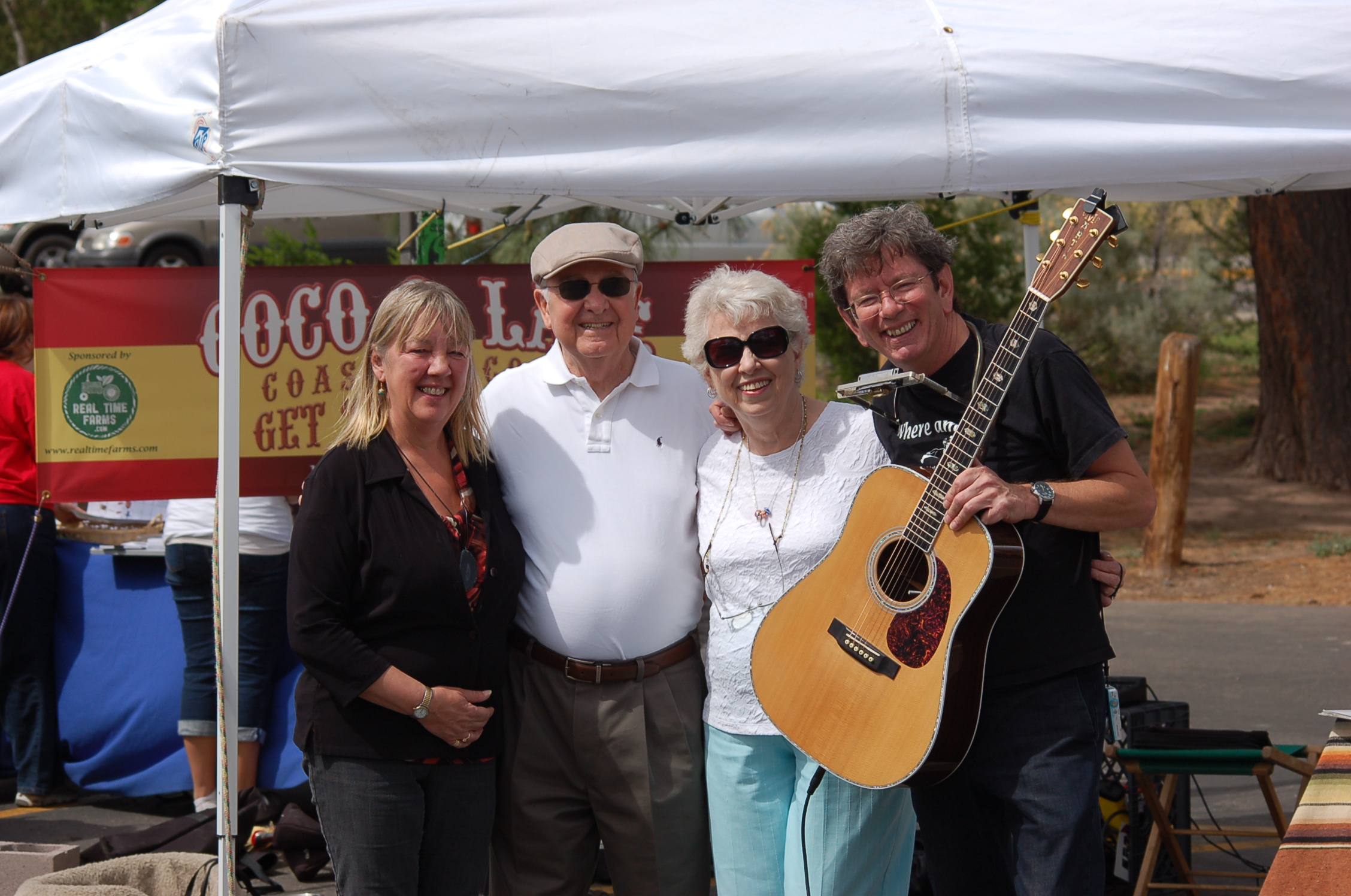
Market Visitors Jed and Jini from Vermont!

Eight people approached us when they saw our Vermont license plate. All 8 were either from Vermont or had lived there at one time.

Regina grew up in Fairlee, Vermont and knows some of the same people we do!

Coco just corrected me: Regina is moving to Los Alamos, not Taos. Taos’s loss for sure.
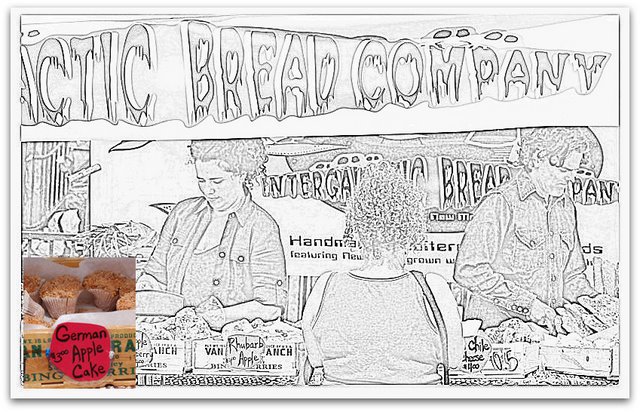
The Intergalactic Bread Company

Amy & Todd started this company 10 years ago. They make Mediterranean style bread from all local ingredients that they get from other farms. Recipes change based on what’s fresh and available. Amy: “I love seeing little kids tear into our stuff.” They attend three markets per week, and educate people that meals SHOULD change with the seasons. Skip tomatoes in January if you live in Los Alamos. They gave us breakfast and lunch: my favorite was the German Apple Cake. Exquisite flavors and wonderful texture.

3 Farms, 3 Acres, and primarily a one man grower. Eat your heart out Superman.

Jesus Guzman Farms produces a variety of Chiles, Corn, Cucumbers and much more. He also enlightened me on the ancient and labor intensive production of ‘Horno Corn’. You strip the corn off the cob, throw it in an Horno oven (you’ve seen them: they’re like those chimney ovens you put in your backyard) overnight, which dries and smokes it. To rehydrate, you simply throw it in a pot with beans for sweet, smokey flavor. Jesus delivers to Chico’s Restaurant, but primarily sells direct at three markets. Kate says she helps “a little.” I loved meeting them both. Jesus says one of his favorite reasons for coming to market is the new methods he learns from other farmers.

Turkeys, Pheasants, Chickens, Geese, Peacocks: feathers everywhere.

Barb is the “plant department,” Wendy is the bird department. Wendy makes fans and jewelry, Barb loves talking to customers. “We spend so much time talking to the plants we gotta get out.”
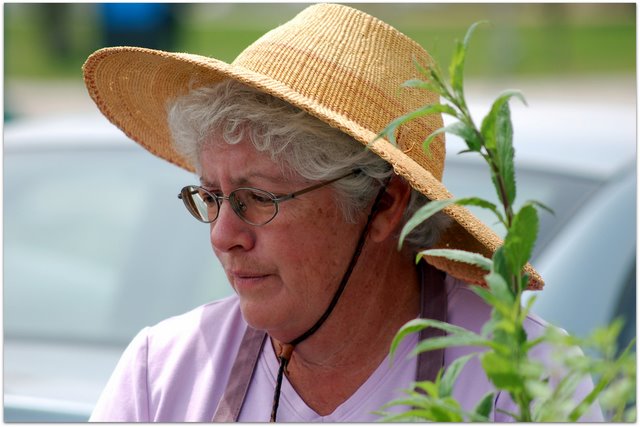
Barbara Mann, who speaks Plantish

KRSN is the heritage Radio Station for Los Alamos and was born as part of the Manhattan Project in 1945. Owned by David and Gillian Sutton, they are community activists and love living there with their three children. We played a few songs on ‘The Live Morning Show” with Dave and Nancy. They asked great questions, we had a lot of laughs (it was too early for margaritas), and they loved Lilla. Nancy is a hoot. You can listen to them live on the web. Our second year playing the Taos Farmers Market:

Coco, Assistant manager Krissy, On-Site Manager Moss and Lafe

Taos is a magical place, with a rich mix of cultures that is reflected in the art, entertainment, farming and social happenings. It’s also water deprived. Snow melt is directed into “ditches,” properly known as acequias, and each acequias is managed by a commissioner. You get one day a week to go fetch your allotment. Can you smell politics? Every region has its agricultural challenges, but this is a tough one getting tougher with less and less snow melt every year. One farmer told me, “We’re going to run out before the season ends.” We won’t mention global warming.

Julie Tennant and a sample menu from Ladybug's CSA program

Julie Tennant and Helen Martin grow greens year round, run a CSA, make wild pesto and create menus around whatever they are harvesting. Julie is also a beautiful graphics designer, Helen is a lifelong farmer and herbalist. Finally, we have not one but two ladies to replace Wonder Woman.

Brad & Courtney’s stall was directly across from ours two years in a row. Great neighbors, they own every one of our CDs and put honey in our basket every year. I think Brad knows the words to all our songs. We want to tow them behind our Rav to all the markets.

"Food as Part of History"

Meet Matias (“Matt”) of Grandma Joan’s Natural Jellies. The fruit is picked wild along the Rio Grande riverbed. The juice is boiled down to a gel the traditional way. They’ve been doing the market for 12 years and sell “…along the roadside” and on the internet. Matias is very passionate about the production process and has a thousand stories.

We were scheduled to play the Taos Pueblo Farmers Market last year but I (Lafe) got stoned: kidney stoned, actually, to the tune of 11.3 mm (if you can’t picture that please don’t try). They were very understanding and booked us for this year. Would Madison Square Garden do that?

Aidan, Dylan and Helana - Taos Sunday Market Managers

Martha and Aidan talking to Coco. Lilla bored.

Aidan insisted he wasn’t a “manager,” but he worked hard and was just as enthusiastic as his brother Dylan and Lady Helana. They also run the Just Kidding Farm and Goat Club.
They make and sell Ricotta, Goats Milk, Dulce De Leche, Strawberry Jam and much more. They are a meld of young entrepreneurs and farmers. I was shocked last year at their maturity, this year I am simply impressed. But they hang around Martha, who is as unusual as the color purple in congress. I bet if I had the time to dig, I’d find a group of family and family friends who have influenced these charmers.

Sidetrack: Lilla says I have spent too much time talking about other people, so here she is:

Lilla and Coco sharing a moment in Taos.
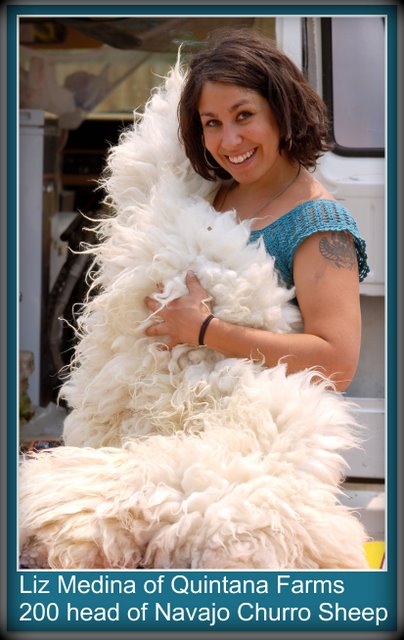
American Hero

There is so much story behind Quintana Farms:

  • Husband & Wife owners Susanna and Arturo Quintano (age 65 and 75, respectively) pasture feed Beef, Pork, Lamb, Poultry and Goats on 200 acres just across the New Mexico border in Colorado.
  • They have no modern technology, including computers.
  • Liz is a college student, and volunteers at the ranch: she reports they have several friends and supporters that help them.
  • The Navajo Churro sheep were brought over by the Spanish in the 17th century, and Navajo’s were enslaved to herd and care for them. After the Spanish left, the Churro’s became a staple for the Navajo.
  • The wool is unique, prized, and rare.
  • The U.S. government “…tried to exterminate the Churro’s” (American history books claim they only exterminated 30% due to drought)
  • Google “Navajo Churro Sheep” – fascinating.
  • They sell raw milk, sour cream and more at markets in Colorado and New Mexico
  • At least two farmers markets have been created because the Quintana’s started selling roadside, and another farmer asked if he could set up beside them, and then another, and then a market was born.

Liz is so informed, so passionate, and so in love with the farm(ers) that it’s hard for me to believe that anyone in America can be pessimistic about our youth or the world’s future. This planet is scattered with heroes like her. (Just look at Aidan, Dylan and Helana above – at the same market.)
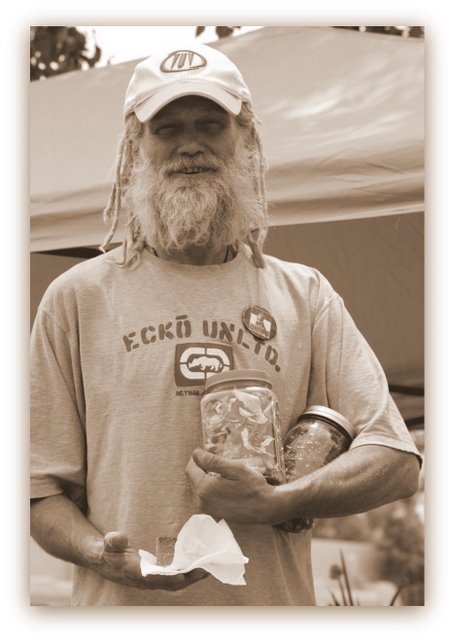
Thomas of Rasti Fari Farm

Thomas of Rasti Fari Farm harvests wild mushrooms, grows organic vegetables, and makes a delectable squash pie. We field tested the pie. We stained the upholstery in our Rav with happy drool.

Charde of Taos Organic Bed and Breakfast

Charde and her prince Jeffrey are caretakers of this beautiful and unusual bed & breakfast. They milk the goats, gather eggs from the Emu, grow herbs and organic, seasonal greens, make cheese and clearly are loving life. If you have five minutes to gaze at some incredible pictures of a truly one-of-a-kind B & B, check out the Taos Organic Bed & Breakfast’s website.

Coco and I also performed live on KTAO Solar Radio with much loved (by the community and for good reason) Paddy Mac. Dozens of people approached us after our appearance on his show to tell us they heard us and to share stories about him. He’s a tireless activist during community crises, tells “it” like it is (he had a row with the Forest Service while we were there over the poor communication about humongous fires.)

We drove through the smoke on the way to Oklahoma, but that’s another blog. Thanks to all of the above and the many more we didn’t have room to mention here.

Where are we now? Find us on this map: 2011 Get Fresh Tour

CONTEST ALERT: If you spot Coco & Lafe at your market, take your picture with them, email it to us at feedback@realtimefarms.com (don’t forget to include the location of the photo!), and you’ll be featured on our blog!

Posted in Messages From the Founders | Tagged , , , , , , , , | 3 Comments

Backyard Chickens: The Deep Litter Method

*UPDATE* Our winner of the Fair Food book giveaway is Nicole! Thanks to everyone that participated, and Nicole look for an email from us!

(This is the eighth in a series of ten Friday posts about Backyard Chickens to give an overview of my experiences these past two years.)

Borden - chicken coop with dirty litter

In one of my first chicken posts I mentioned the book I “borrowed” from my grandparents, Encyclopedia of Organic Gardening: A complete guide to gardening without DDT or other poisons or chemicals edited by J.I. Rodale (published in 1969). There is a section on poultry. I took their litter advice for our girls: “A practice that makes healthier and more productive chickens in deep litter, sometimes called built up litter. Simply let the little accumulate instead of cleaning out the poultry house every couple of weeks. Biological activity in the litter, just as in the compost heat, produces huge amounts of rich food.”

Wait. Not cleaning out the litter from the coop on a weekly basis, me being lazy, is good for the girls? This seemed to good to be true! The section continues.

“Litter-reared chickens need no expensive animal proteins or mineral supplements, and if pastured or given ample feed in addition will need to vitamin A or D supplements. Antibiotics are also produced – litter-raised poultry is remarkably free from disease.”

Wow. What a huge gift. It is healthier for the girls to live around microorganisms in their litter. And yet, summertime is for cleaning.

The Augean stables it was not, but there was about 10 inches of accumulated litter to be transferred onto the compost pile. Last August, we put pine chips 2 inches deep. Over the course of the year we added handfuls of pine chips and cedar chips. The cedar chips smell nice; yet we found cedar stains the outside of the egg, so it is better to avoid cedar where the girls are laying.

I don’t know if they care one way or another, but I love the fresh yellow and the smell of the new sawdust – should last about another week.

Lettuce Lady,

Corinna

Posted in On the Farm | Tagged , , , | Leave a comment

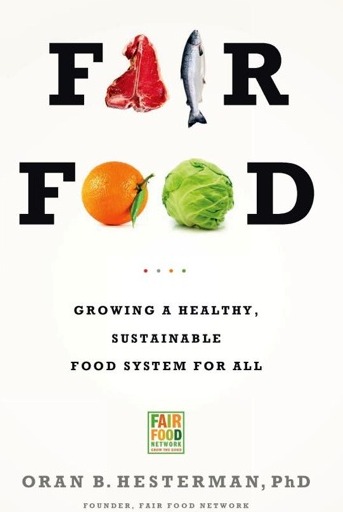
Between the Covers: Fair Food by Dr. Oran Hesterman (and a Giveaway!)

It’s been called “illuminating” by Chef Alice Waters, “a must read” by Robert F. Kennedy, Jr. and was dubbed “an important, accessible book on a crucial subject” in a recent New York Times review.

Intrigued? You should be.

As author Dr. Oran Hesterman, president and CEO of Fair Food Network, describes in his new book Fair Food, Growing a Healthy, Sustainable Food System for All, “The food system that evolved to bring us abundant food at low cost has grown out of control, nourishing us by destroying some of what we hold most precious: our environment, our health and our future…[our food system] is broken and needs to be redesigned.”

Hesterman helps us understand what “food system” means by taking us on a journey following one crop, corn, from production to sale and consumption all the way to the end of the cycle – waste. When I think about corn, I think of corn on the cob so fresh and juicy it barely needs to be cooked. I had no idea the corn I envision makes up “only about one-half of 1 percent of the total corn crop grown in the United States.” The vast majority of corn is “field” corn. Often grown from genetically modified seeds, field corn is sprayed with herbicides and insecticides. Less than half of the field corn crop is fed to livestock, a little gets exported, almost a third becomes ethanol, and the remainder goes into processed foods and even non-food items.

Hesterman argues that a fair food system is equitable, and free from bias. He explores the plethora of unintended consequences endemic in our current food system such as: declining food quality, environmental issues, loss of farmland, problems of food access and food security, diet-related illness, worker exploitation, and an aging farmer population, among many others. As Hesterman reminds us, “…when any of our systems are broken, the pain is usually felt first – and worst – in those communities that historically have been excluded from opportunity and access. In the United States, this usually means inner-city, low-income communities, which are often communities of color.”

Fair Food starts with the problems to be addressed, but it doesn’t linger. Quickly the book moves on to solutions by providing examples of programs working to improve access to healthy food, provide healthy working conditions, and create equitable access to resources. Hesterman both describes and strives to foster “a redesigned system, one that is healthy for people, communities, and the environment.”

At times there is the tendency to vilify the big producers (big = bad, right?), In one of my favorite model examples, Hesterman encourages us to not count the big guys out. He suggests that changing the food system will need the support of major players. Players like Sysco, the largest food distributor in the United States.

Sysco’s CEO was concerned. Some of their growers were using too many pesticides and practicing poor land management techniques. Sysco realized they had the potential to have a major impact in changing agricultural practices. They worked with Cornell University to learn about and implement integrated pest management (IPM), a system designed to use the least amount of synthetic pesticides necessary, and only as a last resort. After five years, Sysco’s growers reduced their pesticide use by more than two million pounds. If like me, you hadn’t heard about this before, you might wonder why Sysco hasn’t been tooting their own horn about their accomplishments – it’s because they believe they still have a lot of work to do!

Hesterman argues that our food system needs to change locally, with big companies and institutions, and via legislation. I love Hesterman’s response. He says, “We need to shift from conscious consumers to engaged citizens.”

That’s a powerful call to action, and he backs it up by suggesting a variety of routes, from changing personal food purchasing decisions to advocating for governmental reform of public policy. I know I’ll be making good use of the fifty-plus pages of resources at the end of the book – filled with organizations working to change the food system in one way or another – and hope you will too.

Check out the book trailer and mark your calendars for this Saturday, June 18th! Dr. Oran B. Hesterman will be at the Ann Arbor Farmers Market (outside the Welcome Center, 315 Detroit Street, Ann Arbor, Michigan) conducting a public book signing to benefit Food Gatherers on June 18, 2011, from 8 a.m. – 12 p.m.

Still reading and looking for the giveaway? Just leave us a comment on this post by the end of the day Thursday June 16th, and tell us what a fair food system means to you. One randomly chosen comment will receive a signed copy of the book, and we’ll announce the winner on our blog on Friday June 17th! If you’re too anxious to wait, you can learn more about the book, “Fair Food: Growing a Healthy, Sustainable Food System for All” by following the hyperlink, including where to purchase a copy for yourself!

Locally yours,

Lindsay-Jean

Posted in Between the Covers & Behind the Scenes (media) | Tagged , , , , , , | 9 Comments

Food Warrior Interns: Coming Soon to a City Near You!

In the spirit of the Farmarazzi campaign, Real Time Farms is sending a food army to document our food system – we have called this program “Food Warriors.” Armed with cameras, pencils, and dedication they are visiting farmers markets and farms all over the country. From age 18 to age 61 our 18 Food Warriors are stationed in New York City, Boulder, Los Angeles, Seattle and throughout the state of Michigan.

Food Warriors photograph vibrant fruits and vegetables and share stories of the farmers they meet at farmers’ markets and while visiting farms and food artisans with videos and blogs. All information is shared with the world on Real Time Farms, giving consumers unfiltered access to the information.

Not only are the Food Warriors educating the public by sharing what they learn with the world it is an educational opportunity for themselves as well. By documenting producers at work and the fruit of their labor at markets, Food Warriors are working to excite consumers about the stories behind the food they are buying and eating. Meanwhile, they, themselves, are learning a tractor load (ha!) about food production and distribution and compiling that information in a way that can be made easily accessible and attractive to people throughout the country. They are educating the public as they educate themselves!

“One of the biggest things I’ve learned so far is to really appreciate how much effort it takes to grow anything. It makes me value what I buy more…I now try even harder not to waste food” says Julie Tasche, Boulder Food Warrior Intern.

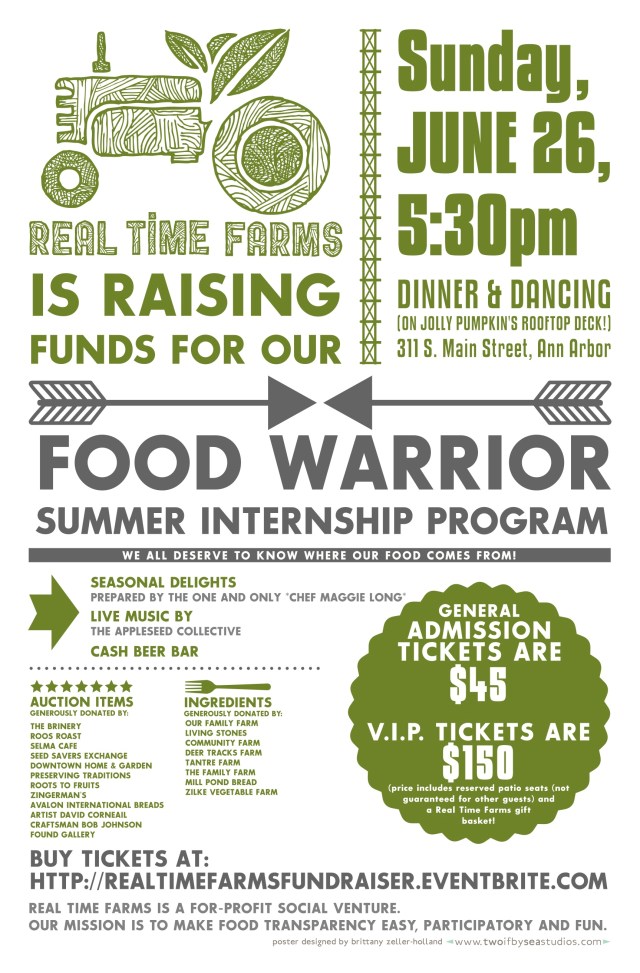
Real Time Farms’s Food Warrior Program is asking the questions of your farmers that you do not have time to ask. We all deserve to know where our food comes from. If you agree, consider attending or donating to our Rooftop Farm Dinner and Dancing Fundraiser Event to support this summer’s Food Warrior Program.

Fresh out of college, I feel incredibly fortunate to have come across a job that allows me to be so closely integrated with the national and local food systems and to directly enable and guide others to work on something they are passionate about. There have been numerous occasions on which I have left the office at the end of a long day of Skype meetings and emailing with enthusiastic Food Warriors and felt like shouting ecstatically, “I LOVE MY JOB!”

Stay Fresh,
Lindsay Partridge
Kernel Colonel: Food Warrior Program

(Thanks to Food Warriors: Danielle Blake and Emily Saltz for their photos of Balthazar Bakery, Davey Monzón for his photos from Underwood Family Farms, Gina Buccolo for her photos from LA’s Monrovia Farmers Market, Danielle Blake for photos from Summit Farmer’s Market, and Jess Halter for her photo of Blue Moon Fish.) 

Posted in Food Warrior Interns | Tagged , , , , , , , | 19 Comments

Backyard Chickens: Food diversity for your backyard chicken is a win-win for all

(This is the seventh in a series of Friday posts about Backyard Chickens to give an overview of my experiences these past two years.)

Our chickens are eating our weeds; their eggs taste fuller as a result – all due to a conversation with a man about his goats.Borden - Chicken in run

This past weekend I met a man who has a few hobby goats. I asked him if it is true that goats are very destructive to the land. He replied, “No, goats prefer to eat upwards. They are browsers not grazers.” The way he said those words jolted my brain into noticing I had never consciously thought of the difference before. So I did some research.

Deer and goats are soft vegetation browsers, which is why they love azalea leaves, fruit, and your prize peonies. Sheep and cows are grass grazers, which is why their teeth have such high crowns to grind the fibrous tissues and why they will denude a field if not rotated and managed properly. Then I thought about chickens.

Two summers ago, we transplanted mature irises next to our driveway along with a few holdouts of the grass that used to be a lawn. The grass is now taller than the irises. Chicken persistence seemed just the solution to deal with the tenacious grass and the extreme density of weeds.

Our chickens have denuded all soft vegetation as well as grasses in their run – the avian equivalent of sowing one’s fields with salt. Technically their enthusiasm for chomping all things green denotes them as a forager. We translated their brower/grazer/pecker/digger/aerator/fertilizer abilities into a quadruple win when we let them loose in the weed infested area by our driveway.Borden - Chicken in area between driveways

Win #1 – Our backyard chickens ate the weeds (grasses, etc.) when we constructed a temporary fence near the driveway. Fresh, fast growing weeds have soft membranes. As long as we continue to limit their time in that area and watch them carefully, we will keep them away from the denser plants we want to keep.

Win #2 – The greenery supplements their diet.

Win #3 – Their eggs taste better (more complex).

Win #4 – We can watch them weed our own garden while we eat their eggs, an experience that attains a level of synchronicity akin to magic.

Rewatching the videos I shot over the first two days of our experiment, it appears the chickens like the greens almost as much as they like digging for worms and bugs in the freshly emerging soil.

Day 1 – First 10 minutes


Day 1 – After 30 minutes

Day 2

Did I mention I find backyard chickens easy and mesmerizing?

Lettuce Lady,

Corinna

Posted in On the Farm | Tagged , , , | 1 Comment

Get Fresh News! Getting Fresh in the Southwest

We’re sponsoring musicians Coco and Lafe on their 2011 “Get Fresh” 100 Market Tour across the U.S.! You heard right, 100 farmers markets coast to coast! Don’t forget to check out the page dedicated to them on our blog, and today we have an update from them!

We sublet the San Diego apartment to a wonderful Navy woman (she’s not blue, she’s a Sea-Bee!)  for the duration of this tour: till November 1st. Five months!

We didn’t leave the beach until after 5 p.m. It was late getting into Sedona, Arizona.

Here’s what we woke up to:

Red Rocks of Sedona

Beautiful Views 360 Degrees

Sidetrack: Round about midnight, on a rural road cutting us across the Arizona foothills, Coco sailed over an unmarked railroad crossing at sixty miles per hour and our Toyota Rav went airborne. Literally off the ground. I had my eyes closed but not asleep and bolted upright. No damage, no problem, and 2 minutes later we startled a huge owl and I was awake enough to see it. The journey. It’s all about the journey.

We performed at Sedona Winds Retirement Center at 1 pm. Great people, great fun, super activities director. They gave us a standing invitation to play there anytime so we’ll be back in October at the end of this tour.

On to the Grand Opening of the Sedona Farmers Market. No go. Predicted wind gusts of 40 mph created a nervous market manager, Katrin Themlitz, who related an incident from last year where a musician’s speaker blew onto a customer and off to the emergency room they roamed. Probably quicker than “roamed.” The customer was fine, but no more music in the wind.

On to one of our favorite markets in the country, one we’ve now played three years in a row on these national tours:

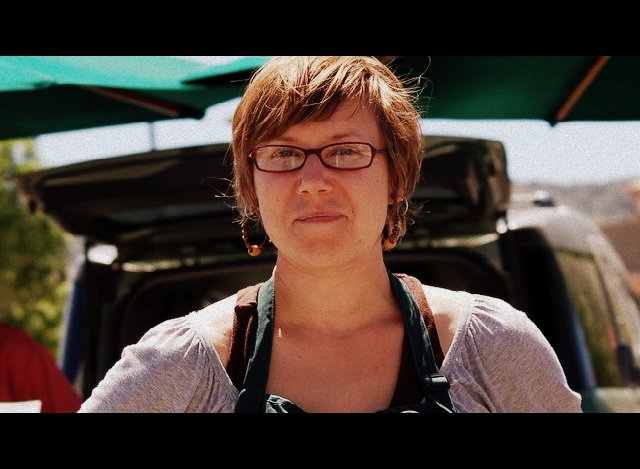
Erin Lingo

Erin Lingo, Prescott Market Manager - This is the picture you'll see when you look up "fun" in the dictionary.

We could write about what makes a market superbly managed or poorly managed, and how you can quickly tell the difference just by walking through one, but that’s not our purpose here. Trust us that the Prescott Farmers Market is one you should detour to if you live or are visiting anywhere in Arizona. Great vendors, crafts, farmers giving cooking tips, dog friendly and a beautiful setting.

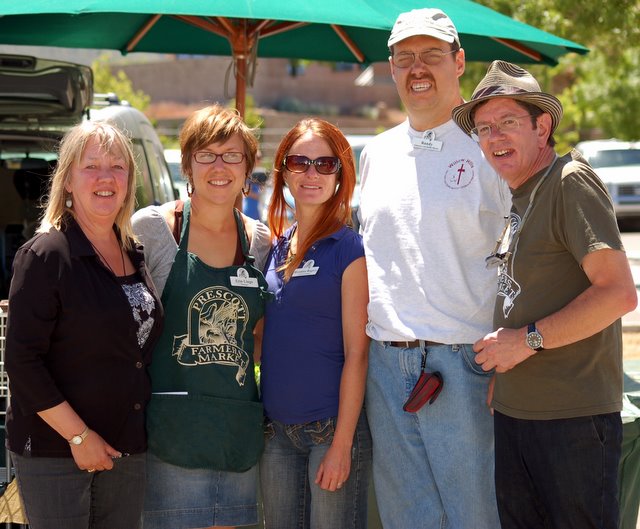
Coco, Erin, Assistant Breanna, market volunteer Randy and Lafe

Coco, manager Erin, Assistant "No problem" Breanna, enthusiastic market volunteer Randy, and Lafe

A look at some of Prescott’s Fresh Heroes:

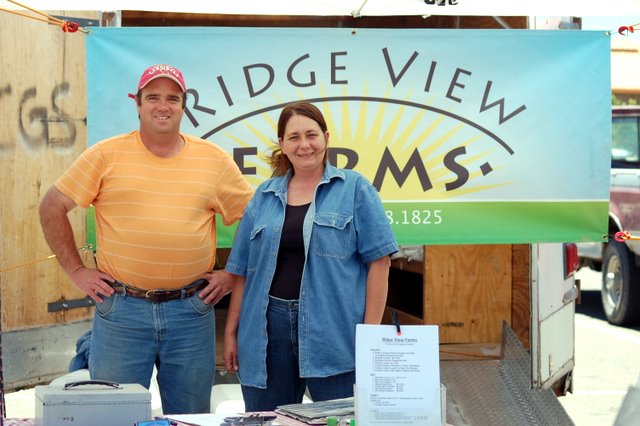
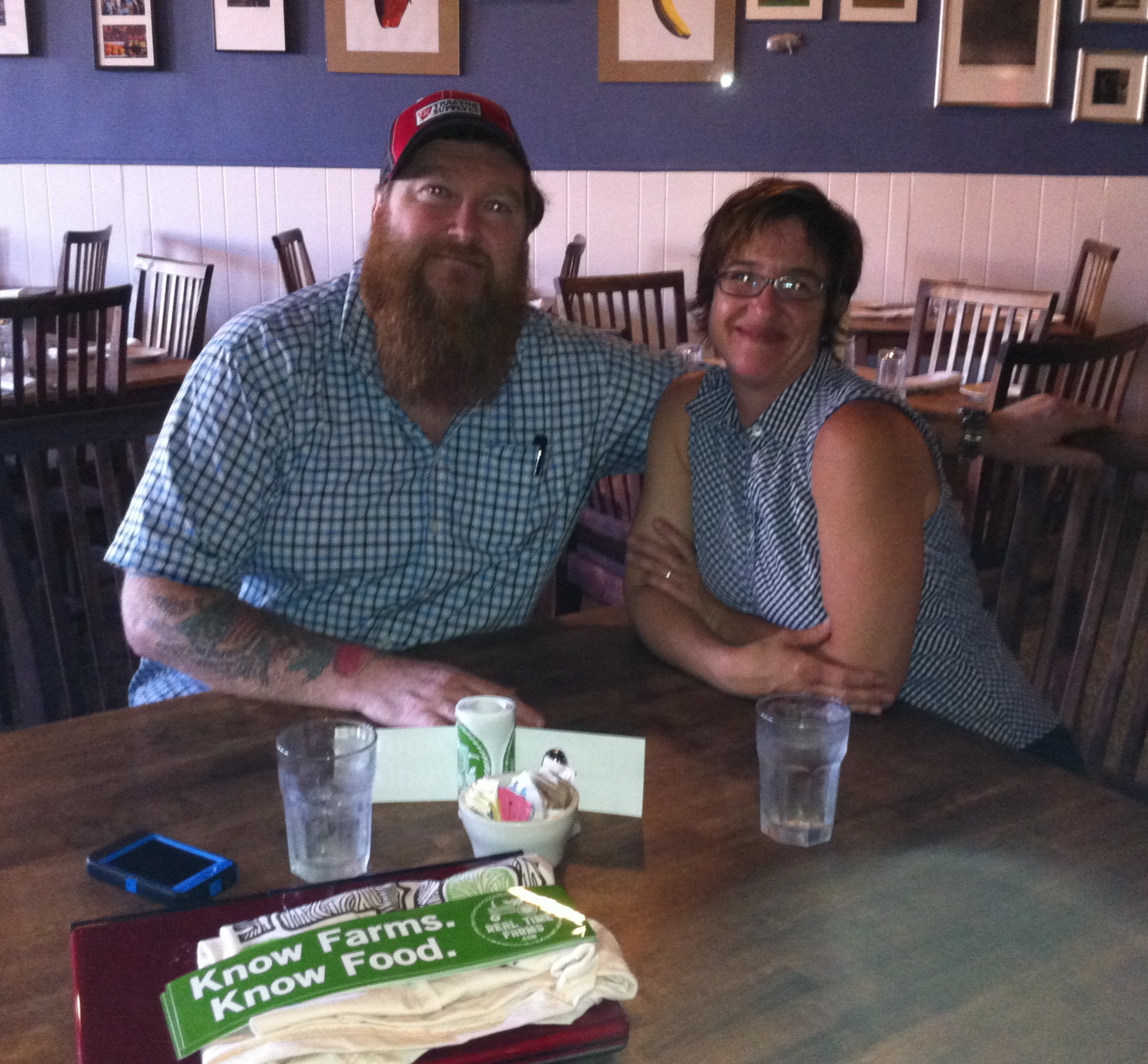
Ridge View Farm Owner

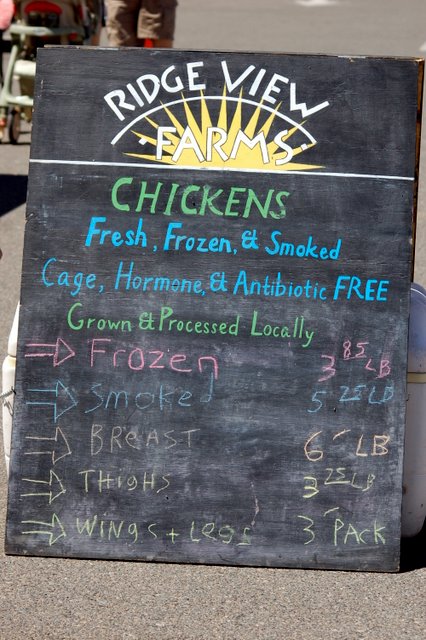
Ridge View Farms - Home of the Happy Chickens

Ridge View Farms Sign

Note the "Cage, Hormone & Antibiotic FREE" - just like you.

Byrnie Florea has been around farming all his life. He and Wade Caslin are in their third year at the market and they will harvest somewhere between 10 and 15,000 chickens this year (up from 2500 three years ago!). They make their own chicken feed which is certified organic. In addition to the market, they supply three restaurants: The Brix Restaurant and Wine Bar and Criollo Latin Kitchen in Flagstaff, and the Turquoise Room in Winslow. They gave us a whole smoked chicken for dinner! Delicious!

And here’s the punchline: They started with just a few chickens in a barn, and Bernie thought they’d be happier if they could get outside the barn. So he built nests for them in the barnyard, and they wandered out to use them. It was so clear, he said, that they were happier, that he expanded it and now it’s part of their farming process. How cool is that? This guy cares about his chicken’s happiness! I’ll eat that.

Moving on:

Whipstone Farms Banner

Dylan was managing the booth today....

Cory started Whipstone in ’95, and now has 10 acres planted. They attend three markets every week, and Cory usually brings the equipment to fire roast hot and sweet peppers at the market. They have an 85 member CSA program, and supply the Turquoise Room restaurant in Winslow.

Punchline? The renowned chef of the Turquoise, John Sharpe, buys squash blossoms from Whipstone. Did you know that squash blossoms have to be picked at the coolest hour of the day? So Whipstone harvests them between 2 and 4 a.m., and delivers them fresh to John by early morn. Another song to be written. Thanks Dylan!

Home on the range:

Orme Ranch Natural Beef

We come to the market because "...we want to be accountable to our customers."

Orme Ranch comprises 26,000 acres: 5% private, 17% State leased, and 78% grazing allotment on the Agua Fria grasslands of Yavapai County. Thirteen years of drought have dropped the herd from 750 to 250 head, “…but we’ve hung on and it will change,” Diana Kessler told me. She could be writing those Bobby McFerron happy songs.

With her husband Alan and four employees they use holistic management principles and follow written goals for maintaining the land and for using low stress methods of handling cattle as they move through the pastures and corrals. The cattle spend their lives grazing native forage and sharing the land with a variety of wildlife species. (That last part is from their market flyer.)

I loved her enthusiasm and obvious passion, and here’s the punchline: Orme Ranch also has a sod farm! That’s right, all those slang terms like “old sod” are harvested on site.

Wait, Coco’s pointing out their business card: “Producing Bluegrass Blends for Your Project.” I’ll leave what I wrote because they clearly have a sense of humor. Also from their business card: “Easy to get a lawn with.” (Coco says to go ahead and grown. )

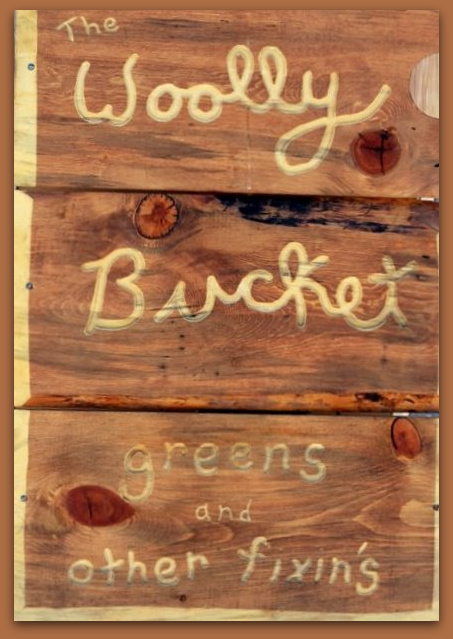
Woolly Bus

Green with a twist....

Jessie of Woolly Bucket Greens

Jessie

Jessie, her husband and their three-year old daughter work a back yard garden and bring bags of mixed greens (she gave us one: crisp, tasty and fresh), but let’s get to the gooder part:

Jessie's Earrings

Handmade from rusted metal and "pretty things found round the farm"

You’ve got to blow the picture up to appreciate these. Absolutely gorgeous. She’s like one of those amateur photographers who have “the eye” but don’t know it or how they do it.

So that wraps up the Prescott Farmers Market pics, although I messed up picks of Chino Valley farms who work 11 acres of tomatoes and cucumbers and more, and harvest an orchard of “…whatever doesn’t freeze. Some years it’s apples and pears, some years plums…” They attend six markets and deliver to four restaurants and, punchline: they run a summer farm camp for kids!

Did I mention the father-son duo who make Scottish Shortbread, among other Scottish goodies. Or the square-dancing vendors? (I have video from our last visit!) Or that many of these vendors, like most markets, filled our tip basket with fresh food, baked goods, and even a strawberry plant? We travel with our own kitchen box of pans and my chef knives, stay at extended stay type places with mini kitchens, and eat fresh and gourmet most every night.

Today we did a studio performance and interview at KRSN radio in Los Alamos, New Mexico, but that’s for next weeks blog. Which will be shorter. I promise.

CONTEST ALERT: If you spot Coco & Lafe at your market, take your picture with them, email it to us at feedback@realtimefarms.com (don’t forget to include the location of the photo!), and you’ll be featured on our blog!

Posted in Messages From the Founders | Tagged , , , , , , , , , | 2 Comments

Backyard Chickens: Chicken litter feeds cows feeds chickens feeds cows

(This is the sixth in a series of Friday posts about Backyard Chickens to give an overview of my experiences these past two years.)

The debate for the FDA about feeding chicken litter to cows appears to stem from their concern over Mad Cow disease, which strikes me as the tail wagging the dog. So before I talk about the dog, I will address the tail.

Chicken litter, i.e. everything from the floor of a chicken house, sawdust, feathers, manure, spilled feed, etc., is being fed to cows in feedlots. The FDA temporarily banned the practice in 2003 because there was concern that the chicken feed (industrial chicken feed includes “recycled cattle proteins” and “ruminant meat and bone meal” – a.k.a. beef, in its ingredients) was spilling onto the litter and being fed back to the cows. As a chicken owner, I can verify that assumption – chickens are not neat eaters.

In February of 2003, a study done by the North American Rendering Industry, showed, “it will require feeding 10 pounds of poultry litter / cow / day for 6,442 days, or 17.65 years, to achieve a single ID50 dose!” The ID50 is the median infective dose for Mad Cow disease. Cows bred and fattened for industry live less than 2 years. The 17-year time frame is very compelling, and I can see why the FDA removed the chicken litter ban in their later rulings.

I had never heard of the National Renderers Association before reading their study, so I did some research.

Formed in 1933 as the professional association of the rendering industry, they process the leftover parts of the animals humans raise for meat and render the raw materials into usable products. As their website states: “Meat and bone meal, meat meal, poultry meal, hydrolyzed feather meal, blood meal, fish meal and animal fats are the primary products resulting from the rendering process. The most important and valuable use for these animal by-products is as feed ingredients for livestock, poultry, aquaculture, and companion animals.”Borden - chicken and chicken litter

Nearly 59 billion pounds of animal byproducts are recycled and reused by the rendering association annually. One third to ½ of an animal we have bred for meat is not used and the renderers turn that into “feed ingredients” as well as “valuable ingredients for various soaps, paints and varnishes, cosmetics, explosives, toothpaste, pharmaceuticals, leather, textiles and lubricants.” Renderers are an integral part of the meat industry.

An association of renderers, who recycle leftover animal parts into animal food, paid for a study to show there is no harmful affect on cows eating cows (small amounts of cows). And honestly, who else has the time, inclination, or finances to run that study other than the people directly affected?

Assuming we have successfully rendered (hehe) the argument against chicken litter causing Mad Cow Disease null and void, let us return to the main point – feeding chicken litter to cows.

According to the North Carolina Extension service, the litter should be processed before being fed to cattle. There are several ways to process the litter, but the goal is to stack it to create conditions for bacteria to raise the temperature of the stack to 140 -160 degrees to kill pathogens present in raw litter (the main pathogen of concern being E. Coli).

The University of Missouri Extension has a chart discussing the nutrient basis of chicken litter. On average the litter contains 25 percent protein, which is a fairly cheap source of food for the beef farmer. The ability to recycle the huge amounts of waste from chicken factories into feed for beef in feedlots appears to be a win-win for all involved. Cheap feed for cows translates into cheap hamburgers.

Which brings us to consumer choice. Do you want to eat cows that have ruminated litter from the floor of an industrial chicken facility, or do you want to eat animals that have masticated grass and felt the warm sun?

It is nice to have choices.

Lettuce Lady,

Corinna

Posted in On the Farm | Tagged , , | Leave a comment

Orwasher’s Ultimate Whole Wheat

This post is from one of the 18 interns in the Real Time Farms Food Warrior Summer Internship Program. These interns are collecting data, pictures, and video on the growing practices of our nation’s farms, collecting food artisans’ stories, and documenting farmers markets. We all deserve to know where our food comes from!

Ultimate Whole Wheat

On a quiet day at Orwasher’s Bakery, the staff was gathered to hear the story of the Ultimate Whole Wheat.  The story was told by Alan Cohen, owner Keith Cohen’s father, who actively sells Orwasher’s bread at local farmers’ markets and is well known for his impassioned bread selling.  Alan insisted that it was important for customers to know the “romance” of the story, the romance of the bread.  Well, I’ve always liked romantic stories, and I like the idea of a bread romance, so I went along with it and began to see the story as a kind of modern day bakery fairy tale: the Ultimate Whole Wheat as straw spun into gold or Cinderella arriving at the ball.

For those who don’t know the Ultimate Whole Wheat, it is a dense and dark round of bread crowned with a spiral of flour.  Its simple, solid appearance is almost medieval looking and its nutty, wheat flavor is straight from the earth.  It holds the position of healthiest bread at Orwasher’s and it is “ultimate” whole wheat because it contains 100% organic whole wheat, local flour, with only a touch of honey to sweeten it.  This is the surface, but the deeper story, the process involved in making the bread, is where the true romance lies.  The wheaty round represents the marriage of old world rural to modern metropolis, a direct relationship between farm and retail business.

Sourdough Pullman

For those who don’t know Orwasher’s, the bakery has been selling classic rye, pumpernickel and sticky cinnamon raisin bread in its Upper East Side location since 1916.  In 2007, Orwasher’s was bought by Keith Cohen, and since then, new and imaginative breads have come to join the old classics.  The Ultimate Whole Wheat is one of these new arrivals – a bread which is known for its healthfulness and connection to old-fashioned farming.  In 2009, having dreamt of a local bread made of 100% whole wheat flour for some time, Cohen decided to pair up with Cayuga Pure Organics, a farm which produces organic grains, beans and flour in Brooktondale, New York.  This high quality flour (made from hard, red winter wheat milled with a stone mill) plus the addition of grains like millet, coarse rye, flax, and oats is the key to the Ultimate Whole Wheat’s success.

Every week, Cayuga Organics mills this special flour for Orwasher’s Ultimate Whole Wheat.   The bags of flour are then driven down to the Upper East Side (a six-hour drive) and brought directly into the store on the shoulders of the farmers.  The flour is then transformed into a gourmet product.  Just as Cinderella was belle of the ball due to her natural goodness, and the gold filling Rumpelstiltskin’s dungeon was more precious due to the labor needed to transform it, the Ultimate Whole Wheat is enjoyed by the metropolitan inhabitants of New York City all the more because of its natural ingredients and their rustic origins.

Mackensie Griffin

Summer 2011 NYC Food Warrior Intern

Posted in Food Warrior Interns, In the Pantry (food artisans) | Tagged , , , , , , , , , | Leave a comment

Encomium for the USDA and the glory of the DC/Baltimore foodworld!

(Other than being a good word for freerice.com, encomium denotes a song of praise.)

Just in time for a perfect week of spring weather, I visited DC (my hometown) and Baltimore to walk up and down the Mall, visit the Department of Agriculture (USDA), talk to restaurants in love with transparency, take pictures of markets, and explore the food changes that have happened to my town in the past 7 years (since I left).

The courtyard garden of verdant vegetables at Poste Moderne Brasserie in DC.

It was a dizzying week because the food world in the capital area has exploded. Farm to fork restaurants are sourcing from a myriad of new and vibrant farmers markets, rooftop gardens are supplying veggies to restaurants across the street – fed by compost from the very restaurants, and the USDA not only hosts a farmers market onsite – they shared the locations of all markets nationwide.

I began the week talking to Amanda Eamich, Director of New Media at the USDA. Eamich was able to highlight and share several of the tools the USDA has provided to help inform policy and the public. The Economic Research Service (ERS) section of the USDA has built two amazing online tools to help pinpoint food availability and broader “determinants of food choices and diet quality.” The Food Desert Locator shows all areas in the country that are more than 1 kilometer from a source of healthy food – you might be surprised at certain locations. The Food Environment Atlas enables you to view on a map a plethora of food choice determinants. Factors such as the 2008 sales tax from soda vending machines, the 2009 low-income preschool obesity rate, or the 2006 relative price ratio of green-leafy veggies to starchy veggies each jostle for your attention in this captivating tool.

Chef Winston Blick and Cristin Dadant at Clementine in Baltimore.

Not only is Eamich working with those two tools, she works with the blog. That is right, the USDA has a blog. And what a blog it is. As the tagline says: “United States Department of Agriculture: Reaching Out, Every Day in Every Way.” There are updates about the First Lady’s Let’s Move Campaign, the People’s Garden expansion to overseas, Chef’s Move to Schools, ‘Know your Farmer, Know your Food’, and even what Smokey Bear has been up to. I walked away feeling our government has truly a vertiginous collection of disparate programs and initiatives all designed to provide access and education around healthier food in “every way.”

The next four days were a whirlwind of visiting restaurants in DC and Baltimore. Chef Rob Weland of Poste Moderne Brasserie showed me his courtyard garden in the Hotel Monaco – where you are literally eating next to a tomato plant growing in a pot. Chef Spike Gjerd of Woodberry Kitchen gave me a tour of his kitchens, including the sausage aging room (all butchered and made in house, naturally) and the wall of in house preserves (the last of the 2000 pounds of tomatoes from 2010 and the first jars of 2011 ramps in evidence). Chef Winston Blick of Clementine spoke of providing compost to Hamilton Crop Circle – a rooftop garden across the street – that, in turn, returns vegetables to his customers. I met with Nic Jammet, one of the founders of Sweetgreen, a sustainable build your own salad/yogurt phenomena that has rocketed to ten locations in the last 3 ½ years. I look forward to attending their Sweetlife Festival next May.

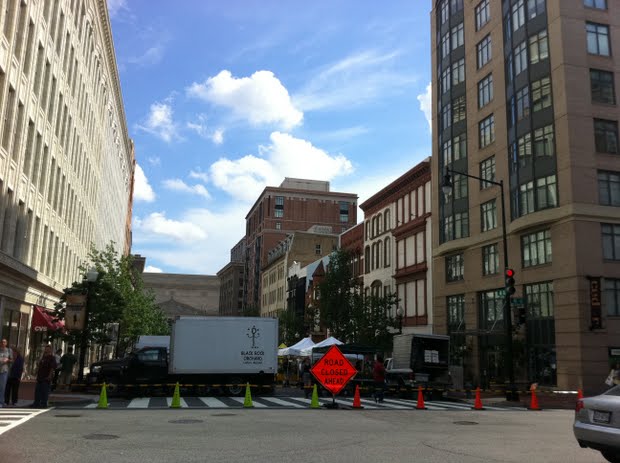
Penn Quarter FRESHFARM Market closes off 8th street just north of the National Archive Building that holds the Constitution, freedom of assembly in action!

When not gawking at menus I was able to visit two farmers markets in the middle of town – and I mean in the middle of town. One is 3 blocks from the Mall and the other is 3 blocks from the White House – producer only, crowded, and diverse (orchids, wood fired pizza, and the first strawberries of the season – glorious). Thank you FRESHFARM for your great work creating pedestrian villages in downtown DC.

My last day started with a meeting with Debra Tropp and her team of committed farmers market devotees in the Farmers Market and Direct Marketing Research Division of the USDA. Food Tech Connect recently posted a great article describing the need and uses for the Farmers Market Directory in a conversation with Tropp. As a former farmers’ market manager, I remember last year feeling honored and vindicated to fill out the survey to populate the directory. I was doing something important when the government asked me the number of people who came to the market or whether we accepted Bridge Cards – my little stretch of pavement 18 weeks of the year became part of something large and meaningful.

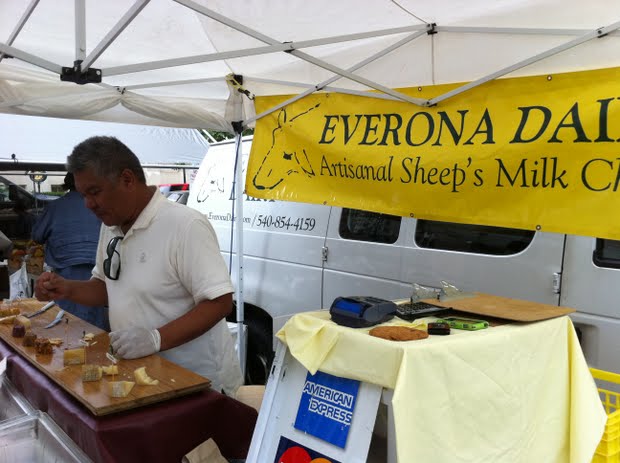
Everona Dairy won the best farmhouse cheese for their Piedmont cheese in 2005.

Little did I know my 15 minutes filling out the survey would be transformed into a resource available to the world. The information in the Farmers Market Directory is what first populated Real Time Farms database of markets.

The cherry on my Sundae week was meeting with Gretchen Hoffman of the American Farmland Trust – the vanguard group who worked in the 1980s to create and implement conservation easements for farmland. A few years ago, Hoffman spearheaded the America’s Favorite Farmers Market Contest, voting starts June 1st!

A week of good food, good company, and good learnings – what more could one want?

Lettuce Lady,

Corinna

(I would also like to appreciate Wendy Wasserman of the USDA, without her help and good sharings my week would have been very different.)

Posted in At the Market (farmers market) | Tagged , , , , , , , , , , | Leave a comment

Backyard Chickens: Sounds of the State (in my backyard)

(This is the fifth in a series of ten Friday posts about Backyard Chickens to give an overview of my experiences these past two years.)

Sounds of the State is a segment on NPR (here in Michigan) where we hear the cadences of nature around Michigan, thank you NPR for a great phrase.

I can think of no better way to celebrate the end of May than to pause for two minutes and see the earth (soil) from the perspective of my chickens.

In case you, too, are drawn to the meditation of watching birds clucking and scratching in honest absorption, here is a small collection of a few of my favorite videos I have taken of the girls.

Learning to navigate their coop:

Experiencing the first snow:

Sunbathing and stretching legs and wings in the warm earth:

Jumping to drink water from the leaves:

Lettuce Lady,

Corinna

(originally posted in annarbor.com)

Posted in On the Farm | Tagged , , , | Leave a comment