Have You Tried: Making Berry Jam?

Borden - blackberry jam on toast

As our household creeps toward food self-sufficiency, you would think our decision to keep backyard chickens would incite more concern than canning fruits and vegetables. However, botulism is a big word and scenes from Louisa May Alcott books where women in full-length wool dresses sweat over a hot stove in the middle of August stirring the gelling fruit are writ large in my psyche.

Last fall we canned tomato sauce for the second year in a row, and we did applesauce as well. I learned to bear the stove heat. So this weekend, inspired by the gorgeous fruit at the farmers market, I made blackberry jam – and I used raspberry honey for the sweetener.

I learned several important lessons.

#1 – I need a bigger stovetop or I need to make smaller batches.

It was a precariously balanced stovetop with two water sterilizations going for the glass jars, the large black canning pot, and the pot for the cooking of the fruit.

#2 – When the recipe says “Measured Ingredients: 4 cups mashed fruit” – read it twice.

I had measured out fruit, mashed it, put in the lemon juice, and then read the four cups is measured as “mashed.”

#3 – Don’t wear a white shirt while making blackberry jam.

Indeed.

#4 – The whole house is infused with sweet warm berry goodness – absolutely divine.

Borden - Bowl of Blackberries

I followed the recipe included in the Pomona’s Universal Pectin, which I purchased from Downtown Home and Garden. Based on my experience with applesauce last fall – I thought I did not need pectin. But I was kindly corrected by Mark Hodesh, owner of Downtown Home and Garden, who shared that apple and quince are the only two fruits that have high enough pectin to gel – otherwise one must augment. According to Wikipedia, guavas, plums, gooseberries, and oranges can be added to the high pectin list.

I am happy there are more weeks of berries because I would like to experiment further. I am curious to hear from those of you who have done this before – aside from not wearing a white shirt, are there more things I should watch for as I dabble?

This is the recipe I followed (well, except for the fact that I put in enough lemon for 12 cups and only ended up with 9 cups of mashed fruit). It did gel and it tastes like blackberries.

• Wash and rinse jars; let stand in hot water. Bring lids and rings to boil; turn down heat; let stand in hot water.
• Measure mashed berries into pan with lemon or lime juice (4 cups of mashed berries for every ¼ cup of lemon or lime juice).
• Add proper amount of calcium water (an addition that Pomona’s includes that helps to activate their pectin, 2 teaspoons).
• Measure 1/3 cup honey and mix in 2 teaspoons of pectin.
• Bring fruit to a boil. Add pectin-honey; stir vigorously 1-2 minutes while cooking to dissolve pectin. Return to boil and remove from heat.
• Fill jars to ¼ inch of top. Boil 10 minutes. Check seals – lids should be sucked down. Lasts about 3 weeks once opened.

Chopstick crazed,

Corinna

Posted in In the Kitchen (recipes & more) | Tagged , , , , , , , | 2 Comments

Who Says Kids Don’t Like Spinach? School Gardens Get Kids Eating Vegetables

This post is from one of the 18 interns in the Real Time Farms Food Warrior Summer Internship Program. These interns are collecting data, pictures, and video on the growing practices of our nation’s farms, collecting food artisans’ stories, and documenting farmers markets. We all deserve to know where our food comes from!

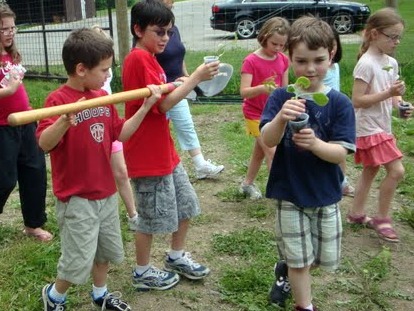
Popeye might not have been successful, but school garden programs do get children interested in eating spinach, along with other vegetables.  Across the country there are federal and state run programs to create gardens in schools.  These programs are bringing youngsters into the garden and teaching them about animals, vegetables, and fruits.  Introducing children to farming gets them active, creates positive habits and encourages them to be excited about eating healthy food.  Not only do school gardens benefit the children, but they also benefit the local community.

Michelle Obama is leading a national movement, Let’s Move, that includes bringing students into the White House Garden to help plant and harvest food.  Students from Bancroft Elementary School and Harriet Tubman Elementary School helped plant the garden this past spring.  Their parents have noticed differences in their eating behaviors: the kids are trying new vegetables and eating more of them.   Not only are parents saying that gardening has changed their kid’s attitudes toward vegetables, but so is the scientific community.  Ratcliffe, Merrigan, Rogers, and Goldberg (2011) found that school gardens improve a child’s attitude toward vegetables, willingness to taste vegetables, and the rage of vegetables they are willing to eat.

Teaching kids to eat more healthy food is just one thing that school gardens teach youngsters. School gardens can also be used as an interactive, hands-one learning environment.  Sealy (2001) investigated how school gardens allow children to draw on real-life experiences which allows them to become active in the learning process and it stimulates the interest in a subject.  For example, teachers use school gardens to teach planning, problem solving and art skills all in one lesson where the kids draw up a map of how they would organize the vegetable patch according to the sunlight available in different areas of the garden.

School gardens also allow students apply their knowledge about the plant and animal life cycles that they learned in the classroom.  Gardening allows students to bridge the gap between abstract academic concepts and their real life experiences.  Lieberman and Hoody’s (1998) research shows that 96% of teachers report students in school garden programs have higher-level cognitive abilities than the traditional classrooms.  School gardening can be implemented into the curriculum to improve student’s learning.

The produce grown at school gardens is often given back to the local community.  At many elementary schools, the food that is grown in the garden is cooked in the cafeteria so students throughout the school have healthier, fresh food which helps them concentrate better during school.  Urban Farms is a non-profit that transforms urban spaces into gardens and has transformed a former school yard into a living classroom at The Urban Farm at Lafayette.  The produce from the garden is donated to the District to cook in the cafeterias and it is also donated to local food banks.  The gardens are not only teaching students valuable lessons, but they are also improving their local communities.

As Michelle Obama explains, “you can affect children’s behavior so much more easily than you can adults’.”  Implementing school gardens can change a student’s behavior at an early age to create healthy life-long habits. Children learn to love vegetables, appreciate farms and farmers and form positive habits.  With the right encouragement and teachers, bringing kids to the garden will be an important step to changing the habits of the kids and introducing them to a new way of thinking about food.

Cheers to Student Gardens,

Jess Halter

Summer 2011 NYC Food Warrior

Posted in Food Warrior Interns, On the Playground (kids) | Tagged , , , , , , , , | Leave a comment

A Pizza Journey

Today we’re welcoming guest blogger Nick Fassler, Real Time Farms’ summer MBA intern. Nick is currently an MBA/MS student at the Erb Institute for Global Sustainable Enterprise at the University of Michigan. When he’s not doing school work or helping us, you will probably find him eating pizza…

Margherita pie at Punch Pizza in St Paul, MN

Most folks who know me have at some point experienced me ranting about this or that amazing pizza place that they need  to try. I’m not sure exactly where this obsession started, perhaps as a boy in Brooklyn eating at my favorite pizza place, Roma Pizza (which at the time I thought was the best in the world, but I realized after returning there a few years ago that it is just pretty good NY pizza).

More recently, this obsession led me to convince my wife, Emily, to take a slight detour through Los Angeles (Pizzeria Mozza) and Phoenix (Pizzeria Bianco, my all time favorite) on our move from Oakland, CA to Ann Arbor, MI (which is decidedly not even close to on the way). And when we were back visiting New York, there was no way I was going to miss the amazing school bus tour of NY pizza led by my high school friend Scott. Since moving to Michigan for grad school, I’ve been in a search for great pizza and luckily have found it at Supino Pizza in Detroit and the brand new Mani Osteria in Ann Arbor. All of this on top of my own adventures making pizza, with my favorite recipes coming from Cook’s Illustrated and Peter Reinhart’s American Pie (a fun read which is half pizza journey and half amazing recipes).

Luckily, I’ve kept fairly good photographic records of my pizza obsession, which I present below for your enjoyment. And at the very bottom of this post (if you make it that far without running out the door for the closest pizzeria), you can check out my current top five pizzas in the country.

The "Rosa" with pistachios, red onion and rosemary from Pizzeria Bianco in Phoenix, AZ

The NY slice worth waiting two hours for at Di Fara Pizza in Brooklyn

Clockwise from top-left: cracker-thin pie from Well's Brothers in Racine, WI; surprisingly good, but expensive mushroom pie from Via Napoli in Epcot Center; one of many amazing concoctions from Cheeseboard Collective in Berkeley, CA; and a squash blossom and burrata pie from Pizzeria Mozza in Los Angeles.

My own pizza creation - potato, red onion, radish and smoked mozzarella

And finally, what you’ve been waiting for…my current top five pizzas in the country (this list is subject to change without notice):

  1. Pizzeria Bianco (Pheonix, AZ) – the “Rosa” with pistachios, rosemary and red onion
  2. Di Fara Pizza (Brooklyn, NY) – the holy grail of plain NY pies
  3. Pizzeria Picco (Larkspur, CA) – the “Marin” with razor thin potatoes and garlic
  4. Supino Pizza (Detroit, MI) – the seasonal “Rooty Giuliani” with celery root and garlic
  5. Cheeseboard Pizza (Berkeley, CA) – an infrequent daily selection with cilantro, corn, lime, and feta cheese
Posted in At the Table (eateries) | Tagged , , , , , , , , , , , , | Leave a comment

Pesticide Science

I recently took Oprah’s Test Your Food IQ online quiz. It is five questions about food choices, food miles, pesticides, and antibiotics in animals. Such quizzes remind me of a constant choices I make as a food consumer when I vote with my wallet. Especially in the pesticide debate.

Borden - Lettuce in the garden

In my Master Gardener class “Integrated Plant Management,” I learned some of the science behind pesticide classification and pesticide toxicity. Whether synthetic, natural or organic-certified – all pesticides have certain elements in common. All pesticides are selecting for resistant bugs and are tested on animals.

Pesticides kill pests. A pest is anything that has caused damage or has the ability to cause damage to agriculture (backyard gardens to 100-acre farms). Insects, mites, fungus, bacteria, plants, rodents, slugs, birds, eggs or vertebrates all fall under this umbrella – depending to whom you are speaking.

Given enough time, all of our current poisons will be obsolete because the pest population will have adapted resistance to them. Our teacher defined resistance as, “genetic selection in response to exposure to cultural, biological and chemical control methods.” This genetic development to outwit extinction is not a question of if; it is a question of when. Mother nature will work around whatever controls we think are necessary.

So that is one side of the pesticide argument – that we are breeding resistant pests. Another side of the pesticide argument is the toxicity to humans. Acute toxicity from pesticides is expressed as LD50 (lethal dose 50) or LC50 (lethal concentration 50). When scientists were testing this item (pesticide or otherwise) on animals, 50 percent of them died. LD50 values are expressed as ratio of mg/kg or ppm. The lower the LD50 the higher the toxicity. For example, sugar has a LD50 of 29,700 mg/kg and Botox has a LD50 of 0.000001 mg/kg.

Borden - LD50 definition

Our teacher’s voice boomed across the classroom again and again throughout the class: “Chemical control is the last resort! Just because a pesticide is ‘natural’ does not mean it is safe!” We saw pictures of using fire torches to kill potato bugs in the fields (it retards the growth of the plant by a week). He talked about using boiling water to remove unwanted weeds from your driveway. We spoke about changing the expectations for what consumers will accept in the grocery store.

The key is for us, as consumers, to change our threshold for what we will buy from commercial growers. According to Oprah’s IQ test and the dirty dozen, apples have an incredible amount of pesticides – growers think no one will purchase an apple with blemishes or worms in it. I disagree; I purchased no-spray apples at the Westside Farmers Market last summer and learned to eat around the worms.

We need to shift our threshold for what we think our food should look like. As I learn more about pesticides, I certainly will.

Chopstick crazed,

Corinna

Posted in On the Farm | Tagged , , , , , , | Leave a comment

From Pyramid to Plate

This post is from one of the 18 interns in the Real Time Farms Food Warrior Summer Internship Program. These interns are collecting data, pictures, and video on the growing practices of our nation’s farms, collecting food artisans’ stories, and documenting farmers markets. We all deserve to know where our food comes from!

Recently, the USDA has issued a new tactic to balance the diets of everyday Americans: the plate. Yes, I know this does not sound like a cunning strategy our government would use to trick citizens into incorporating all food groups into each meal. In fact, it seems surprisingly straightforward. Which leads me to state what I know everyone hates to admit, it would not hurt us to eat a little more vegetables everyday. I’m not talking about the servings of vegetables we are now witnessing being ‘hidden’ within the sugary fruit drinks we are giving to our children. I am referring to the fresh goodness of the earth that is grown in the ground for the sole purpose of benefitting our bodies. A crisp carrot, a cool cucumber, a plump pepper. All three sound more wholesome and palatably pleasing than processed apple juice. Let me point out that vegetables aren’t the only food group getting neglected. The idea of the plate is not just to eat more vegetables, but to eat all foods within proper boundaries.

In case you have not heard the details of this change, let me briefly outline the basics. The traditional pyramid has been used ever since the nutritional benefits of food became a major focus 19 years ago. In 2005, the pyramid underwent an extreme makeover to more clearly show the equal importance of all the food groups and put an emphasis on exercise. Overall, the pyramid has always concentrated on the number of servings in a day. In comparison, the plate centers its attention completely on portions of food groups at each mealtime, resulting in an equally balanced breakfast, lunch, and dinner. Fortunately for us, the same nutritional phrases that we have heard again and again since childhood are still applied. How could anyone ever dare to change the adorable ‘vary your veggies’ or clever ‘make half your grains whole’ idioms?

With any abrupt adjustment, comes the inevitable split of two opposing sides. The USDA and the Obama Administration support the plate symbol as a simplified teaching tool for younger children. By accentuating the fact you can eat anything you want if kept in the correct proportions, it prevents people from worrying about fitting 11 servings of grains into their day. Some dietitians, nutritionists, and other health facilitators are opposed to this change. They resist the alluring simplicity of the plate by stating that an emphasis on proportions is not always nutritionally sound. They maintain that the proportions of food groups should change with your age, your gender, if you are an athlete, your lifestyle, etc.

It is no shock that most adult Americans have not looked at the nutritional pyramid in years. Sure we are taught about it in school, but how many people actually apply it to their diets? By changing this classic teaching tool, the USDA brings some much-needed press back to the importance of what we eat. Simply put, the controversy surrounding the plate is actually causing Americans to notice what they eat. I hope attendance grows at farmer’s markets as Americans realize that their diets need more fruits and vegetables, and what better place to add to these food groups than a place where you can ask exactly how the produce is grown?!

So what is your opinion? Do you like the new modern straightforward plate or prefer the familiarity of the detail-oriented pyramid? Or do you think, instead of a complete replacement, the two symbols should be used in tandem? To formulate an educated outlook of your own, check out MyPlate.gov.

And take a minute to check out my video introduction to nutrition and the recent change affecting American’s eating habits.

See you in the patch,

Susie Zammit

Summer 2011 Michigan Food Warrior

Posted in Food Transparency (the issues), Food Warrior Interns | Tagged , , , , , , , , | 1 Comment

5 Must-Try Food Destinations in Detroit

1. Avalon International Breads (first Detroit eatery to use Real Time Farms)

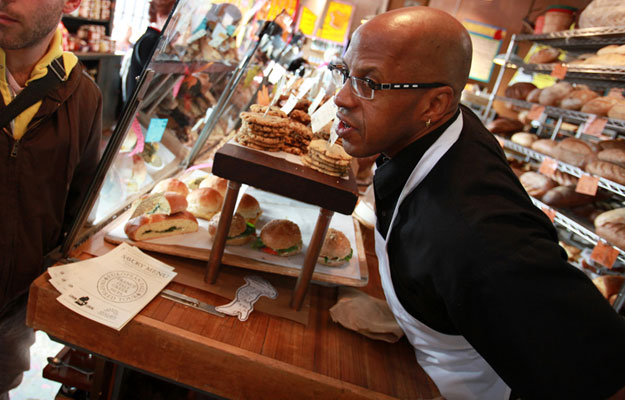
Jackie Victor, co-founder of Avalon (the one with the t-shirt), meets me outside on a sunny day, as a man in front of me relaxes with his iced mountain green tea, Garden Works sandwich, and chocolate sea salt cookie. (And yes…you must find room for them all). Named after a farm in Ann Arbor, Garden Works, the sandwich is a concoction of deliciousness: avocado, house-made basil-walnut pesto, roasted red pepper, Garden Works’ sunflower shoots on Avalon’s own Motown Multigrain made with 100% organic flour.  A man in the distance catches her attention, she runs to give him a hug and a jovial exchange, waves hello to a regular, and we head into their office (a recently renovated detroit public school warehouse).  She co-owns Avalon with Ann Perrault – they’ve been at it for 14 years – and now have a bustling retail and wholesale bakery and Detroit cafe that employees 45 people and counting. Their motto is “Eat Well. Do Good.”, best part is…it just feels good. (Also, she is solely responsible for introducing us to all the hot spots below – thanks Jackie!)

Image from avalonbreads.net

2. Motor City Brewing Works

John Linardos, Dan Scarsella (pictured in the middle on right), and team just want to make good beer. Since their opening in 1994, they’ve been best known for their beers like “Ghettoblaster” and their “Nut Brown Ale”, but I was captivated by their Cass Farm Series which are drinks made from various MI fruits. The series includes Hard Cider, Perry, Blueberry Perry and their Pumpkin Ale. The brew pub never intended to serve food, but the locals made sure it was otherwise. Dan recounts, “Our customers would pound on the doors when we weren’t open. They’d want to just come in, have a drink, chat, and eat pizza. The pizza delivery guy was here all the time.” Now, no need. Pull up a chair, get a cool, crisp, hand-crafted brew, and order a roasted pear & fig brick oven pizza from their kitchen.

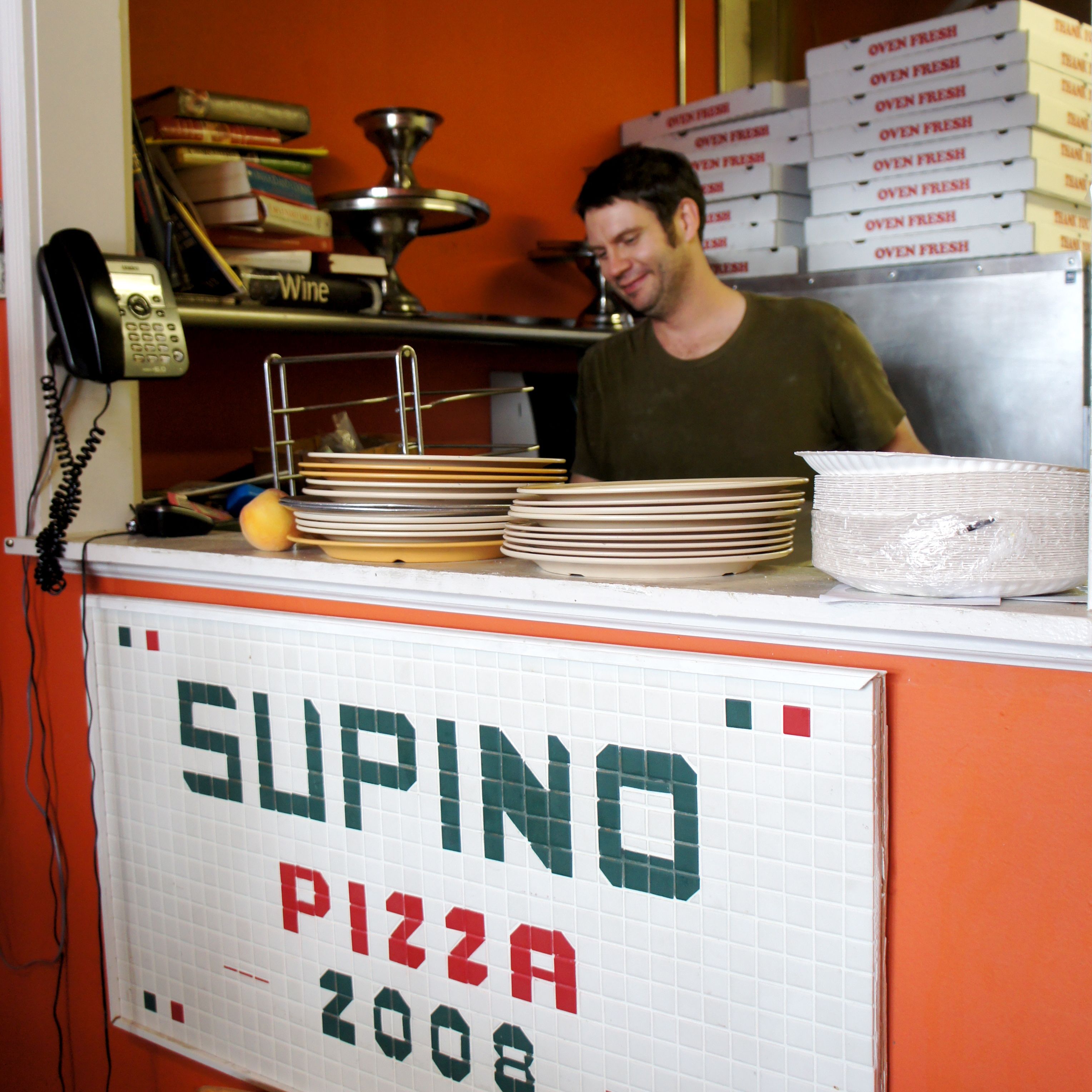
3. Supino Pizzeria

Dave Mancini is a busy man. When I asked him on the phone if he would mind if we swung by to chat, he said “No, not at all, just as long as you don’t mind if I have to get up to make pizza. I’m the guy that makes the pizza too.”

Kind-hearted and warm, he rushes around to make sure everyone is well taken care of. It’s a small, neighborhood spot across from the famed Eastern Market. He just makes amazing pizza. Thinner crust, slightly crispy, bubbly crust….yum. The pizzas change with the seasons, and we were too early for my co-workers, Nick Fassler’s, favorites: the Rooty Guilliani. Made with celeriac and garlic, he rates the “Rooty” as one of his top 3 pizzas ever. Need I say more.

4. Russell St. Deli

A Detroit landmark – established in 1989 – this is a must eat place on my list next time I’m in town. Located a few doors down from Supino’s and across from Eastern Market, it’s in one of Detroit’s good food meccas. Next time I go, I’m hoping they’ll have today’s special available, the Habana Ensalada- made with grown-in-Detroit spring greens, roasted corn, black beans, locally grown tomatoes, red onion, cilantro, cotija cheese and fresh tortilla chips served with house-made lime vinaigrette.

5. Detroit’s Eastern Market

A cultural hot-spot – a must-see. I got vegetable starters and flowers last summer at the market for an insanely great price (ave. $1-$2/starter).  It is a market that boasts an impressive 250+ vendors and draws crowds of over 40,000 shoppers each week. Whoa.

Now open Tuesdays and Saturdays. See none other than, Real Time Farms, for details.

Director of Vegetable Outreach,  Cara Rosaen

Posted in At the Table (eateries) | Tagged , , , , , , , , , | 2 Comments

A Sliver of the Sweet Life: DC Restaurants

Concerns such as transparency and accountability may not be forefront within the halls of government but they certainly are when government goes to dine.

The Sweetgreen Bethesda location. (Photo courtesy of Sweetgreen)

Sweetgreen
Touted as “an ecofriendly salad-centric resto” in Daily Candy, Sweetgreen has taken DC by storm. First opened in DC in 2007 with a blizzard of media attention: US Weekly for healthful organic munching, ArchitectureDC’s accolades for Sweetgreen’s award for Sustainable Design, and the Washington Post’s review of the inaugural Sweetlife Festival 2011, to name a few.

This media attention is richly deserved. As Bo Burlingham of Inc Magazine talks about in his book, Small Giants, certain establishments have a palpable mojo – and Sweetgreen’s got it. From the warmth of the recycled wood for walls and benches, vibrant green leaf-esque designs on the walls, and the line of passionate salad co-creators that will walk you through their organic offerings – this is a place for health, for salad, for lunch & dinner weekly. Communal benches or small tables made from recycled wood add to the common joie de vivre.

The bustling lunch line at Sweetgreen Dupont.

Nicolas Jammet, Jonathan Neman, and Nathaniel Ru spent their undergraduate years at Georgetown tired of food options near campus. Their desire to create a haven for daily eating bloomed into Sweetgreen with 8 locations in the DC area and 2 more in Philadelphia. According to Jammet there are plans for expansion within their current markets as well as into new territory.

Do you choose one of their 8 signature salads? Or do you take the plunge into the make-your-own salads and wraps? A selection of greens to start – then an overwhelming choice of veggies from standbys such as cucumber and chickpeas to spicy organic quinoa or fennel – then goat cheese from Firefly Farms or perhaps tofu from JC Bean Sprouts – finally to the crunch and dressing arena – all tastes are covered.

Sweetflow! (Photo courtesy of Sweetgreen)

Last, and some would say first and only, is the organic yogurt from Stonyfield Farms, “branded Sweetflow, [marrying] the texture of soft serve with the sharp tang of Greek yogurt,” according to the Washingtonian.com: Best Cool Treats. Sweetflow hits the streets with their Sweetflow Mobile Truck (you can find them at @SweetflowMobile on Twitter).

As Jammet shares, “traceability and transparency is a big part of our success. We serve a very educated consumer. Our messaging is very transparent – the customers have a lot of trust in us and they want to eat with us. Real Time Farms is good way to explore eating healthy, locally, and to eat organic!”

Check out Sweetgreen’s farm-linked menu!

A view of Equinox from the main dining room to the glass enclosed atrium.

Equinox
The Restaurant Association of Metropolitan Washington (RAMW) has been a mainstay of the Washington dining scene since 1920 and they give awards, dubbed RAMMY awards. Two weeks ago, Chef Todd Gray of Equinox was awarded Chef of the Year at the RAMMY awards. This is the fifth coveted RAMMY award Equinox has garnered since its lauded opening in 1999 (including best new restaurant, best pastry chef, manager of the year to Gray’s wife and business partner Ellen Kassoff Gray, and best fine dining restaurant).

The RAMMY awards joust for space on a mantelpiece already groaning with salutations for excellence and fine dining. The awards are rivaled only by the media attention Equinox has garnered over the years from the Today Show (for recipes) to CNN (for Chef Gray’s work with school lunches). Equinox was described by The Los Angeles Times as “a chic and sleek restaurant…an established staple” and the beginning of the Obama’s love affair with Washington restaurants.

Chef Gray’s long relationship with area farmers and his and Kassoff Gray’s commitment to local sourcing means the restaurant receives food from a smorgasbord of different farmers and suppliers.

Check out Equinox’s farm-linked menu!

Founding Farmers!

Founding Farmers
The first LEED Gold Certified restaurant in our nation’s capital opened September 2008. A 2011 RAMMY for Best Beverage/Mixology Program joined the many awards Founding Farmers has garnered, including many for its green and sustainable practices. This 100% carbon neutral restaurant goes the extra mile to address all facets of the guests’ experience. Even the way Founding Farmers approaches educating their diners – offering both a comfortable book nook one can sit and thumb through titles by authors Michael Pollen and Vice President Al Gore, as well as scannable QR codes on the rotating crop list placed on each table – shows their commitment to great service.

Founding Farmer’s latest venture is establishing an urban apiary in collaboration with George Washington University to provide honey to the restaurant once the hives are established. The hives are “a natural extension of Founding Farmers’ mission to minimize its impact on the environment through sustainable practices,” says Dan Simons, Concept Developer and Managing Partner of the restaurant. The six beehives and their inhabitants will be studied by the Biology Department and Founding Farmers set up an annual scholarship for an undergraduate student to tend for the hives.

Owned by the 42,000 family farmers of the North Dakota Farmers Union, Founding Farmers has created a menu as varied as the nation’s landscape. Yankee Pot Roast rubs elbows with Shrimp & Grits. All of their pasta, breads, dressings, and desserts are made in house.

Check out Founding Farmer’s farm-linked menu!

State Dinner in the Rose Garden

The White House
Due to understandable security concerns the White House does not release information about all of their food sources. However, anything served on state china from the White House Kitchen garden can be recorded. Check out the latest State Dinner featuring items from the White House Kitchen Garden!

A very special thank you to Eddie Gehman Kohan of ObamaFoodOrama for all of her help!

Shoutouts to…
Againn
For serving banana toffee pie and for having a pig charcuterie map on their shirts, this contemporary British Gastro-Pub makes their own charcuterie. Chicken Liver Mousse, anyone?

Bar Pilar & Cafe Saint-Ex
Chef Justin of Bar Pilar welcomed me back to his kitchen as he was peeling onions just in from Tuscarora Organic Growers Cooperative. What are you going to do with them, I asked? “I never know, we will have to see what works!” He smiled gleefully before sharing with me why tomato puree was being filtered through cheesecloth behind him, “it makes a more intense flavor.”

Coppi’s Organic Restaurant
As Carlos Amaya, the owner says to me, “I don’t only source from the farmers markets, I talk to the farmers in January and we go through their seed catalogues together.” The relatively small prep area at the back of the dining room is the extent of the kitchen – the only oven is the wood fired oven.  Transparency and trust are the name of the game, as Amaya talks about juggling incoming ingredients: “four of my farmers have keys to my restaurant to drop off their produce, I’ll come in the morning and there will be produce waiting for me on tables from their early morning deliveries.”

Sonoma
From their recent Tuscarora Farm Dinner, to the many farm dinners where they showcase their suppliers, Sonoma is solidifying its place for transparency and great sourcing on the Hill. Chef Mike’s menu features, “local pork, local lamb, local beef” instead of listing cuts – because you never know what will be available from day to day.

Chopstick Crazed,

Corinna

Posted in At the Table (eateries) | Tagged , , , | 2 Comments

Sprouts: a Whole New World

If you google “sprouts enzymes” you receive nearly 2.5 million hits that talk about the rich world of the sprout. If you visit or live in the raw food, juicing, cleansing, detoxifying world of nutrition you will quickly be told about the benefits of sprouts. For example, “a sprouted Mung Bean has a carbohydrate content of a melon, vitamin A of a lemon, thiamin of an avocado, riboflavin of a dry apple, niacin of a banana, and ascorbic acid of a loganberry.” (The mung bean will now be known as a melemacappanaberry.)

As consumers learn about the world of superfoods, companies jump on the opportunity to put denatured Omega 3 into our yogurt. I agree with a nutritionist from the Center for Science in the Public Interest (despite the fact that her organization sounds Orwellian) when she says the whole thing is “very confusing.”

Borden - trays of Sprouts

I am all about making my life less confusing, which is why I love to sprout.

Two years ago three things happened for me simultaneously: I read Animal, Vegetable, Miracle, the economy nosedived, and gas prices were very high. I started ranting about food miles, carbon footprints, and our budget. My husband, hoping to placate my rants, gave me a sprouter for my birthday. I was so enamored that I quickly bought two more.

The reason I bought two more is because I wanted to be able to eat sprouts for my veggie bowl everyday. In order to have a constant supply I quickly learned the importance of staggering the growing of the seeds. Certain seeds take a long time (for example, I’ve found wheatgrass, sunflower, and broccoli take about 6-8 days to really be something). Certain seeds don’t (red clover, alfalfa, and radish take about 4-6). I am constantly washing out and starting new seeds to make sure my supply is fairly regular.

My system of sprouting is extremely easy. I soak the seeds overnight in water. Dump them onto the sprouting tray and then rinse them morning and night. In a few days I eat them and start over. Some seeds my be duds and turn into mush instead of sprouting, in which case I dump the healthy ones out, clean out the duds, and put the healthy ones back in. That’s it. Easy as pie.

It is possible to purchase lids to go on top of mason jars in order to sprout inside the jar. That option is the most economical, especially if you have wide-mouth jars around from canning! If you want to augment your “in case the world ends” shelves in the basement, you can purchase POUNDS of seeds and store them next to your water drums and hand-crank radio.

Last but not least, what do you do with sprouts and how do they taste? I love the nutty flavor of sunflower sprouts stir-fried, in a salad, or eaten plain as a snack. Radish sprouts have a peppery bite that kicks you and is nice to put on a grilled cheese to cut through the fat. Alfalfa and red clover are very delicate and I only eat them raw. I find wheatgrass too stringy to eat in a salad, so that one goes directly into the juicer.

While debate rages in the netherworld of potentialities, maybes, and “one day,” it is nice to know I can do something simple, nutritious, and delicious now.

Chopstick Crazed,

Corinna

Posted in On the Farm | Tagged , , , , | Leave a comment

Food Labels and Certifications: What Does it All Mean?

This post is from one of the 18 interns in the Real Time Farms Food Warrior Summer Internship Program. These interns are collecting data, pictures, and video on the growing practices of our nation’s farms, collecting food artisans’ stories, and documenting farmers markets. We all deserve to know where our food comes from!

The USDA Certified Organic logo has become an icon in our food society. After visiting a blossoming local coffee business in my hometown, and learning of their other certifications verifying growing practices, I began to investigate other certifications used on food in the United States. Many stamps of certifications have become staples in our food system, such as USDA Organic, but many are far less common, and often just as meaningful.

There are two major organizations that grant certifications for organic goods: The United States Department of Agriculture, and Quality Assurance International. The USDA Organic certification holds standards to raw produce grown in the United States, and processed food that may contain these products. The QAI Organic certification is found on goods produced internationally, and certifies every step of food production, from the land on which the food is grown to the processing facilities.

In addition to organic certification, other organizations around the world grant additional stamps to farming organizations recognizing their labor practices, or sustainability. The Fair Trade certification protects the workers producing the food to ensure that they are granted fair wages and working conditions. This certification is targeted towards good produced in developing countries.

The Food Alliance certification recognizes farms using basic and “real” farming practices on both meat and produce, targeting farms growing/raising produce, meat, dairy, grains, legumes and oils with fair and safe working conditions. It also recognizes sustainable farming practices in terms of soil and water use, and the relationship of the operation with surrounding wildlife, along with the reduced use of pesticides and toxic chemicals. In addition, it recognizes humane living conditions for livestock raised without hormones or “non-theraputic” antibiotics, and not genetically modifying livestock or crops.

How meaningful is the USDA Organic label, or any of these other labels? A number of farms around the country agree with organic farming practices, and abide by them, but do not have the resources to pay for the official inspection or certification. Many farmers will say that they are “organic in practice,” but do not feel the need or desire to be certified because they believe has very small worth. This reinforces the importance of the dialogue between farmers and they consumers in order to communicate all farming and production practices, certified or uncertified. Please continue to investigate the importance of certain labels and what they signify, but also keep in mind that a label may not always be present with equally deserving farms and food suppliers.

Keepin’ it ripe,

Charlotte Steele

Summer 2011 NYC Food Warrior Intern

Learn More:

Posted in Food Transparency (the issues), Food Warrior Interns | Tagged , , , , , , , , | 1 Comment

Strengthening Family and Community Ties Through Food

Today we’re welcoming guest blogger Melissa Graham, a former attorney who found more joy in the kitchen than the courtroom. These days, in addition to being the founding Executive Director of Purple Asparagus, Melissa also speaks and writes regularly on child nutrition and sustainability both in the Chicago community and online.

In 2005, I left behind my first career as a big firm attorney to found Purple Asparagus, a non-profit organization dedicated to educating children, families and the community to eating that’s good for the body and the planet. In the beginning, we organized events that introduced children and families to the pleasures of the table. Our mission soon expanded to include advocacy and education in the schools. Six years later, we’ve worked with thousands of parents and children at public schools, community centers, and farmers’ markets throughout Chicago and its surrounding suburbs.

Purple Asparagus’ educational program, Delicious Nutritious Adventures, is based on the simple notion that if you eat close to the ground, incorporating lots of diverse fruits and vegetables into  your diet while getting the processed junk out, you’ll be well on your way towards a healthy lifestyle. At Purple Asparagus, we don’t view food as simply fuel or nutritional building blocks to feed the body.  Food can be, and should be, more than that. We believe that sharing food, at least good, clean food, can strengthen family and community ties.

The roots of this notion dig deep into my childhood. Through my parents, I was exposed to good food both in fine restaurants and in clam shacks.  Growing up near the bounty of the Atlantic on Long Island instilled in me a respect for local and sustainable products.  We clammed, caught crabs, and gathered beach plums that we transformed into jam.  Each Labor Day, we traveled to the island’s east end returning home with bags heavy with local corn, peaches, and tomatoes.  While my mother wasn’t a food snob and often used the tricks of the processed food industry, she also froze, canned, and dried the gifts of the growing season. Through food, we explored the world and connected as a family.

Having long since moved from Long Island and my parents, my husband and I continue these traditions here in the Midwest.  My son, age seven, is already an old hand at navigating the farmers’ markets. Our weekly, sometimes bi-weekly, visits have created so many wonderful memories, including trying his first strawberry plucked straight out of a pristine pile by the farmer, or his market play dates with the daughter of another farmer who lives in the same small Indiana town as my husband’s relatives.  We too explore the world and connect as a family through food.  While we’re not perfect, we do our best to consume food that is good and clean, raised by farmers and producers whose practices replenish the earth.

Purple Asparagus in Ambush

Asparagus in Ambush was a popular cocktail appetizer in the 1950’s. I resurrected it recently for our family dinner updating it by using the purple variety, my favorite. It was a big hit on our table.

blank

blank

Serves 4

  • 4 pretzel rolls
  • 1/2 pound asparagus
  • 1 tablespoon unsalted butter
  • 1 tablespoon all-purpose flour
  • 1 green garlic stalk, finely chopped
  • 1 tablespoon white wine
  • 3/4 cup milk
  • 1/4 cup parmesan
  • 1/8 pound Black Forest ham

Preheat the oven to 325 F. Steam the asparagus and cut into 4 to 5 inch lengths.  Heat the butter in a small saucepan over medium heat. Add the green garlic and sauté until fragrant. Stir in flour and cook for another 3 to 4 minutes.  Pour in wine and let simmer for 3 to 4 minutes. Whisk in milk and simmer until the sauce is thickened. Add parmesan and ham and remove from the heat.

Cut a slit in the top of each roll and pull out some of the bread from the center. Fill each roll with the white sauce. Stick the asparagus spears into the sauce and place on an aluminum foil lined  baking sheet. Bake until toasty and bubbling about 10 minutes.

Posted in In the Kitchen (recipes & more) | Tagged , , , , , , , | Leave a comment