A Visit to Snow’s Sugarbush

Last weekend we were able to take a tour of Snow’s Sugarbush, in Mason, during maple syrup season. Snow’s is a family run business that has been going strong for 40 years. Their maple syrup is a mainstay of the Ann Arbor Farmers Market and our cupboard at home.

Borden - Maple syrup pails tapped into the tree

A sugarbush is a grove of trees dominated by the Sugar maple (Acer saccharum – one guess as to which word means sugar). Sugar maples are so named because they have the highest sugar content and thus are the best to tap to make maple syrup.

As with so many things we eat (artichokes, oysters, truffles) I wonder about the many failed attempts that happened when boiling down tree sap into something palatable. But that is another story.

Tapping trees for syrup was a Native American tradition that soon caught on with the settlers. When the spring days hit 45 to 50 degrees and are 20 degrees at night, there is enough temperature fluctuation for the sap to start “running.”

Borden - plastic lines running from maple trees

From my Master Gardener class I know the sap begins to move against gravity because suction is formed by the heat on the stems, creating an evaporation vacuum that pulls up liquid and nutrients from the roots. As long as the temperature keeps shifting the tree will continue to pull liquid up from the roots. That liquid is 97.75 percent water and 2.25 percent sugar.
According to Uncle Sam, maple syrup has to contain 66.7 percent sugar. The general rule of thumb is that it takes 40 gallons of sap to make one gallon of syrup. There are several ways to reduce the amount of water – mostly depending on the amount of sap you have.

If I were to drill a 2 ½ inch hole into the sugar maple in my back garden, put a tap in it, a pail under the tap, and a cover to keep the rain out, I could probably collect about 10 gallons over the course of the 6 week season. 10 gallons would boil down to about one quart of finished maple syrup.

If, however, I am dealing with two large sugarbushes and nearly 80,000 pails tapped into trees all over the neighborhood, like Snow’s Sugarbush operation, the process would be more complex. The newest innovation adopted by the Snow family is the use of a vacuum generator and lines running from the trees instead of pails. The two sugarbushes behind their barns do not have pails attached to the trees. Rather, it is a cobweb of connecting blue tubes that move the sap under the ground and directly into the evaporator machine via an vacuum.

When sap arrives at the processing area, the first stop it makes is to the evaporating reverse osmosis machine that removes 75 percent of the water. The reduced liquid is then boiled. Here is a video of Matt Snow describing the boiling process.

Once the syrup reaches the 66.6 percent sugar content, it is then graded into different categories. The color variations and mineral content are completely dependent upon the tree, and there is a lot of yearly variation. There are four grades of syrup: light amber, medium amber, dark amber and Grade B. Due to the popularity of the detoxifying diet, The Master Cleanse, Grade B syrup has become much more desired in the last 10 years.

Borden - Maple syrup grading tool

Snow’s Sugarbush also makes maple cream, maple sugar and maple cream candies. They serve breakfast all day long during the season, and you can enjoy their syrup on top of French toast, waffles, pancakes and sausage. It is a beautiful outing on a sunny weekend day and a nice seasonal reminder of the earth waking up for spring.

Lettuce Lady,

Corinna

Posted in On the Farm | Tagged , , , , , , , | Leave a comment

Funny Food for April Fools’!

As a fan of food and of fun, I wanted to share a round-up of great food ideas for April Fools’ Day. Get ready to be inspired to pull some harmless (and tasty!) pranks!

How about starting off your family’s day with a bowl of cereal…

Image Credit: Bowl of Cereal by Nina Callaway for The Kitchn, recipe from The Surreal Gourmet

Only to have them discover that they’re eating cauliflower soup with garam masala spiced cereal! Another great idea is to make a fake egg by thinly spreading out yogurt on a plate in an egg shape, and then topping it with half of a canned (or peeled) apricot to form the ‘yolk.’

How about a warm baked potato with butter, sour cream, and chives for lunch?

Image Credit: MarthaStewart.com April Fools’ Day Pranks, recipe on MarthaStewart.com

That’s actually an ice cream sundae! What a sweet surprise!

Have you ever seen jelled fruit slices? Check out the tutorial on notmartha.org and freak out your friends with jiggly orange wedges! (Fellow vegetarians can participate by using agar agar and fruit juice instead of gelatin.)

What’s your favorite April Fool’s Day food trick? Making a meatloaf cake ‘frosted’ with mashed potatoes? Sharing ‘sushi’ made with candy and puffed rice cereal? Swapping out the salt for sugar? Share what you’re making today in the comments!

Locally yours,

Lindsay-Jean

Posted in In the Kitchen (recipes & more) | Tagged , , , , , , , | Leave a comment

Have You Met: Catharine Calder? Helping kids get their hands dirty since 1993.

Catharine at the door of the first Montessori School in Italy

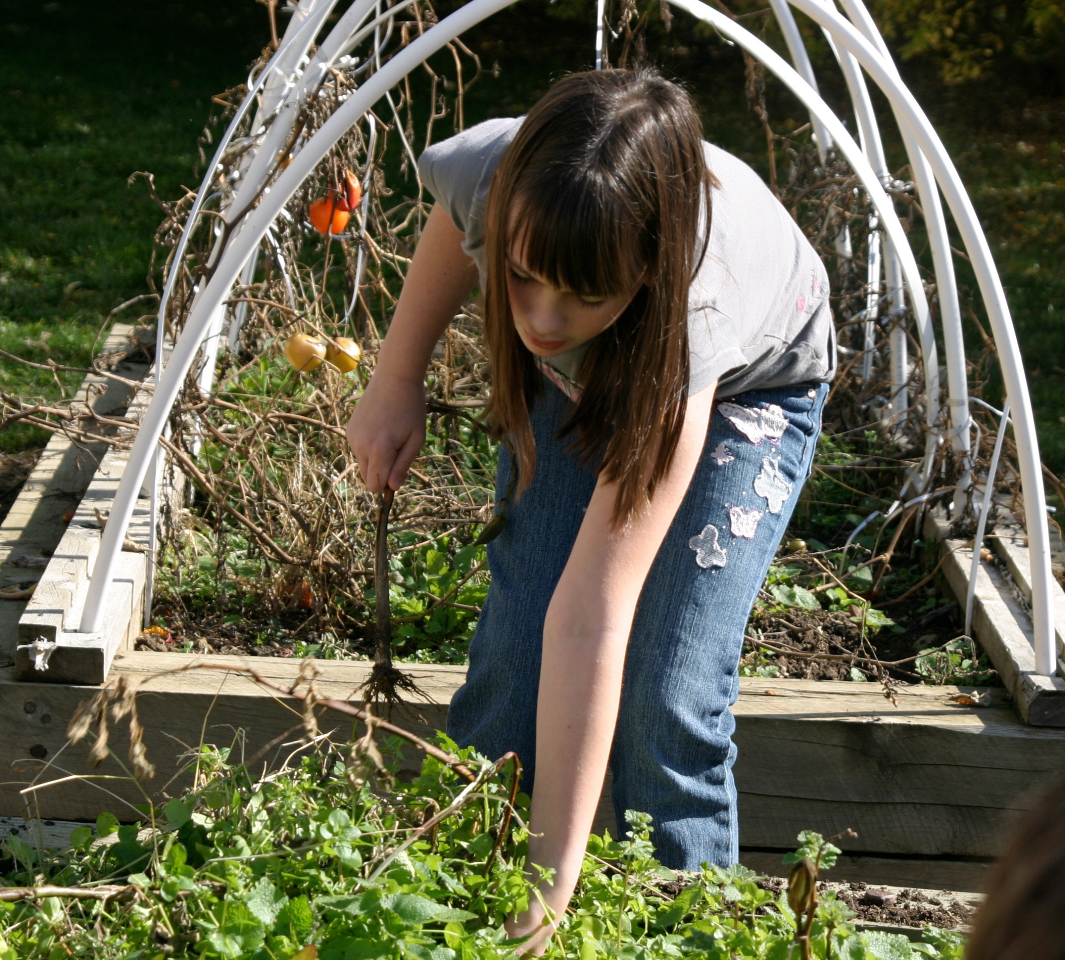
For about twenty years, Catharine Calder, daughter of William Calder of Calder Dairy and mother of Ian Calder-Piedmonte of Balsam Farms, has been managing an educational program at the Meadow Montessori School in Monroe, Michigan that gives young adolescent students a chance to get their hands dirty.

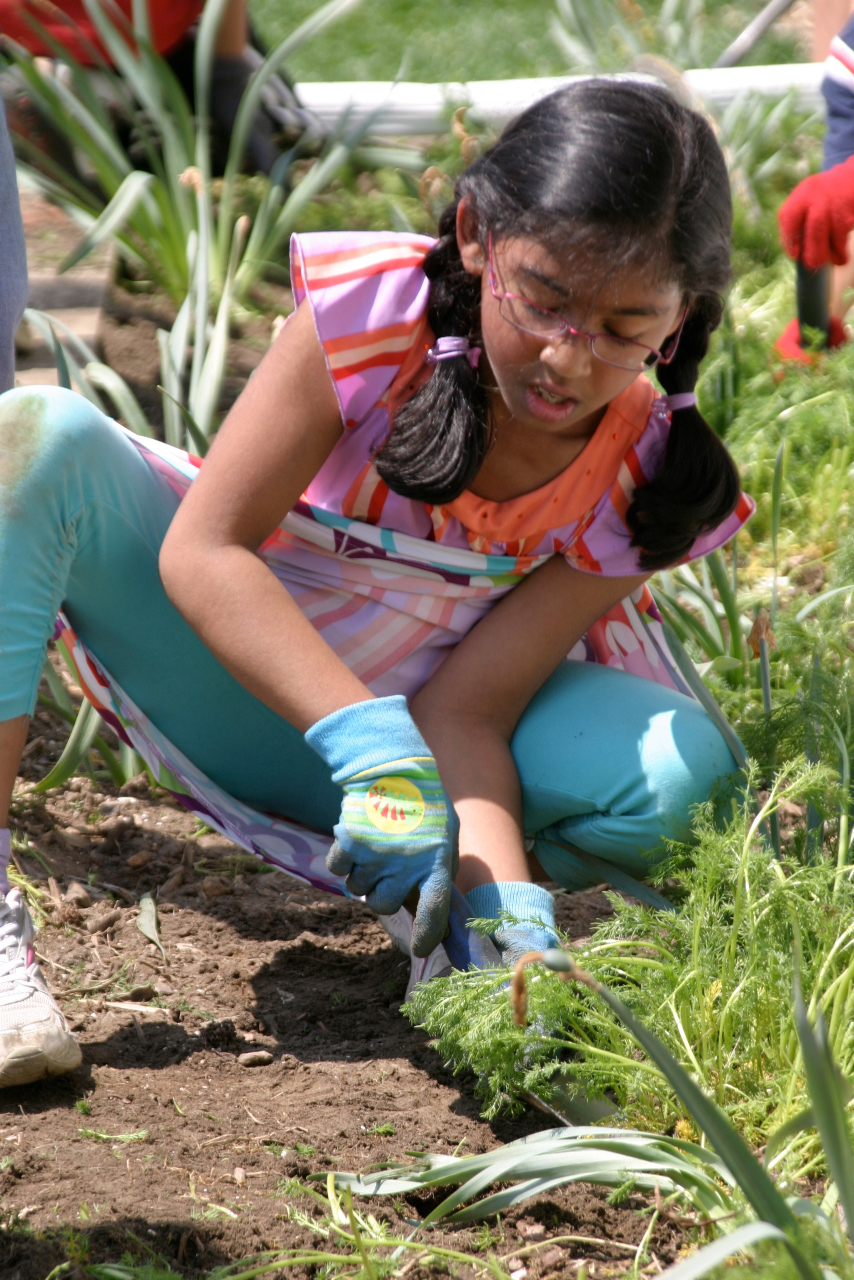
Every Friday, students (ages 12 to 15) spend the first half of their school day engaging in agriculture, horticulture, or “house-i-culture” whereby they learn by experience. Students rotate through the three sections. When in the agriculture section, they spend their time in the fields learning about farm management and animal husbandry; in the horticulture section, they focus on garden and greenhouse management; the “house-i-culture” section gives students a chance to cook meals for their classmates using the food from the garden and can what they harvest. Depending on the time of year, the farm provides up to 60% of the food eaten at school by the students. Curricula is detailed here.

The Farm Program originates from Maria Montessori’s vision that all children between the ages of 12 and 18 should live on a farm and live as “children of the earth.” Montessori believed that by adolescence, students had gained enough book learning to live in the real world and get the rest of their education through real experience. Since today, such a lifestyle is not entirely possible or practical, the Meadow Montessori School farm program adapts by bringing students to the fields once a week.

Catharine acknowledges that the program is very practical because there are so many natural consequences when working on a farm– “If you’re not mindful, the consequences are immediate. It teaches young people to think ahead and be very mindful in the moment.” Although some students are a bit hesitant when beginning their outdoor education, they quickly get over their phobias of dirt and bugs. For the most part, students are pretty enthusiastic about the program from the get-go. Catharine says it’s the parents that are initially somewhat resistant and don’t necessarily understand what their kids will get out of it. However, parents see over the course of the Farm Program that it builds their child’s self-competence, and they often come back to thank Catharine once they realize the very real benefits.

While the program originally started with students working on land owned by other people, it now takes place on Catharine’s own 110-acre working farm, Plum Run, right outside her home, about a mile from the school. According to Catharine, students now feel a greater sense of ownership over the land. They can come back years after finishing the program and still feel that they had an essential part in the development and health of the land. “Kids view my house as their house and the farm as their own,” she says.

Since the beginning of the program, students have grown up and many have expressed that the farm program has made all the difference in the course of their lives. Over the course of the past twenty years, it has been made evident to Catharine that it is extremely meaningful for young people to make connections with the earth and the food they eat. “They become better stewards of the earth because they are connected with the whole cycle of growing and preserving,” she says.

In 2008, Catharine Calder won the Outstanding Farm K-12 Educator of the Year Award from the Michigan Farm Bureau. Her farm program at the Meadow Montessori school is just one very notable example of the growing number of schools that encourage young students to give back to the land that nourishes them, quite literally.

Stay Fresh,

Lindsay Partridge, Intern Director, Food Warriors Summer Internship Program

Posted in On the Playground (kids) | Tagged , , , , , | 1 Comment

And the Winner is…

A great big thank you to everyone who participated in our first annual Real Time Farms Poetry Contest to celebrate World Poetry Day (March 21). We had many good poems come in and very much enjoyed reading them all, but of course we had to choose just one. Our top choice used both quatrain and alliteration to create a fun, fantastical poem that brought a smile our faces. We hope you enjoy it too!

Photo courtesy of: Stone & Thistle Farm in Meredith, NY

Voracious for Vegetables,

Meg

Posted in Between the Covers & Behind the Scenes (media) | Tagged , , , , , , , | Leave a comment

Movers & Shakers: The Many & Brave of Bicycle Food Delivery

As Spring is fast approaching (I swear….), I can’t help but reflect on all of the men and women connecting people to local food, decreasing our use of carbon, and all this on wheels.

When I met Ed Weymouth, the man behind the bike, for Michigan’s Arbor Cycle, I thought: here is a man truly devoted to connecting people to fresh vegetables even in the piercing-cold, ravaging, windy days of a typical Midwest Winter. He told me, “The wind will steal your body heat faster than a team of ninjas stealing pirate booty.” But almost in the same sentence, he tells me:

“Winter biking can make your world brighter and more full during the dreary months when that bluish, coldish feeling creeps into the soul and the desire to curl up in a warm, dry spot and wait it out is almost overwhelming.  It’s counter intuitive but the best thing to do when you feel this way is go outside,  your hands may freeze, you toes may tingle, but you will feel more alive, trust me.”

This was a completely new world to me…I am one of those winter hermits that Ed is eluding to. I thought, is Ed the only man on this earth doing this, or are people all over these cold landscapes biking to deliver the freshest and tastiest ingredients to our doorsteps?

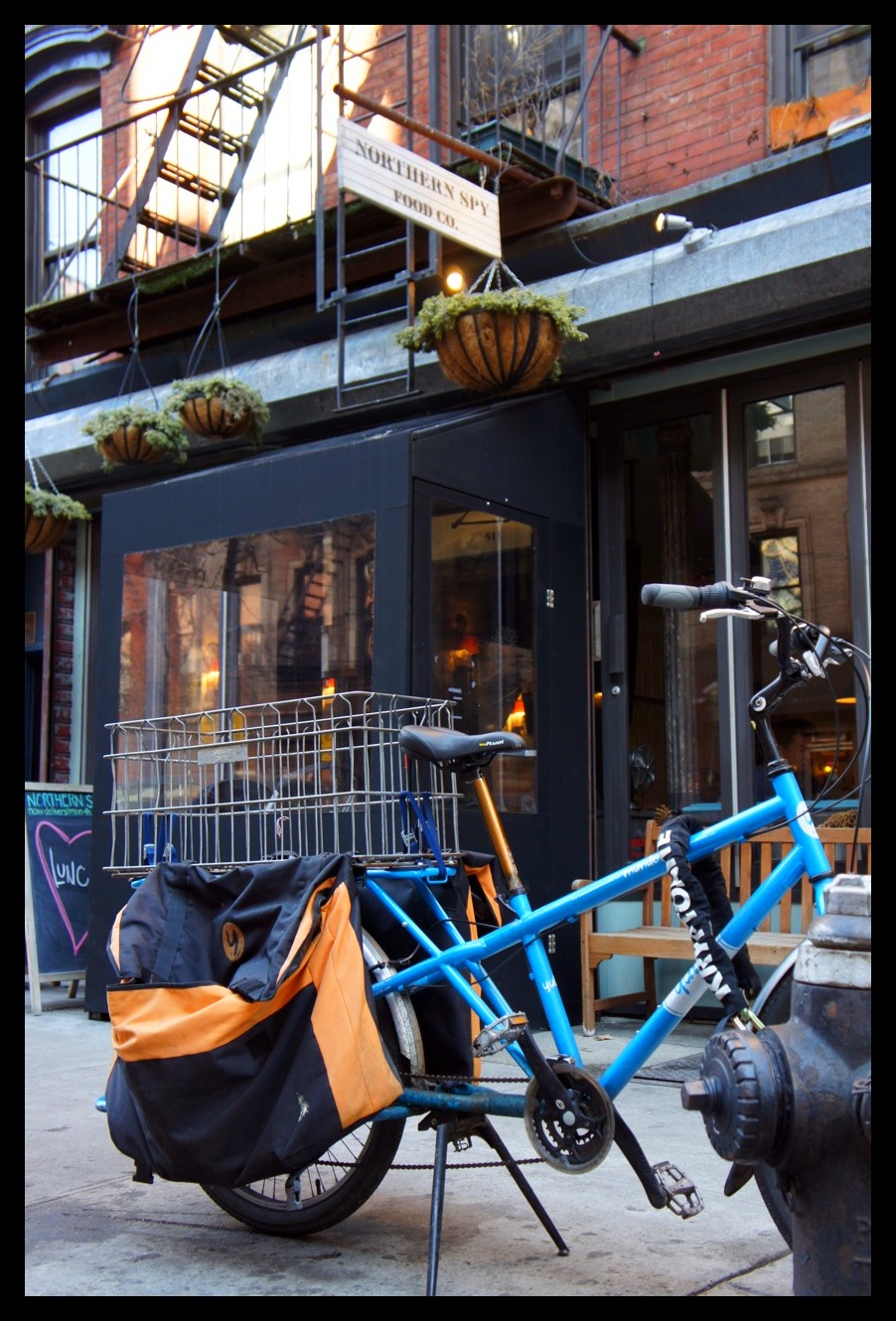
I sent out a Twitter call in December to people who deliver veggies by bike. Over the Twittersphere, I met Christophe Hille, co-owner of the down-to-earth & immensely delectable, Northern Spy Food Co. in New York City’s East Village. We chatted, and I asked him, “So you actually bike your veggies from the farmers markets in the winter back to your restaurant to cook?” “Yep” said Chris. “But what about in the Winter, in the snow, in the ice, you do it then?” “Yep” responded Chris, calmly. “So, are there other people out there that do this?” I asked. “Well, in the city, most people do it by bike. It’s the easiest way.”

Okay. Hold up. I’m officially completely missing something. People are carting veggies around all over the U.S….I had no idea. Northern Spy Food Co. shops at the markets, then brings the food back to the kitchen. Turns out, there are many farm and market bike delivery companies that will deliver to your door whether you be a consumer or a chef.

Ann Arbor: Arbor Cycle’s Ed Weymouth delivers pre-ordered goods to your door (think CSA’s, prepared foods from the market, produce and meat for your restaurant…the options are limitless.)

Chicago: LoadedBikes.com will deliver your CSA to your door.

NYC: From Earth to Kitchen delivers pre-ordered goods right to chef’s doors, Farmers’ Lunch (pre-made farmers market goodies) to your home or work office or Recipe Baskets of fresh produce and a chef’s recipe to your door.  (They are delivering to the kitchens of Blue Hill, Gramercy Tavern, and PRINT. among many others.)

Minneapolis: VeloVeggies delivers VegBoxes your CSAs to your door. They will even pick up your compost.

Vancouver: Recent start-up Green Apple Delivery will shop and deliver to your door.

So, I know, you’re thinking, I want to try this too. Maybe you want to give it a whirl in the summer, and ease into the whole winter thing. Turns out, there are cargo bikes that can handle hundreds of pounds of local heaven in one go.

Note: Sweet cargo bins they built

Ellie of From Earth To Kitchen in NYC recounts one day (while not in the Winter) when they biked 4 whole pigs to a festival on one of their tricycles. They have some sweet things in the works: solar-operated refrigeration for their cargo boxes.

If we’re really gonna geek out on equipment, though, you must meet Paul Freedman Founder of Rock The Bike, part owner of Yuba, and yes, he is the bike rapper, Fossil Fool.  Good friends with Christophe Hille, he and his crew are building bikes that will seriously blow your mind.

Mundo Cargo Bike (w/ a guy, not Paul)

“Cargo biking can be an awesome element in the local food picture, combining our need for activity, community, and exercise, with our need to move serious quantities of food.”

Turns out he makes cargo bikes that are functional, sleek, and just plain crazy fun. Check out Yuba’s Mundo Cargo Bike.  Paul has been working on perfecting the Mundo’s design for the past 7 years.

“Here’s a picture of a Mundo loaded with food, mostly rice, at a recent charity event called the Supermarket Street Sweep, in which we hauled 500 pounds to the Food Bank.”

Paul seems to have more tricks up his sleeve. It turns out he’s prepared us to be deliverers and the hostesses with the mostesses.  He and his team have designed a series of bikes, Fender Blenders, that co-function as blenders. (Did I mention all the plastic parts in the blenders are made from recycled milk jugs?) The Fender Bender Extracycle is the “creme de la creme” for someone wanting to cart a lot, park the bike, then craft up some smoothies on location. But if you want an option that will just convert the bike you have into a blending machine, then you should check out the Fender Blender Universale.

Fender Blender Universale

To all those who decided to try something new this year, I highly recommend, letting your hair blow in the wind (but wear a helmet), pick up some food at your favorite local farmers market or farm to table restaurant, and enjoy. As Ed says “Gear up and may the force be with you.”

Loco for Local,   Cara Rosaen

Posted in At the Table (eateries), Messages From the Founders | Tagged , , , , , , , , , , , , , , | 6 Comments

Food & Farm Poetry Contest

Happy World Poetry Day! In honor of this international day to celebrate the art of poetry, we are holding a poetry contest. Using one of the three poem formats described below, write a poem about food and farming and send it to us by this Saturday, March 26th. The winning poet will have their work posted on our blog in addition to receiving a complementary Real Time Farms t-shirt. Just email your submissions to meg@realtimefarms.com before the deadline to be considered for the contest.

Don’t delay! Take a brief moment out of your day to sit back, relax and get your creative juices flowing.

1. Quatrain
Four-line poetry that is often formed by two rhyming couplets. A common and easy way to write a quatrain poem is to use this pattern: aabb (where the first line rhymes with the second and the third line rhymes with the fourth–see below). Additional quatrain patterns include: abab, abba, and abcb.

My Example:
Vegetables planted all in a row.
People lined up because they want to know,
how is it grown? and, how was it raised?
This movement is more than a passing craze.

2. Haiku
A popular one that you might remember from elementary school. Three-line poem with a total of 17 syllables–first line 5 syllables, second line 7 syllables, third line 5 syllables.

My Example:
Small seeds sprouting up
Reaching toward the bright sun rays
Growing tall and strong

3. Alliteration
Poems with phrases or sentences with adjacent or closely connected words that repeat the same letter or sounds at the beginning.

My Example:
Cool cucumbers hiding in the shade,
of great green leaves.
Lovely ladies out in the fields,
wiping water droplets from their brows.
Relentless sun shining down,
heating the soil and sand beneath their feet.

Want to know more about poetry? Need additional examples for inspiration? Visit
www.poetryfoundation.org and check out their poetry tool (search for poems by glossary term to see examples of haiku and alliteration, among other poem formats).

Posted in Between the Covers & Behind the Scenes (media) | Tagged , , , , , , , | Leave a comment

Young Foodies: Katelin Davis

“Food is the source of energy and the food that comes into your body directly influences you, nutritionally and emotionally,” responded 22-year-old Katelin Davis when asked why she cares about the food she eats.  She is a firm believer that the energy she consumes affects her well-being, and for this reason she tries to eat only what she considers “happy food.”

Katelin’s definition of “happy food” is produce grown on soil that is not degraded, on a farm that promotes biodiversity and does not pump pesticides into the soil. She believes that food carries the energy with  which it was produced, so it is important to consume food that was grown with respect for the land and the farmer.

While she tries to eat primarily organically, sustainably, and locally, she says that local is the most important to her because she believes you can build a community by supporting local producers and frequenting the community farmer’s market.

As a student of the University of Michigan’s Program in the Environment, Katelin is very conscious of the impacts of her consumption habits, and this ties in directly to the decisions she makes about what she eats.  “It’s about education and being a conscious eater and buyer,” she says, and believes that people’s habits would be changed if people were educated on the topic. From her perspective, the industrial food system is extremely hidden, but it is every person’s responsibility to educate themselves on the food they are eating.

Nothing is more important to Katelin than eating—to her, it is a community builder, a source of business, and a source of pleasure. “Nothing can bring people together like eating happy food, sharing local beer and wine, and cooking together. People will be intrinsically pulled by good food and drink because of the positive feelings attached.”

Katelin’s passion for food was strengthened by her experience last year maintaining a garden with her dad. Together, they tore out the grass and planted herbs, kale, cherry and heirloom tomatoes, chard, and marigolds in raised beds. They frequented the farmer’s market and the botanical garden for plants, and she quickly became obsessed with gardening. “I loved being surrounded by it,” she said. “I felt like it was my little oasis. I began to value my food so much more and developed a whole different sense of food.” She describes her relationship to the produce from her garden as a partnership. “I was taking care of it and it was taking care of me,” she reflects.

This winter, Katelin applied for a grant from the University of Michigan Ginsberg Center to start a community garden, which will be located at Hill and Division outside of Outdoor Adventures. She plans to give a lot of the produce to Outdoor Adventures for their trips and wants to have a booth at the farmer’s market with produce and crafts. She is graduating this spring with a concentration in “sacred relationships with plants” (yes, she made it up), and plans to pursue edible landscaping and sustainable agriculture in the future.

Posted in At the Market (farmers market) | Tagged , , , , , , , , | Leave a comment

Get Fresh News!

We’re sponsoring musicians Coco and Lafe on their 2011 “Get Fresh” 100 Market Tour across the U.S.! You heard right, 100 farmers markets coast to coast! Don’t forget to check out the page dedicated to them on our blog, and today we have an update from them!

From California to the Treasure Coast of Florida, we drove 2400 miles and received an education in homegrown and handspun fibers, and an exciting overview of hydroponic and vertical farming in hurricane country.

This map shows where we expect to be on this next tour. Over 60 markets are booked already. You can see the map in real time here.

VISTA FARMERS MARKET

The Vista Farmers Market in California is managed by Mark Wall. Three years ago we shot our “Get Fresh” video for farmers markets there, along with our press kit video and a music video. You can see the 30 second “Get Fresh Video” here on YouTube or on our website.

FRESH HEROES
Some Of The Amazing People We Meet At The Markets

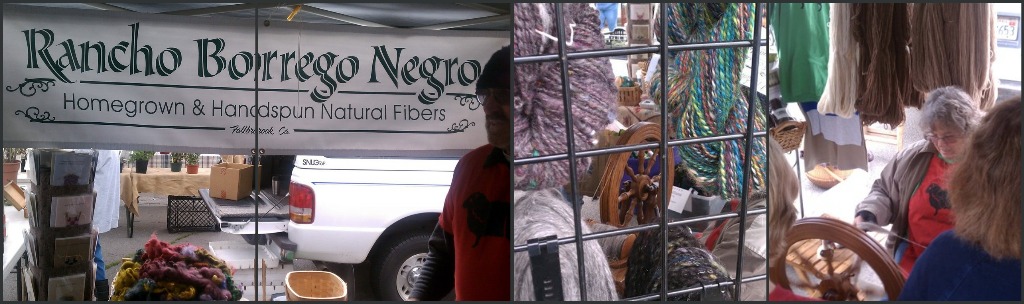
Kids and adults trying a spinning wheel at the market? Homegrown and handspun yarn, soft hats, luxurious rugs with no wool itching?

Kathy Lambert, a retired school teacher, sets up one of her spinners every week at the Vista Farmers Market in Vista, California. She’s a present example of where our clothes come from, or should come from.

30 plus years on the farm, she and her husband raise the llamas, sheep and goats, shear them and spin the wool.

She read and believes the practice: “Support the view you want to see. Do you want to see a factory or a pasture with sheep in it?” She’s also a sweetheart. Take a look at beauty at Rancho Borrego Negro’s home on the web.

This is Angel, one of the happy residents at Rancho Borrego Negro. You can own her fleece here.

Imperial Beach, California Farmers Market

We’ve played over 100 farmers markets coast to coast, and this is one of the most beautiful settings of all them. Which is saying a lot if you’ve seen Colorado’s and Maine’s.

This is our view from the microphone.

Deanna Rose is the manager and greets us with a hug. Even the surrounding retailers treat us like royalty. I walked into a coffee shop called Cowabunga, and the owners recognized me from a picture in their local paper and asked “Is Coco with you?” I explained she was setting up the sound system (you see how it is? I’m getting coffee while she’s busting butt. I can explain.). They insisted on giving me a homemade, fragrant whole-grain muffin to take to her.

Why do I love this life?

Delray Beach GreenMarket, Delray, Florida

Thomas Produce Company, Boca Raton, Florida

Meet Cindy Thomas.

“My grandfather came from Italy in 1902 and started the farm in Buffalo, [New York].”

Her grandfather, Angelo Thomas, dynamited the stumps to grow beans and other vegetables.

In the 50’s, her father, John Thomas Sr., added the Florida farm.

Today, John Thomas Sr. is 90 years old and “shows up at 7 a.m.” already moving fast. He and his seven children, along with about 90 employees, farm 4,000 acres in New York and another 17,000 acres in Florida. They truck produce back and forth as the harvest and weather shifts.

They produce 10 million boxes of tomatoes, bell peppers, green beans and cucumbers.

They grow 5,000 acres of green beans. “This year, with the cold weather, we covered 1,000 acres of green beans. What we didn’t cover burned [frost] right down to the ground.”

Who’s afraid of hard work? Me; that’s why I’m a musician, but no one in the Thomas family.

Posted in Messages From the Founders | Tagged , , , , , , | 2 Comments

Starting Off Your Little One on Fresh, Homemade Baby Food

Today we’re lucky to have Kate Storey, Michigan Mama author, guest blogging for us!

I only consider myself to be “moderately crunchy.”

Sure, I’ll look for more natural ways of living, but I’m not completely ready to live off
the land and give up every modern convenience. I do what’s doable and try not to beat
myself up about the rest.

But my crunchy side kicked into high gear once I became pregnant with my daughter
three years ago. I read natural pregnancy books, exercised to a prenatal Pilates DVD in
which the instructor announces at the end that her unborn daughter’s name is Sienna
Chile, purchased an organic crib mattress and made a commitment to myself and my
unborn child that I would breastfeed for at least a year. Hey, if you’re going to pick any
time in your life to live as healthily as possible, why not while you’re pregnant?

And once our daughter arrived, I knew I wanted to make her baby food. My husband and
I shared this view with our parents and friends – and mostly got confused looks.

“Uh, really? When are you going to find the time to do that?” was the primary response
we received. That, or, “WHY would you want to do that?” After all, we were both full-time working parents now, and the jarred foods are just so darn convenient and easy.
But I had read in multiple news sources how much sodium, sugar and other unnecessary
ingredients were part of store-bought baby food, and the thought of starting our daughter
off in life on the taste of processed foods had started to creep us out. We tried to eat
healthy foods; why shouldn’t we offer the same for our infant?

I started researching different baby food-making kits and websites, and it sounded like it
was simple enough…so why not have her first taste of “real food” be, well, real food? I
had read that sweet potatoes were often a good starting point for solids – the jury’s out on
whether starting your child on fruits will predispose them to wanting only sweet foods,
but just to be on the safe side, I figured a palate-pleasing starch was an okay place to
start.

I scrubbed a whole sweet potato, pricked it all over with a fork and popped it into the
microwave, just like I make for me and my husband. When it had cooled down a bit, I
sliced it in half, scooped out the flesh into a baby bowl – and then stared at it in disbelief.
Seriously? This was all it takes to make your own baby food? I was sold.

Our five-month-old daughter was even more enthusiastic. All of the baby books had warned us to just offer a few bites to start, to not push her to eat…but after a few
spoonfuls, she actually grabbed the spoon out of our hands and tried to feed herself!

From there, it was all homemade baby food, all the time – and it really couldn’t have been easier. Each Sunday night, I would make a batch of different types of fresh and
frozen vegetables and fruits by steaming them in the microwave in a glass container,
blending them right in the container with an immersion blender, and then doling them out into ice-cube trays to pop into the freezer. The next day, I would label a plastic freezer
bag with the vegetable’s name and cook date, add the frozen food cubes – and I had fresh
food ready to go for my little girl every night when I got home. (And breakfast was even
easier – all I had to do was peel half of a banana and mash it up with a fork!)

Our daughter remained an enthusiastic eater throughout her entire infancy, and I
fully believe it had to do with the delicious taste of the freshly prepared food she was
consuming. There’s a reason why babies make those adorable grossed-out faces when
they’re eating jarred baby food – how would you like to eat shelf-stable pureed turkey?
Blech!

Now, we’re expecting our second daughter this summer – and even though I realize our
lives are about to get twice as hectic, I fully intend to make all of her baby food as well.

There are really only two things I plan to do a bit differently: buy more local food
through our Lunasa membership and from our local farmers market (neither of which
were around when our first daughter was born), and to be a bit more adventurous with her
food selection. I was a typical first-time mom who was terrified of her child developing
allergies to certain foods, so I rigidly followed a specific (though very helpful) guide I’d
found online to show which foods should be introduced when; but a friend of mine who’d
seen us make our baby food and decided to do the same was much more laid-back than
me. After introducing the basic veggies and fruits, she started pureeing whatever she had
made for dinner – lasagna, chicken casserole, you get the idea! – and her daughter has
never given them any trouble devouring her food at mealtime.

If you’re a new parent or grandparent, expecting or simply know that kids are in your
future someday, I would absolutely encourage you to try making your own baby food,
too! It really couldn’t be any easier or faster, and the health benefits for your child are
beyond compare. Happy eating!

Posted in On the Playground (kids) | Tagged , , , , , , , , | 3 Comments

Savor the Season: Cabbage and Apple

Who doesn’t love a good slaw?

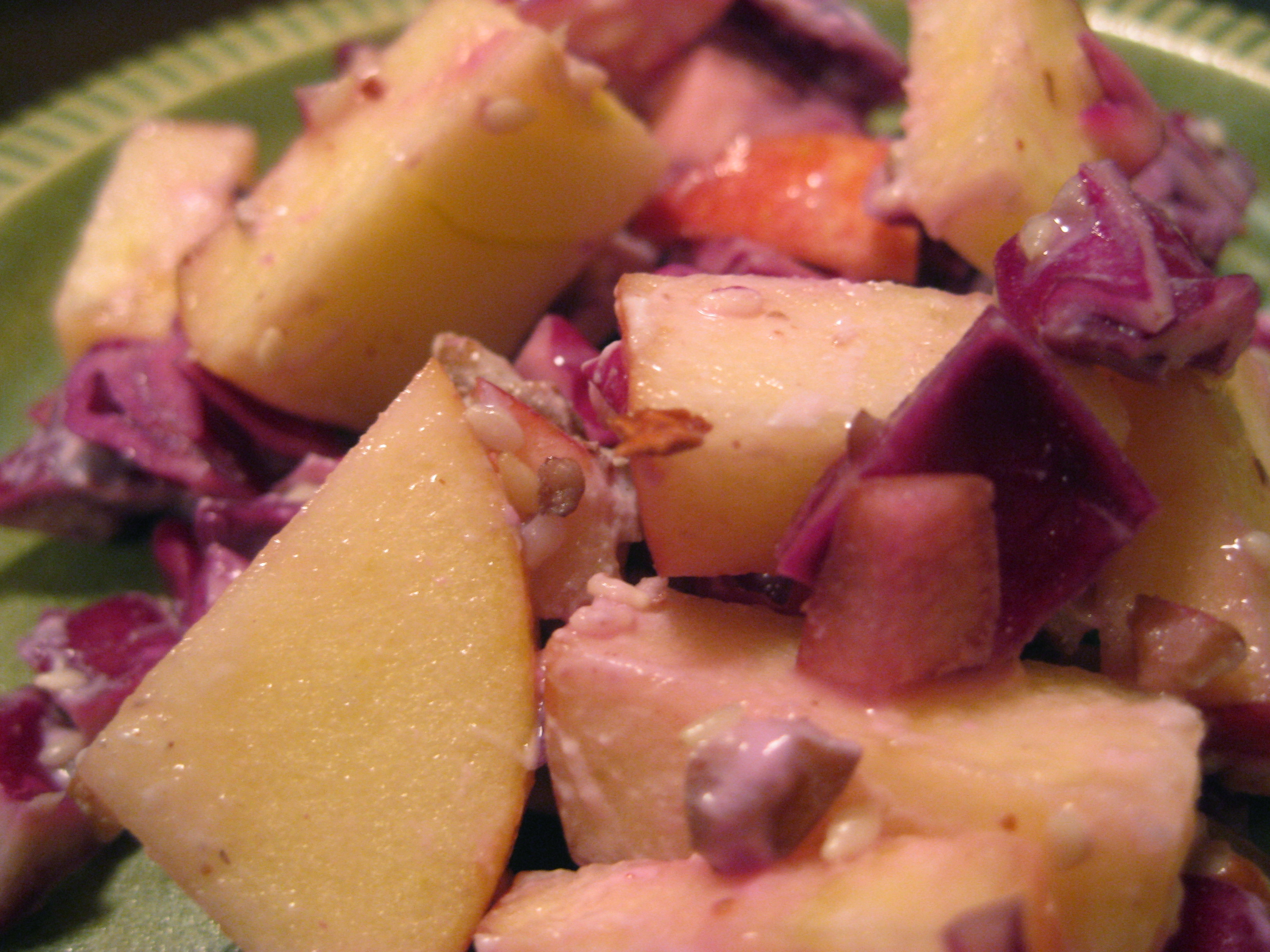
Beautiful purple cabbages and red apples combine to make a bright dish during dreary winter days.

I combined 1/2 a head of cabbage, sliced and diced with an apple chopped bite size. No tried and true recipe here, but into the mix went a bit of champagne vinegar, a bit of plain yogurt, and some chopped pecans.

I added some sesame seeds that were lurking in my cabinet, along with a little salt and just a pinch of sugar. Then I covered my bowl of cabbage-y, apple-y deliciousness and let it sit in the fridge overnight.

The purple color of the cabbage infused the whole dish, turning the thin yogurt sauce a beautiful shade, and slightly coloring the apples. The vinegar in the dish kept the yellow flesh of the apples from browning, and their red peels provide a nice contrast to the purple cabbage.

Crunchy, colorful, sweet and sour. Slightly creamy, but mostly tangy. Delightful as a side dish, or tasty as a sandwich topper.

You can’t go wrong with a good coleslaw.

Enjoy!

Cheers from Seattle,

Lisa

Posted in In the Kitchen (recipes & more) | Tagged , , , , , , , | 1 Comment