Applications Open! Winter/Spring 2012 Food Warrior Internship Program

Real Time Farms is accepting applications for the Winter/Spring 2012 Food Warrior Internship Program, which will run from January 21st through May 7th. We are looking for Food Warriors in Atlanta, Austin, the Bay Area, and throughout Hawaii.

Description
Food Warrior Interns for Real Time Farms will learn about their local food system while documenting farms, farmers markets, and food artisans in their area. You will have the opportunity to interact directly with producers, learn about and get hands-on experience with photography and videography, collect information on growing practices and personal stories of producers, and contribute to the Real Time Farms blog. You will be contributing to the greater goal of bringing transparency to the food system – we all deserve to know where our food comes from!

Food Warriors will work approximately 15-20 hours each week and will be responsible for uploading all the information, photos, and video compiled to the Real Time Farms website. You will check in regularly through email and with weekly Skype meetings. Food Warriors can receive academic credit for completing the internship if coordinated with and accepted by their advisors.

Interns are able to choose their own schedules, but should be available for one 1-hour team meeting each Monday. Internet access is essential.

Enthusiasm, a strong work ethic, and passion for food transparency are a must. Writing and photography experience are a plus.

How to Apply
Email me at lindsayp@realtimefarms.com with “Food Warrior Application” and your city in the subject line.

Please attach a copy of your resume and answers to the following questions:
1) Why do you care about food transparency?
2) Why do you want to be a Food Warrior for Real Time Farms?
3) Sample blog post on a related topic (be creative!)

Please inform me of any relevant experience with blogging, journalism, photography, or other related work. Also please let me know if you have a camera and/or access to a car (Not necessarily required, but we need to make sure at least one intern in each area has a car to travel to farms. We have a limited number of spare cameras that can be loaned to interns who do not have one).

Applications are due by December 30th and will be considered on a rolling basis, so the sooner you apply, the greater your chances of acceptance to the program.

Stay Fresh,
Lindsay Partridge
Kernel Colonel: Food Warrior Program

(Thanks to 2011 Summer and Fall Food Warriors: SusieAlec, and Charlotte for their photos!)
Posted in Food Warrior Interns | Tagged , , , , | 4 Comments

A Very Pumpkin Weekend

This post is from one of the interns in the Real Time Farms Food Warrior Fall Internship Program. These interns are in Asheville, Austin, Nashville, Portland and San Francisco, collecting data, pictures, and video on the growing practices of our nation’s farms, gathering food artisans’ stories, and documenting farmers markets. We all deserve to know where our food comes from!
blank
Why, why, WHY would I get up at 6:30 AM on a Saturday morning? I didn’t. I got up at 7:15, fifteen minutes late to pick up my best friend to go to the Half Moon Bay Art and Pumpkin Festival. I thought she was being ridiculous about being stuck in traffic, but as we crawled along Highway 92, I was glad we left when we did. Had we left any later the extra 15 minutes we spent in traffic would have easily turned into an extra hour. Many of the parking lots we came across were already full, and the event had just started!

Farmer Mike has been creating masterpieces for 25 years. The Atlantic Giant Pumpkin, seen here is a variety known for yielding humongous results.

Each year the city of Half Moon Bay hosts the Half Moon Bay Art and Pumpkin Festival, featuring local artists, a haunted house, parade, live music, and of course: pumpkins. Pumpkins in every form you can think of: smoothies, pancakes, and even mac & cheese. If you’re not stuffing your face with it, you’re staring at it in awe: Farmer Mike, “the Picasso of Pumpkin Carvers”, chisels away at hundred pound pumpkins, creating whimsical 3-D faces and scenes in the fleshy gourds. If that doesn’t wow you, the top five winners of Safeway’s World Championship Pumpkin Weigh-Off will. Fork-lifts, cranes, and harnesses are used to place the winners, usually weighing in over a thousand pounds, on display for crowds to gawk and pose in front of. Farmers from all over the country enter in hopes of placing first: at $6 per pound former winners have been taking home over $10,000.blank

While I easily could’ve taken home a pumpkin from Half Moon Bay’s many nearby farms, I had already visited Peter Pumpkin Patch in Petaluma, about 75 miles North. About fifteen minutes from downtown Petaluma, amongst the rolling green hills you’ll spot a field of orange. You have arrived at Spring Hill Dairy, where each year Larry Peter opens up the farm to the public for pumpkin season. Here you can dig for your own potatoes, taste cheese mere steps away from where it was made, and pick your own pumpkin fresh off its vine.blank

Larry Peter has been hosting the pumpkin patch for the past 16 years, and each year it becomes more popular amongst locals and visitors from nearby cities. Today school buses trek their way to the patch; up to a few hundred children every day during the fall season get a hands-on farming experience.blank

Andy sharing the history of the farm.

“Larry wanted a place where kids could run around and not have their moms worry.” Andy says. Andy Wells works the pumpkin patch each year, pointing out to visitors great tips on choosing your pumpkin, or where to dig for potatoes. Andy starts up his tractor and gives visitors tours of the 480 acre farm, pointing out the white Sears Roebuck Kit Home perched above the patch, the hay pyramids, and beyond them, their 350 Jersey cows.
blank
While the farm isn’t certified organic, it is certified humane, from cow to pumpkin. Peter and his team rotate the pumpkin and potato crops; while the produce is being grown on one field, the other is being planted with fava beans for their cows, replenishing nitrogen levels in the soil. The pumpkins and potatoes benefit greatly from the hands-on treatment, and bright, robust Jack-o’-lantern varieties meet you on your drive in. On the opposite side, visitors roll their provided wheelbarrows over to the potato field, unearthing red bliss, russet, butterball, and yukon gold potatoes. Up on the hill, housed by a large tent you’ll find more Jack-o’-lanterns, as well as over a dozen lesser-known pumpkin varieties and winter squash. Shades of orange, yellow, green, white, and even blue-green in an array of sizes and shapes jog your creativity.
blank
Grace Wells, who works for Spring Hill Dairy, leads visitors on a delicious cheese tour, sampling a smorgasbord of different flavors, from fresh unadulterated curds to their award-winning Sage Cheddar. She also provides tips on their pumpkins—the Jack-O’-Lantern may be your go-to for carving a spooky face, but for a smooth pumpkin puree, go for the Sugar Pie variety; albeit smaller, it yields a less-stringy, sweeter flesh!
blank

You may have been on a field trip to a pumpkin patch yourself as children, but if faced with the opportunity, drive out to a pumpkin farm! The experience is unmatched, the farmers armed with wealth of knowledge—from carving tips to recipes. Meet the land, animals, and people behind your future jack-o’-lantern!
blank
Nom nom Noshing,
Charlotte
Fall 2011 California Food Warrior
Posted in Food Warrior Interns, On the Farm | Tagged , , , , , , | Leave a comment

A New Type of Renaissance (Wo)Man: The Farmer!

This post is from one of the interns in the Real Time Farms Food Warrior Fall Internship Program. These interns are in Asheville, Austin, Nashville, Portland and San Francisco, collecting data, pictures, and video on the growing practices of our nation’s farms, gathering food artisans’ stories, and documenting farmers markets. We all deserve to know where our food comes from!

What do you get when you cross a food lover, an anthropologist, a businessman, a biologist, an ecologist, a writer, and a veterinarian?

A farmer, of course!

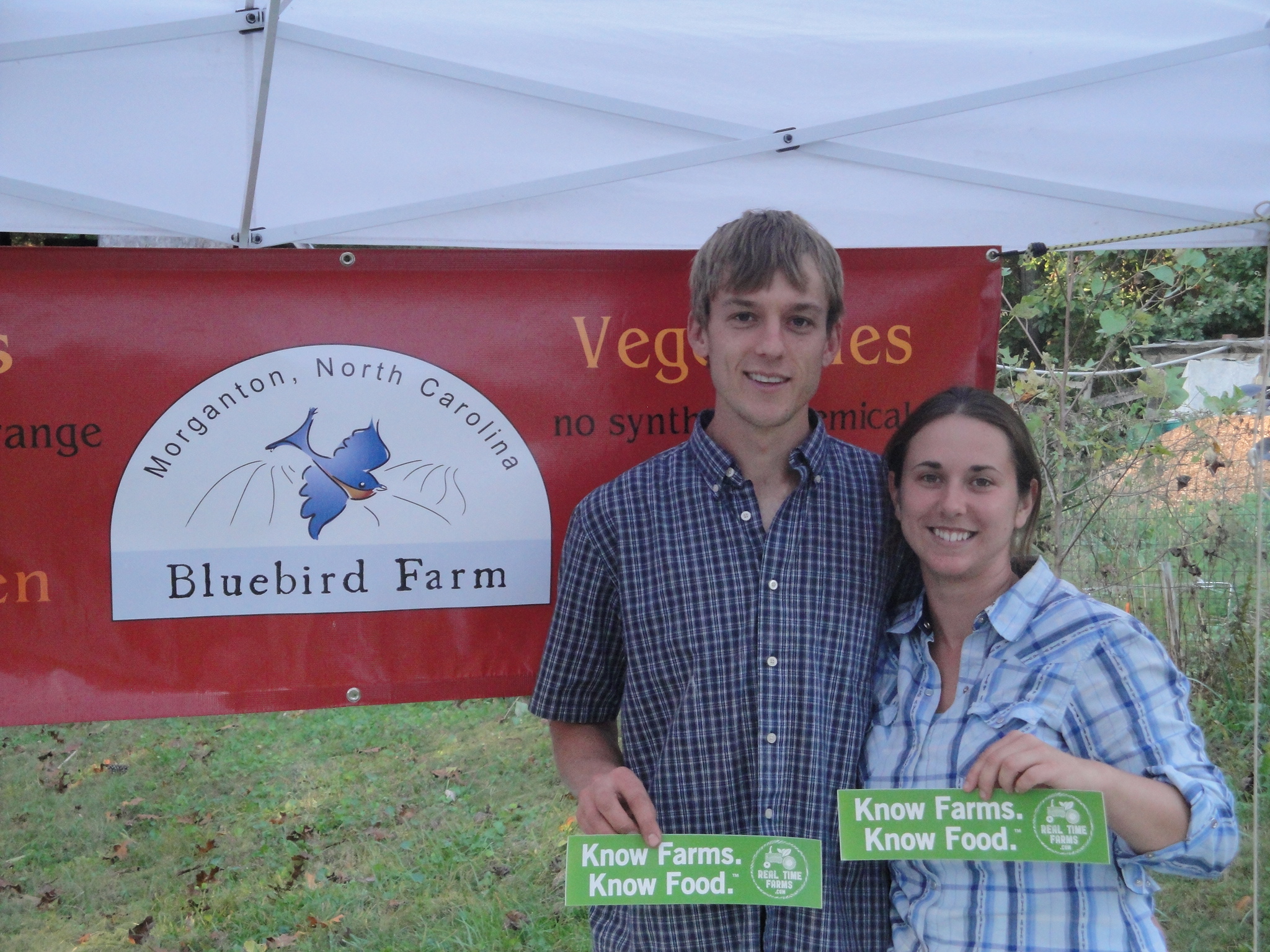
Meet life partners William Lyons and Marie Williamson, whose interests in the aforementioned fields led them to farming.

When asked why William wanted to farm, he explains that as a high school student, “he thought it would be fun.” After working on a farm in high school, he was attracted to Warren Wilson College’s (WWC) garden and agriculture program.  That is where he met Marie, who at one time intended to become a veterinarian.  After working with the farm at WWC, Marie soon realized that vets spend a significant amount of time with sick animals and she wanted to spend hers with happy and healthy ones. Fast forwarding to the present, farmers William and Marie now run Bluebird Farm, complete with a variety of happy, healthy animals and plants, in Morganton, North Carolina.

Both lovers of the natural sciences, William explains that, “one reason farming is so exciting for us is because of that intersection of keeping healthy animals and keeping healthy plants.  To do that we get to think about the ecology and biology classes that we liked so much […] and we start thinking about farm ecosystems.”

The cross-section of food, people, and land management, all collided into a beautiful symphony the day of my farm visit, complete with their annual farm day filled with family, farm tours, and food samples.

On the farm tour, we were introduced to the ‘Pig Garden.’  A product of the farm’s grazing style. William explains to the tour group that the farm’s grazing methods “mimic natural patterns, of grass herds – deer, elk, bison, wildebeest, whatever- [which] come through [an area] all packed together, mow everything down and leave, [to be] accompanied by a bird, then they all leave, and then they don’t come back for [a series of months].  At that time the grass is fully recovered and any parasites they had they are not picking back up immediately.  The bird, other animal combo helps because most internal parasites are creature specific.”

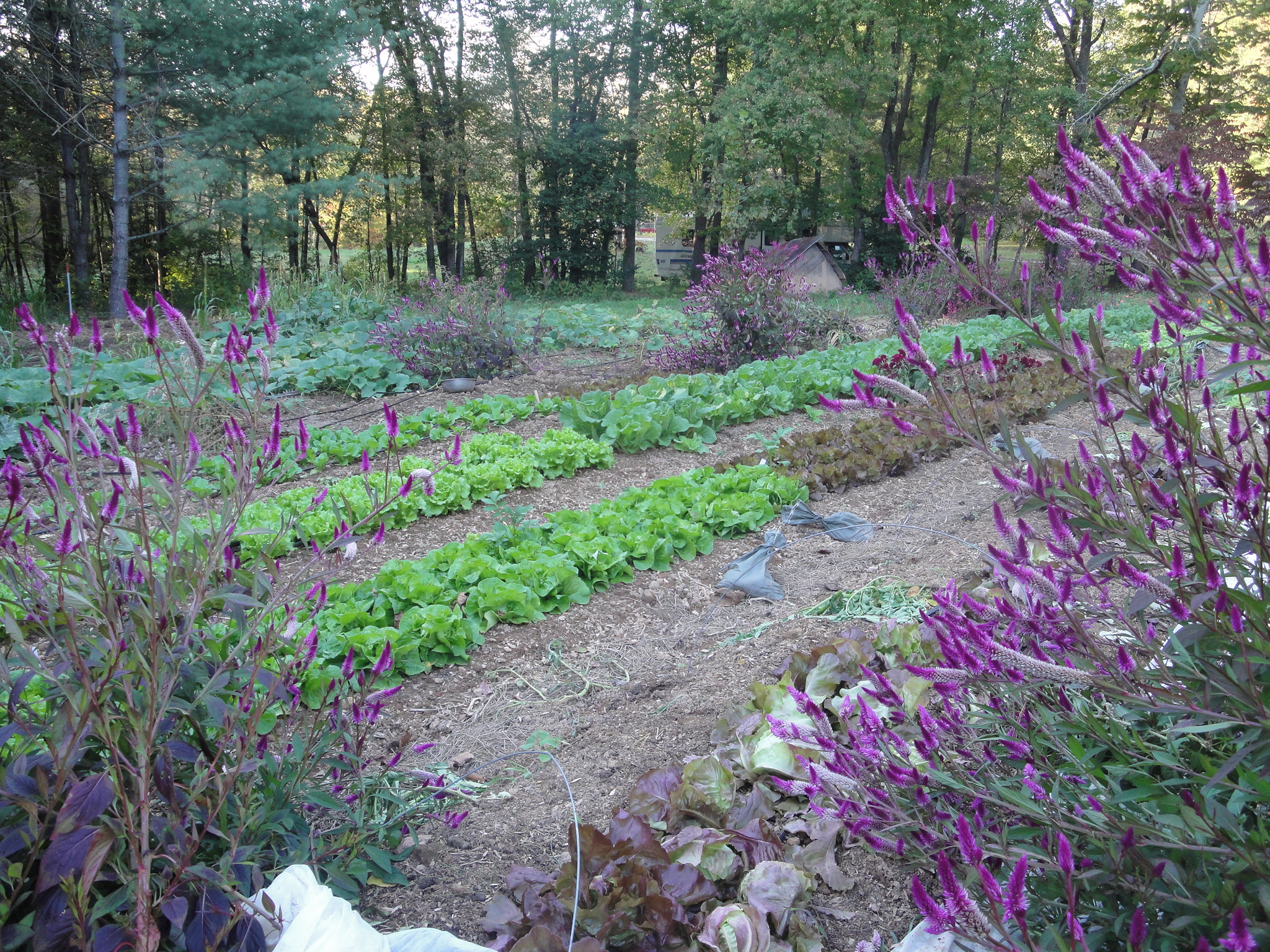
The current Pig Garden, the result of this mimicked ecological process, is located on an area once occupied by pigs and chickens, where you will now find a marvelous field of head lettuce, swiss chard, kale, and chinese cabbage.  Not only does their field act as an ecological wonder, it doubles as a classroom. William explains that “[they] both like eating, and that eating is connected with human culture, and we both like anthropology […] It is fun how those all come together with food and land management and all that.”  With that, we find ourselves on the next stop of the tour, a future Pig Garden.  Here, children visiting the farm toss seeds to the pigs to aid in the rotation process.  Farther along in our visit, children help to round-up mischievous chickens and collect farm fresh eggs.

It is about more than just land management at Bluebird Farm. They take the time to teach children and their customers about their practices.  William and Marie afford individuals the opportunity to make a strong connection with the food they eat. They do this not only by offering farm tours, but by keeping a farm blog, providing customers with recipes on their website, and showing up to sell at weekly markets in the area.

With the average age of farmers hovering around 57 and with farms becoming increasingly mechanized and lacking in biodiversity, Marie and William are indeed an anomaly.  They are truly a renaissance couple helping to create a more transparent food system one visitor at a time!

Callie Herron

Fall 2011 North Carolina Food Warrior

Posted in Food Warrior Interns, On the Farm | Tagged , , , , , | 1 Comment

Home Economics: Planting Sunflowers is a Good Investment

Sunflower sprouts are delicious, nutty, and full of flavor – you can sauté them with soy sauce and toasted sesame oil, put them fresh in salad, or put them in a sandwich. You can make butter out of the seeds, eat them roasted and salted, or turn them into bird food. According to the National Sunflower Association, the sunflower market was valued at $450 million dollars in 2009.

Borden - drying sunflower head with seeds

I just wish I didn’t have to wait 12 months to grow more after realizing the economic benefits of growing your own. I adore sunflower sprouts and I could have grown enough seeds to keep me in sprouts till next harvest, if I had only known.

It costs $3 for a serving of about 30 sprouts at the farmers market, or $.10 per sprout.

One sunflower head, if you are growing a large one like the Mammoth varietal, can provide 200-400 seeds – which can all be sprouted. A packet of 20 Mammoth sunflower seeds costs $3.95 (let us say $4). Each seed therefore costs $4/20 = $0.20.

That one seed can grow to a giant sunflower head which can yield you ~300 seeds when you harvest it. You can sprout those seeds yourself, ending up with 300 sprouts, which at the market would cost you $.10 per sprout, or $30.

Your $0.20 has become $30 worth of sprouts, with a little time, patience, and watering. Therefore, your profit from that one seed could be $29.80, which is a 14900% return.

That is an incredible return on your cost.

Borden - sunflower head

Living life with the seasons is a powerful antidote to the culture of immediate gratification, and for the most part I am content to wait – but sometimes, when I think of all of the sunflowers I could have grown this year, that it is going to take 12 months to get here again, had I only known about this in May, that I really love sunflower sprouts – I am not content to wait.

Chopstick Crazed,

Corinna

(reposted from annarbor.com)

Posted in On the Farm | Tagged , , , | 1 Comment

Shirley Thompson of Hawaii Brings Home the Gold: Our Food Day Winner

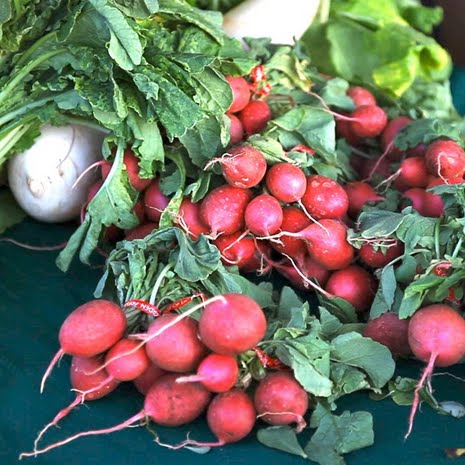
We have a winner! Congrats to Shirley Thompson of Hawaii for her radishes photo documenting the Kaka‘ako Makai Community Cultural Marketplace.

Shirley’s photo was the top photo of those posted on the site yesterday, Food Day 2011. Since launch in April 2010, there have been 25,000+ photos submitted to the site. Cheers to everyone who brings Real Time Farms to life!

Posted in Aw Snaps! (our best photos) | Tagged , , , , , | Leave a comment

Shine a Light on Our Food System. Take Pics. Post. Win.

It’s FOOD DAY 2012! Shed light on our food system!

Drumroll please……here is a heat map of farmers, food artisans, and food distributors on Real Time Farms (thanks to you!). As you know Real Time Farms is powered by the people. We can all put our local farms and food artisans on the map!

What is Food Day and how can I help you might ask?

Food Day 2012 Plan for Awesomeness:                                                                                           1. Visit your local farmers market or farm.                                                                                     2. Fill your bellies with insane goodness.                                                                                       3. Take pics while you’re there.                                                                                                         4. Get home. Post them to Real Time Farms.                                                                                 5. Cook with friends and family. Fill your belly again (note: now it’s double insane                   goodness) and smile knowing you’ve put your farmer on the map.

“Sites like this are what keep us going when we don’t have time to market our farm ourselves.” Karen Warner, Farmer

All Day today, Monday Oct. 24th, as photos stream in, we’ll pick the best. Best Photo WINS 100% Organic Cotton American Apparel Real Time Farms T-shirt!

Posted in Messages From the Founders | Tagged , , | Leave a comment

The Custom Dairy Fairy Works Magic on Traditional Ice Cream Sandwiches

This post is from one of the interns in the Real Time Farms Food Warrior Fall Internship Program. These interns are in Asheville, Austin, Nashville, Portland and San Francisco, collecting data, pictures, and video on the growing practices of our nation’s farms, gathering food artisans’ stories, and documenting farmers markets. We all deserve to know where our food comes from!

Andrea and Bruce Bowers in the kitchen

When you hear the phrase “Snappy Goat,” a tasty ice cream sandwich may not be the first thing that comes to mind. But for Andrea Bowers, co-owner of The Custom Dairy Fairy with her husband Bruce, the Snappy Goat is the foundation upon which they built their ice cream business.

During a trip to San Francisco last December, the couple visited the Ferry Building to grab a few goodies. They picked up prosciutto, goat cheese, wine, and some unassuming gingersnaps from Miette. Upon returning to the hotel and feasting on the assortment of snacks, Bruce bit into a gingersnap and proclaimed, “Wow, this would make a great ice cream sandwich.”

And so The Custom Dairy Fairy was born. Andrea and Bruce, both pastry chefs, decided to turn their love for making ice cream into a business. Andrea took a food entrepreneurship class at Portland Community College where she developed the concept, packaging, and distribution strategy for her new venture. Through a unique partnership with Portland’s Culinary Workshop, Andrea is able to use their commercial kitchen to create all of the tasty treats. Consisting of lemon goat cheese ice cream held in place by two gingersnap pie crusts, the Snappy Goat is their signature sandwich.

The Snappy Goat and other irresistible ice cream sandwiches

Their artisanal ice creams begin with a base from Sunshine Dairy, a local Portland business that sources fresh milk from family farms in the area. Andrea successfully worked with them to remove corn syrup from their product, so she now has a clean, blank canvas to infuse with her creative flavors. At a recent farmers market, offerings included Bourbon Hazelnut, Caramel Corn, Berry Tarragon, and Basil Mint, to name a few. Andrea gets inspiration from whatever she can find at her neighbors’ stalls at the markets. Sometimes she doesn’t even have to travel that far to be inspired: “I get basil from my own backyard,” she says.

Showing off the reach-in cooler-turned-smoker contraption

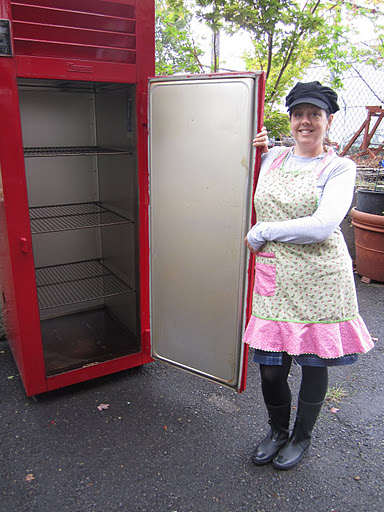
As the leaves change and the weather gets cooler, Andrea has an enticing lineup of fall flavors. During my October visit, she showed off her smoked caramel, cinnamon coffee toffee, and pumpkin chai ice creams. In a world where salty caramel has become increasingly prevalent (and I’m not complaining), smoked caramel offers a pleasant twist. Andrea achieves the “smoked” part of her caramel with a fire truck red smoker that her friends at Portland’s Culinary Workshop fashioned out of an old reach-in cooler.

If your mouth is watering by now (I know mine is), you can find The Custom Dairy Fairy at Milwaukie Sunday Farmers Market and St. Johns Farmers Market.  “There is no scoop shop in the plans as of yet,” explains Andrea, but you can bet that when people start catching onto these delectable treats, she may have to tweak her business plan.

Gina Lorubbio

Fall 2011 Portland Food Warrior

Posted in Food Warrior Interns, In the Pantry (food artisans) | Tagged , , , , , , , , | Leave a comment

The Secret Life of a Beekeeper

This post is from one of the interns in the Real Time Farms Food Warrior Fall Internship Program. These interns are in Asheville, Austin, Nashville, Portland and San Francisco, collecting data, pictures, and video on the growing practices of our nation’s farms, gathering food artisans’ stories, and documenting farmers markets. We all deserve to know where our food comes from!

“You either have to be crazy or have been dropped on your head to be a bee farmer.” Mark, of Nature’s Best Oregon Honey, has farmed bees in the north-west hills of Portland since the 70’s, and is a self-confessed member of the latter group. Mark maintains that all bee farmers are crazy, because there’s no money to be made. It is clearly a labor born of love.  Among this group of bee berserkers is an even smaller sub-group who try to be organic beekeepers. For these outliers the reward is the craft because, Mark explains, there are nearly insurmountable hurdles to certification.

Honeybee frame--each comb represents a fertilized bee waiting to hatch

What money there is in beekeeping comes from unexpected places. Honey, the amber gold that we associate as the obvious engine for the bee market, is actually just a precious byproduct. Apiaries (bee farms) are like traveling circuses; apiarists (beekeepers) travel from farm to farm letting the bees perform their pollinating act. Herein lies the first hurdle to becoming an organic beekeeper. Beekeepers are inextricably bound to farmers for their livelihoods and are at the whims and exigencies of the conventional farming market.  Mark is forced to follow the money and often it leads him to crops raised unsustainably. The organic infrastructure isn’t robust enough to allow apiarists to deal exclusively with organic farmers. To complicate matters further, bees can travel up to three miles from their hives, so in order to claim organic status with any certainty all farms within three miles have to be certified organic as well.

Mark removes a honeycomb frame from an active hive

Mark doesn’t outsource any of his labor, unless it’s to his neighbors or volunteers from their church group. I was given the grand tour, in reverse, starting with the refining of honey. Mark removes the honeycomb frames from the hives and runs them through a mill to remove a waxy cap that bees produce to help store the honey. Then the frames are hung, run through a centrifuge and the honey is pumped into large tanks to settle before bottling.

Seeing all this in September one doesn’t have an inkling of the mountain of work it took to get us here. Work for both Mark and the bees, begins in January. Every year Mark, along with at least half of all beekeepers in the U.S., caravans to Southern California for the single largest pollinating event of the year: the almond orchards. Nearly 1.7 million bee colonies are needed to pollinate the entire almond crop (each colony is roughly 40,000 bees). There are just over 2 million hives in the US.  The rest of Mark’s work year is dedicated to following crops as they bloom.  When Mark’s bees aren’t busy pollinating the almonds, they pollinate alfalfa, clover, and carrot seed. These different plants lend different flavor bouquets to his honey.

The honey mill that planes off the waxy cap on the honeycomb

Mark doesn’t have an inflated sense of his role as an apiarist, but it’s obvious by the end of the tour that the current food infrastructure is entirely contingent upon the honeybee. Large monoculture crops, like the California almonds, cannot survive without them. If the almonds were left to our native pollinators (such as moths) roughly 70% of the crop would not bloom. In the hierarchy of pollinators, we’ve artificially placed honeybees at the top. This shaky hegemony has placed our system at risk. The current agricultural infrastructure is further compromised by the Colony Collapse Disorder, a mysterious species wide disease. Every year Mark sees at least 30% of his bee population die. This statistic mirrors the national average. Bees have never suffered from our indifference, but are now suffering under our acute attention.

Mark sees the Do-It-Yourself (DIY) beekeeping movement as potential redemption. Portland is fertile ground for a rich backyard beekeeping movement. Mark has tended bees long enough to know that this current keen interest is an iteration of a cycle that’s been around since the 70’s. The diehard apiarists that survived the ebbs and flows of fads all have grey hair. These small time apiarists often abide by sustainable growing practices. Hopefully they will have enough power to drive and shape the market. Mark is a proponent of the DIY movement, because any motion big or small to raise bees is a sharpening of a tool to help combat Colony Collapse Disorder.

Mark receives one sting, a sacrifice for our interview

After talking to Mark the act of buying honey has taken on new meaning. Before, buying honey was just a need for sweetener. Now I feel as if I am playing a small part in sustaining our food system. Mark no longer wears a HAZMAT suit while working with his bees; that fear of being stung has long subsided. The fear that apiarists are awakening to is Colony Collapse Disorder. Many believe a move towards organic and away from the monoculture is the solution.  Because apiaries are auxiliary to the actual production of food, it is hard for them to be the drivers of an organic movement. They can be a pressure point, but can’t change the system. So buy honey!

Good Grubbing,

Ava Mikolavich
2011 Fall Portland Food Warrior

Posted in Food Warrior Interns, In the Pantry (food artisans) | Tagged , , , , , , | Leave a comment

Have You Tried: Making Sushi?

I recently took a raw food “cooking” class (or raw food construction class) at Raw Gourmets International in Chicago. We spent the whole day pureeing, chopping, and dicing various vegetables and nuts to make ourselves lunch and dinner. In addition to changing the way I use my food processor, I have become emboldened to attempt previously out of reach culinary arts thanks to the class.

Borden - Nut Quinoa Sushi

As such ~ sushi. Whether it be the dexterous challenge involved in using chopsticks, the otherworldliness of seaweed, or the addictive salty dark depths of soysauce ~ sushi is my ultimate night out and one I thought beyond my skill at home.

Thanks to the class’s gentle nudge, sushimaki has been rolling off my counter.

In the raw food class we learned a version of “tuna salad” to go into the sushi roll. “Tuna salad” involved pureed soaked nuts as the “meat” to which we added minced celery, red onion, parsley, dill, sea salt, and kelp. I have simplified the “tuna salad” into simply pureeing soaked nuts.

The rationale behind soaking nuts before you eat them is much the same as soaking seeds before you plant them in the earth. According to my class notes, “the water neutralizes the enzyme inhibitors allowing nuts and seeds to be more easily digested.” Making a raw nut puree is literally just that, soaking the nuts overnight, and then pureeing them into a white mash in the blender.

Here is the recipe for this very easy, relatively quick (the quinoa takes 10 minutes to cook), and delicious sushi roll (don’t be deterred if you do not have a bamboo mat, I have made almost 15 rolls without the use of one).

Borden - flat sushi before rolling

• 3 sheets nori seeweed
• 3 teaspoons miso paste (you can find soy, barley, and adzuki in stores – I prefer the adzuki bean)
• 1 ½ cup cooked quinoa (either red or white)
• 1 cup nut puree (You can add a garlic clove or ginger root for an extra kick as it blends. I like Brazil nuts and Macadamia nuts.)
• 2 cups sprouts (alfalfa, radish, or broccoli all work well)
• thinly sliced turnip and beet pickles from The Brinery

1. Lay one sheet of nori shiny side down, using the back of a teaspoon spread the miso paste on a third of the nori sheet (closest to you).
2. Layer quinoa, nut puree, sprouts, and pickles onto the area with the miso paste.
3. Tucking the edge in as you press down with your fingers, roll the nori sheet away from you tightly. You can seal the edge of the nori roll with a little water.
4. Cut the roll into 8 pieces.
5. Repeat with remaining nori sheets.
6. Serve with tamari or other dipping sauce.

This is what I learned from my attempts these past months.

• A freshly honed knife is required so that the roll does not collapse under the pressure and spout out the ends.
• Make sure the quinoa has absorbed all of the cooking liquid, or it will soften the nori to the point of collapse.
• The nori, nuts, pickles, and sprouts are all raw and thus full of digestive enzymes. Quinoa is a great source of protein. This is a great winter treat of color and vibrancy.
• Make a few rolls for your own consumption to gain proficiency with the technique before sharing this amazing treat with your friends.

Enjoy!

Chopstick Crazed,

Corinna

(reposted from annarbor.com)

Posted in In the Kitchen (recipes & more) | Tagged , , | 2 Comments

Missionary Chocolates: Truffles Changing Medicine

This post is from one of the interns in the Real Time Farms Food Warrior Fall Internship Program. These interns are in Asheville, Austin, Nashville, Portland and San Francisco, collecting data, pictures, and video on the growing practices of our nation’s farms, gathering food artisans’ stories, and documenting farmers markets. We all deserve to know where our food comes from!

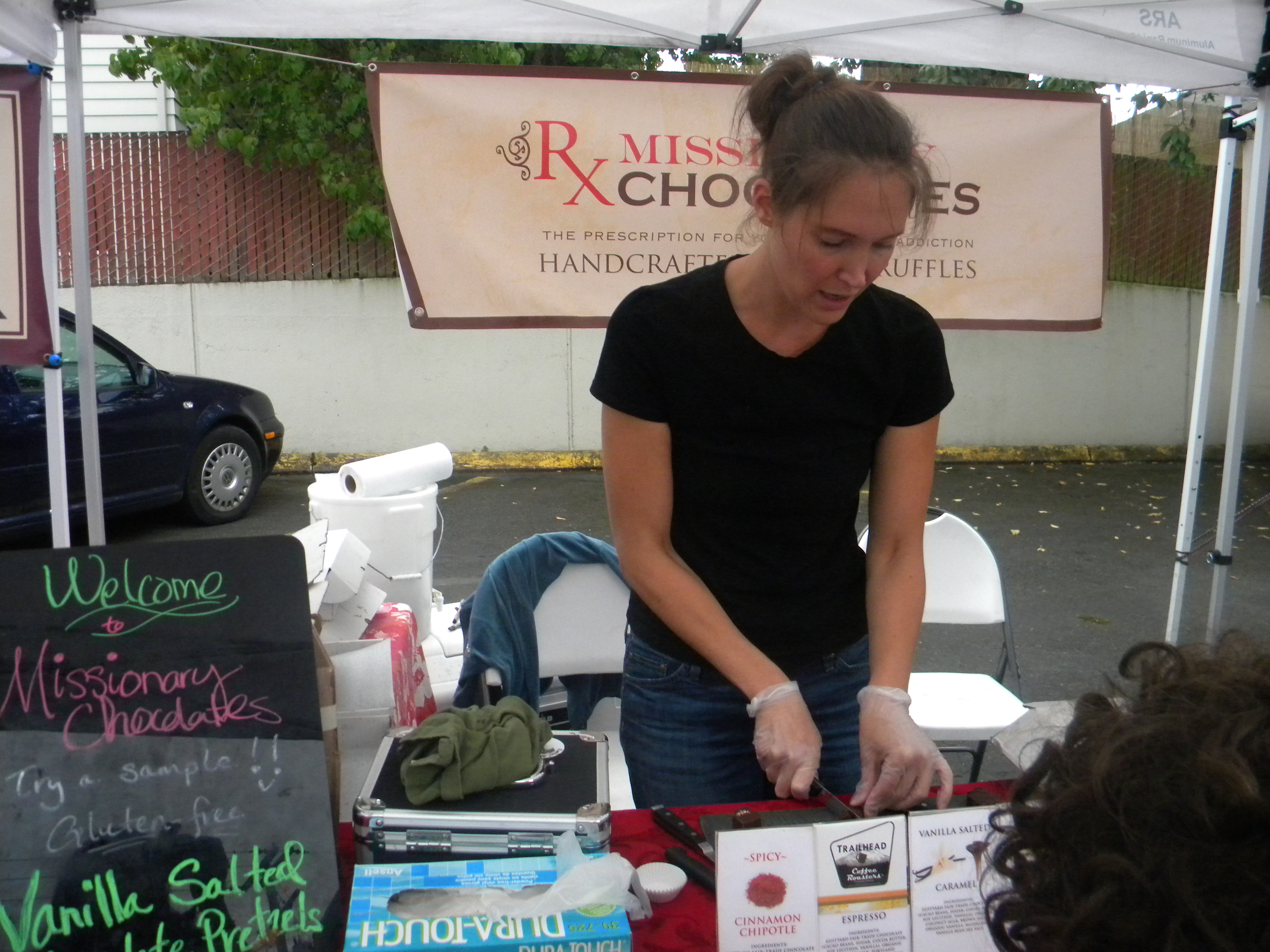
Melissa Berry, ND, sampling chocolates at Buckman Farmers Market

blank
Melissa Berry never meant to become a chocolatier.  But when her mother, a life-long vegan who cut out gluten, contracted lyme disease, Melissa wanted to do something special for her. She gathered a stack of books from the library and set to concocting the perfect vegan, gluten-free truffle just in time for Christmas.  Then she filled a suitcase with chocolates and headed down to California.

blank

“A lot of them were terrible,” Melissa said, laughing. “But the truffles made with coconut milk seemed to work.  At least, everyone ate them.”

Award-winning Lemon Meyer Explosion Truffles

Working out of a her apartment kitchen in Portland, Oregon, Melissa followed the coconut milk, the rich, fatty liquid that soaked up flavors without overwhelming the taste of dark chocolate.  Soon her ganache was creamy, smooth, and perfect.  Her friends – and her mother – couldn’t get enough of it.  Encouraged by their enthusiasm, Melissa walked into Food Front Co-op with her baby on her back and a tray of truffles. In February 2008, Missionary Chocolates (named after her family’s Seventh Day Adventist missionary roots) appeared in stores.  Only eight months later, her Lemon Meyer truffle won the #1 People’s Choice award for best chocolate at the Northwest Chocolate Festival. Suddenly, Melissa was a chocolatier – and a great one.

While Melissa was discovering her talent for chocolate, she was pursuing a bigger dream. A single mom, she was working her way through medical school, studying to be a Naturopath.  Now a certified ND, Melissa crafts and sells fine vegan, gluten-free truffles not just to bring more chocolate into the world, but also to advance her dream of changing medicine.

“I want to increases access to various types of medicine.  I want people to be able to seek treatment for their whole bodies in one place,” she said.  She recognizes the body as one unified entity that requires complex attention.  Melissa’s goal is to use Missionary Chocolates to fund the establishment of a complementary health center in Portland. Every truffle is a step towards that dream.

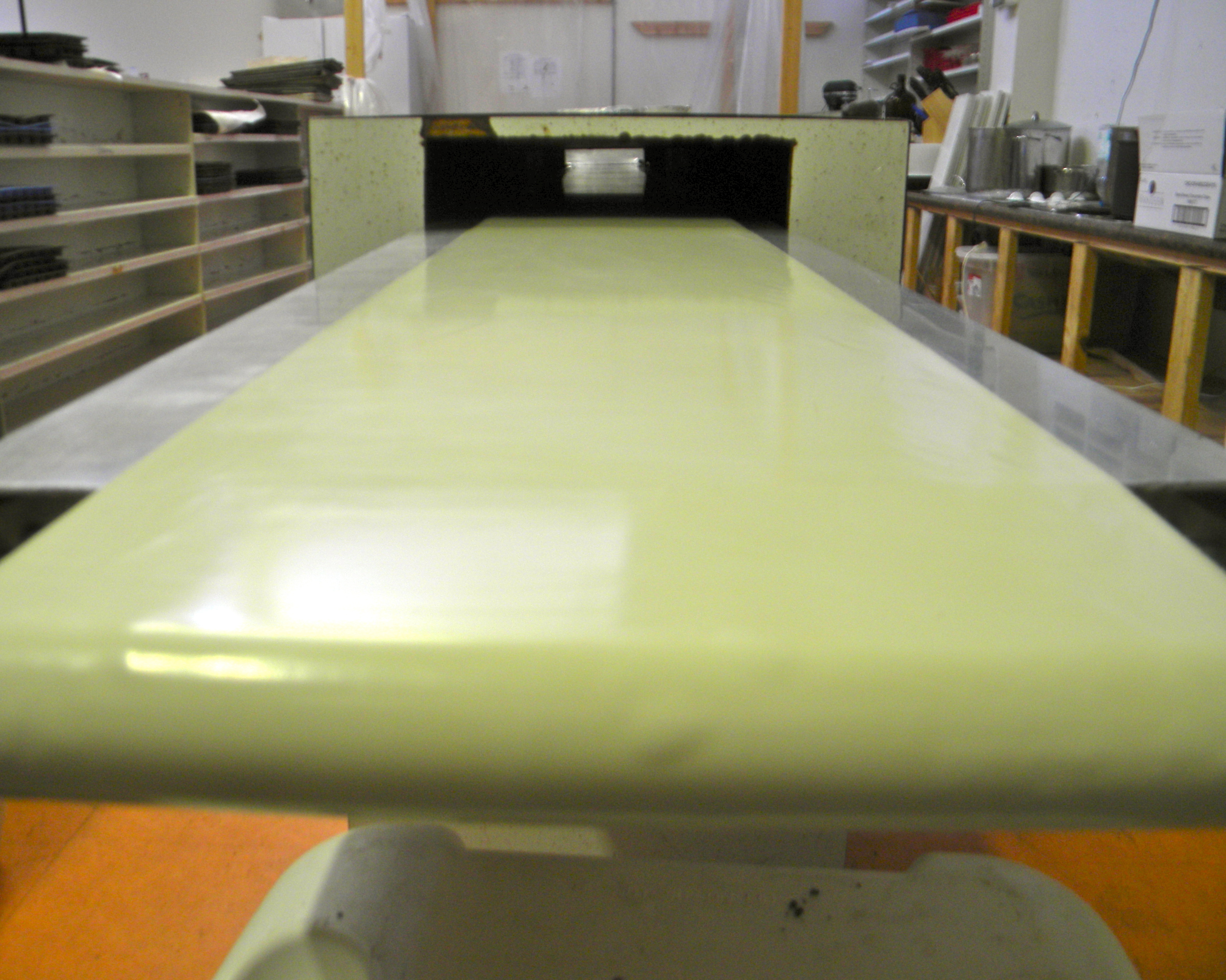
Chocolate Machine

For now, Melissa dedicates herself to making the most delicious, most wholesome chocolates she can.  Each truffle is a three-day process of perfection, from infusing the coconut milk to taking the finished product off the conveyor belt of her single Hillard chocolate machine.  She sources most of her ingredients from Earthly Gourmet, a vegan/gluten-free supplier based in Oregon and Washington.  She infuses her coconut milk with pure ingredients: lemon oil, Trailhead Roasters coffee, pumpkin puree, peppermint, and more.  She takes care not to use nuts on her chocolate production line, and every single truffle is vegan and gluten-free.

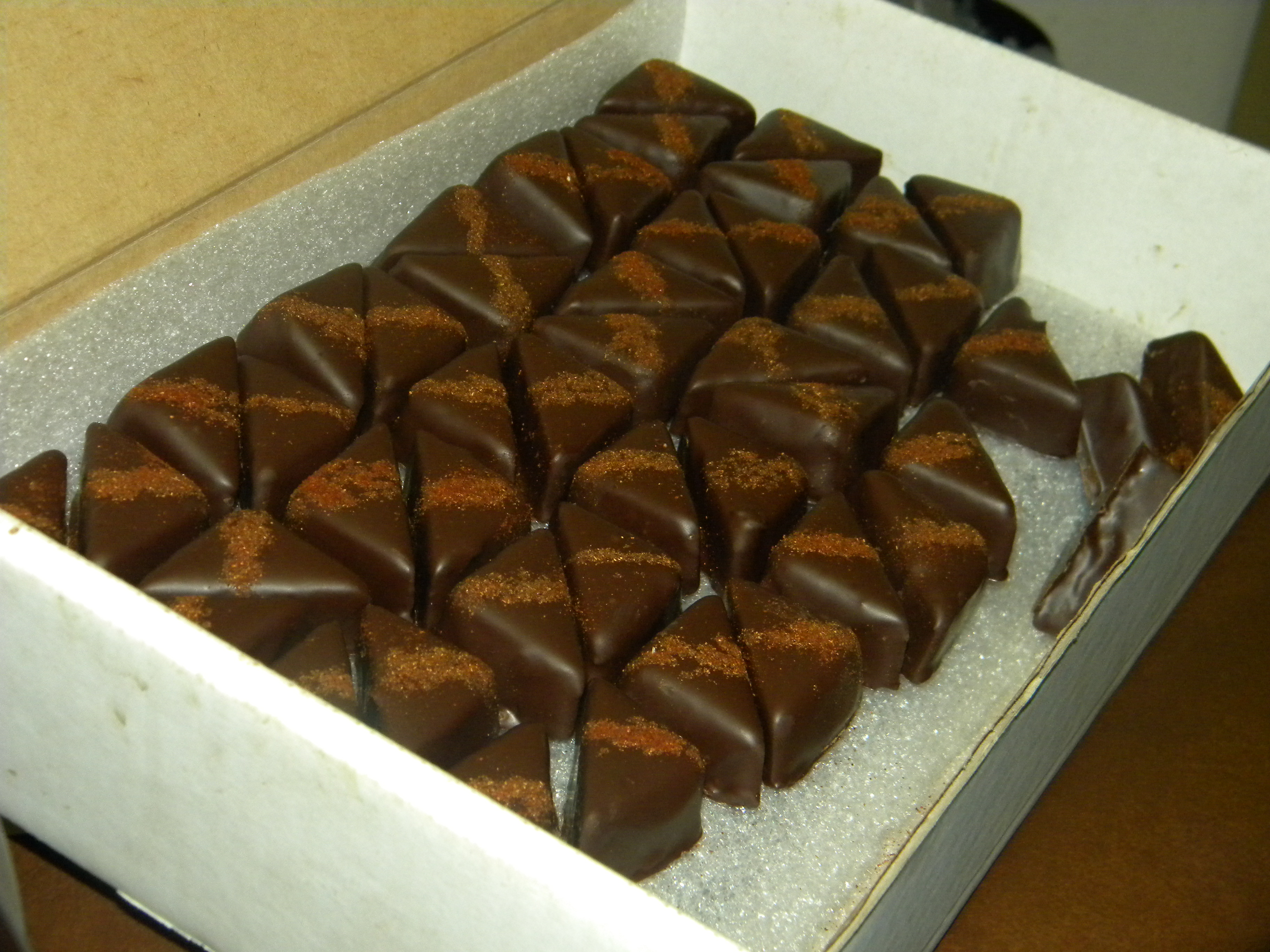
Spicy Cinnamon Chipotle

Four years after it began, Missionary Chocolates is now a thriving small business run by Melissa and her sister, Vanessa, and supported by volunteers.  At farmers markets, their stall is surrounded by curious chocolate lovers, dedicated fans, and children with their weekly allowance.  Her flavors change seasonally (Pumpkin Pie is coming up!), but include Vanilla Salted Caramel, Dark Chocolate Delight, Trailhead Espresso, Glorious Ginger, Spicy Cinnamon Chipotle, and her award-winning Meyer Lemon Explosion.  She also makes chocolate-covered pretzels.

While Missionary Chocolates currently shares a space with Trailhead Coffee Roasters, they are soon to move to a brand new retail/chocolate crafting space at 2712 NE Glisan (so check their website for information about the grand opening!). There, they will sell other vegan, gluten-free treats like Sift cookies.  Melissa’s hope is to eventually establish a collaborative kitchen there for vegan, gluten-free products.

Melissa found chocolatiering by accident. With her friendly, outgoing nature and her dedication to her dreams, she has worked hard to make Missionary Chocolates what it is today.  Now we have to grab a truffle and watch where she brings it next.

Katie Woods

Fall 2011 Portland Food Warrior

Missionary Chocolates can be found at www.missionarychocolates.com, Living Room Theatres, and various groceries, farmers markets, and restaurants throughout Portland.  Check them out on Real Time Farms.
Posted in Food Warrior Interns, In the Pantry (food artisans) | Tagged , , , , , , , | Leave a comment