Some Like It Hot – Peppers That Is!

This post is from one of the 16 interns in the Real Time Farms Food Warrior Summer Internship Program (our Fall 2011 Food Warriors have started and will be blogging  soon!). These interns collect data, pictures, and video on the growing practices of our nation’s farms, collect food artisans’ stories, and document farmers markets. We all deserve to know where our food comes from!

Last week, my sister’s boyfriend and his friends competed to finish a ‘hellfire burger’ filled with ghost peppers to win a free t-shirt. A burger eating competition may not seem like that big of a deal, but anything that can break a grown man into tears is something to be examined.

Although chili peppers first appeared around 7,000 BC in Mexico, Christopher Columbus did not technically discover them until around 1493. After trying to look for an alternate black pepper, Columbus found a ‘small hot pod’ instead. Since then chili peppers have spread across the world and gained fame for their heat.

The ability for chili peppers to cause a blazing sensation comes from capsaicin. Capsaicin is an insoluble in water, tasteless, odorless compound that gives chili peppers that extra ‘kick.’ The Scoville scale measures the capsaicin content. Pure capsaicin is 15,000,000 Scoville heat units (SHU); jalapeno peppers range from 2,000-8,000 SHU; mild bell peppers are 0 SHU.
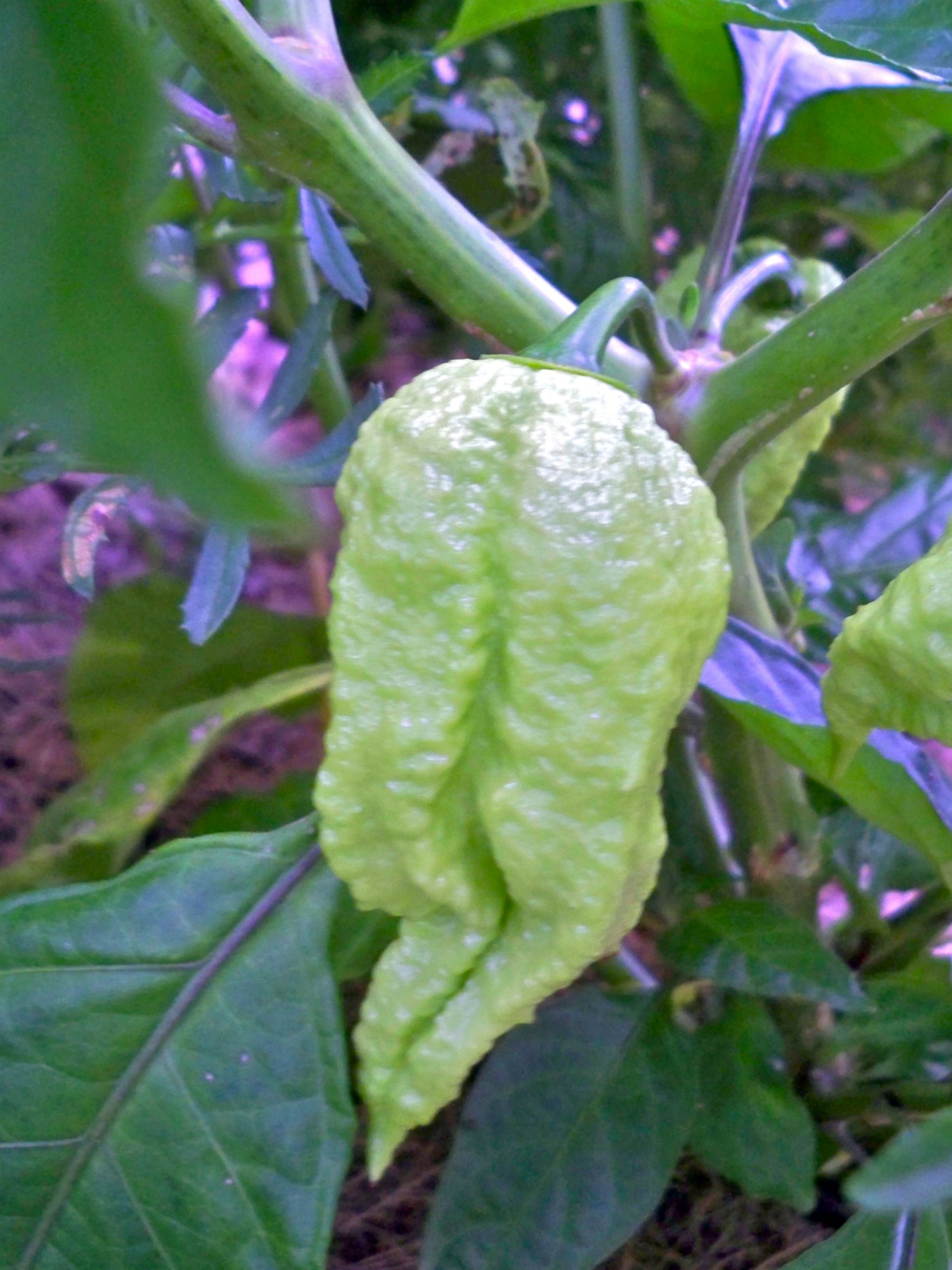
The Bhut Jolokia, commonly called the ‘ghost pepper,’ originated in India and held the title of being the hottest pepper in 2007. Since February of 2011, this record has been overthrown three times. The ghost pepper is 855,000 to 1,041,427 SHU. You must wear gloves to pick up the Bhut Jolokia, if allowed, it will eat through car paint, and yet it is currently only the 4th hottest chili pepper.

blank

In February 2011, the Infinity Chili pepper was hailed the hottest pepper at 1,067,286 SHU. Sadly, for chili breeder Nick Woods of Lincolnshire, England was this victory was short-lived.

Two weeks later on February 25th of this year, the Naga Viper pepper registered at 1,382,118 SHU, scorching the competition. This unique hybrid is a mix of the Naga Morich, the Bhut Jolokia, and the Trinidad Scorpion peppers, created by Gerald Fowler, another Englishmen. Due to the nature of hybrids, and the instability of offspring traits there is yet another hottest pepper.

Since March there has been a new reigning hottest pepper called the Trinidad Scorpion Butch T pepper. Not to be confused with other Trinidad Scorpion peppers, this pepper is a particular strain created by Butch Taylor and measuring at 1,463,700 SHU. However, like other ‘scorpion’ peppers it has the same pointed end resembling a scorpion’s stinger. To touch this pepper you must always wear protective gloves. Also, exposure to the eye or skin near the eyes can cause temporary blindness. A chemical mask or body suit must be used to block off fumes in the cooking process.

To most, this obsession with creating a pepper so hot it could cause blindness may seem absurd. To others this mania is a searing passion. As Christian Flickinger, of the Garden Hoard, said, “I love spicy foods…and when I found out there were peppers that were so hot they were hard to eat, I had to grow them.” Only chili peppers contain the capsaicin needed to give that extra piquancy. Besides making peppers sweltering, capsaicin offers health benefits. It is effective treatment for inflammation, reduces risk of heart attacks, clears blocked nose and congested lungs, and prevents stomach ulcers by killing bacteria. All peppers are good sources of Vitamin A and Vitamin C that work to lower blood pressure.

You can pick up these peppers at local farmer’s markets. To find out which ones in particular check out on Real Time Farms and look for vendors with pictures featuring these unique hot creations. After buying these peppers just remember that water is of no use to quenching the burning heat a chili pepper provides. Capsaicin is insoluble in water after all. On the other hand, consumption of dairy products (the more fat the better) is the best suggestion.  Keep in mind that avoiding seeds will not prevent the heat. Capsaicin is in the placenta of the pepper that attaches the seeds to the pod. For those of you that like it hot, the smaller and thinner the pepper, the hotter it is!

See you in the patch,

Susie Zammit

Summer 2011 Michigan Food Warrior

Posted in Food Warrior Interns, In the Kitchen (recipes & more) | Tagged , , , , , , , | Leave a comment

A visit to the Amish collective Path Valley Farms

Last week I visited three of the 20 Amish farms that comprise the Path Valley Farms collective, serving nearly 60 DC restaurants. In this enchanting place food is grown by those who ride in buggies to serve the needs of customers who travel by jets.

One gets the sense travelers seldom visit the 2-3 mile wide valley of farmland rolling and undulating between long blue gray ranges, 100 miles west of the touristed trails of the Lancaster Pennsylvania Amish. The farms of Path Valley thrive along a former Indian trail. I found Path Valley human sized (as opposed to outer worldly like the Grand Canyon), cradled within the arms of the soft hills.

Katie Joynt manages the collective for the growers. She took me on the tour and explained the logistics of this remarkable organization.

Every January a planning meeting takes place where several things are decided. A new collective board leadership is voted in and commitment sheets are filled out – a page of what the farmer plans on growing for the season. Joynt checks these sheets and ensures there is a wide variety of produce offered as well as not just one person growing carrots, “to spread the risk.”

In April the delivery goes from once a week to twice a week, Tuesdays and Fridays, and this is how it works. As produce is collected on Monday Joynt receives individual sheets from the 20 growers with what they feel they could harvest that week – 3 pounds of carrots, 9 pounds of kale, 10 pounds of potatoes, etc. Tuesday evening she compiles all of those individual sheets into a comprehensive availability list that she emails out to her list of DC restauranteurs.

Purple and green curly leafed kale, grown by Eli.

Chefs have until Thursday at 10 am to respond with their order. “I get contacted at all hours,” says Joynt with a smile. Restaurant orders are broken down into individual orders for farmers. Thursday at 8 am the farmers call her and again at 12 pm so they can start picking and preparing the produce for collection. (*A small pause here is necessary: Path Valley Farms picks to order, that means the english peas you are eating at Sonoma on Saturday were picked on Thursday afternoon, that is very unusual.*) The produce is all brought to a cooler dock where the individual pickings are then reshuffled into the restaurant orders. By 4 am Friday morning all is complete and a truck with two volunteers heads to DC to drop off the freshly picked vegetables to discerning DC’s restaurants.

Greenhouses made entirely of salvaged wood.

When I asked Joynt about growing practices she says that working with Path Valley is often in addition to the many other enterprises the farmer’s family might be involved in. Therefore, many families choose not to go through the tedious process of becoming certified organic. They do grow using organic practices. The fertilizers and pesticides they use are those that are allowed by organic standards. It is a practical approach that allows a variety of growers to participate instead of just those who can afford the certification process. The co-op welcomes the great-grandmother who sends just a few pounds of okra per week as well as those who send fifty pounds.

Driving around to visit the three farms I received an education in not just the care and the love with which plants were tended, but also a slice of human existence so very different from my own. For example, my lifestyle is “English” and, though politeness dictated an attempt, it was clear that me describing a “blog” or Real Time Farm’s “farm-linked menu” where you “scroll” over items with a “mouse” didn’t work.

I sampled my first fresh gooseberry on a hilltop with Mary – “I feel on top of the world up here.”

I tasted a late season strawberry as Eli, gesturing to his neat 18 inch rows, gave me a strawberry lesson – “Some people want a nice wide row and I don’t like it. I like it like this – because I want that ventilation. If I don’t have ventilation, I have trouble. If I have one thing on that leaf there [he pulls up a leaf with some brown gray spots]– it will just keep growing – if it never dries out the water actually spreads it. That is why I like my wind – I like my wind flowing through there. You see a strawberries worst enemy is itself. It can’t be crowded.”

Path Valley Farms provides vegetables and eggs. The goat milk stays on the farms.

Finally I toured a greenhouse complex with Nancy. She showed me microgreens being grown with the aid of pipes warmed during the winter by a stove that takes “about 70 bundles, maybe 80” of cut wood to help warm the tender shoots. “You could put up your bed in here if you wanted to,” she laughed as she pointed to the cavernous soot filled space inside the stove.

I reluctantly tore myself away from the warm hospitality and kindness of Joynt and the farmers and followed the route the produce takes to feed Washington DC restaurants. 120 miles and 2 1/2 hours later I turned off the expressway, and went inside to the televisions, computers, lamps, refrigerator, stove, and microwave – to sit and savor a perfectly ripe watermelon grown with love from Path Valley Farms.

Chopstick Crazed,

Corinna

Posted in On the Farm | Tagged , , , , , , | Leave a comment

You can change what students eat! Celebrate the first National Farm to School Month!

(In the interests of being a good lesson planner, I am going to outline the format of this story so you know what to expect. First I am going to share my personal experiences teaching in a school, then I am going to talk about our first National Farm to School Month, then I am going to talk about what Real Time Farms is doing to help. Here goes!)

My first job was teaching in a Washington DC charter school. By my second year, after the patina of terror and bewilderment wore off, I was able to look up from my classroom (which hadn’t had a fight in months, thank you very much) and begin to pay attention to other things – most notably, the school “food.”

We ate in the biggest space in the school, the auditorium, on long tables with benches that could be folded in half and shoved onto one side for large meetings (when the 320 students would sit on the floor). We did not have a kitchen. The food arrived in big tubs, warmed in metal closets on wheels, served onto paper plates that would be thrown away at the end of breakfast and lunch. I had voted to join the 80% of our students on the subsidized federal meal plan by paying very little (perhaps $60/month?) to eat the same food.

Lunch varied: macaroni and cheese, meat and rice, meat and vegetables, etc. After the first two weeks of serving myself two chunks of nameless meat covered in brown sauce from one tub and perfect orange and white vegetable cubes from another I asked to be given the vegetarian option. Tofu replaced the nameless meat, same sauce. It was edible, mostly monochromatic; none of it was inspiring.

My scalding food memory is wandering among the tables and seeing two bags in front of a 6th grader. One was a bountiful bag of white cheerful marshmallows and one was a bag of glowing orange Cheetos. “What is this?”

“My lunch. Food is gross today.”

“Fair enough, but you can’t eat this. You are having my sandwich.” I marched up to the teacher table, grabbed my sandwich – a testament to my second year energy: whole grain bread, almond butter, and boysenberry jam. I walked over and handed it to the child. “You can’t eat those for lunch, we have a test this afternoon, how are you supposed on concentrate on sugar? I will give these back to you at the end of the day so you can take them home.” I took the offending bags and marched back to the teachers’ table.

A colleague leaned over, “Corinna, you are a moron. He is not going to eat your sandwich. He has never seen anything like it before. You are doing this for nothing. You can’t change what he will eat. Now both of you are going to be hungry.”

“I have nuts and an apple at my desk,” I retorted, suddenly feeling unsure and silly. Sure enough when I peered over at the tables, my sandwich sat untouched, serene in its neglected glory, taunting my idealism.

Our school was in the second story of a rented building in downtown Washington. There was no outside recess. We would take field trips to our closest playground, a 6-block walk under a highway. We had summer school, school on Saturdays, and I received a cell phone where students and parents could call me at all times.

What we did share with many other schools across the country was the “heat n serve” method of feeding our children. Cheaper to purchase warmed food and pay someone to serve from tubs and throw away paper plates and cups than to have a full kitchen. All of the headache of food preparation outsourced: no hassle over finding a vendor, purchasing delays, training chefs, dishwashers breaking, health code checks for ventilation, etc.  And besides, “you can’t change what he will eat.”

First Lady Michelle Obama's Let's Move Campaign is one of the many spotlights shining down on food in schools.

I am thrilled to report, as you probably well know, that in the last 10 years there has been a cosmic shift. In some areas of the country I feel one is tripping over squash vines or the latest greenhouse effort to get to the front door in time for class to begin. Whether driven by concerns about obesity rates, soda in school, or feeding gray cells – concerted efforts are being made to bring a kitchen with fresh food back into the schoolhouse.

Though often food service providers have contractual limits to how much food can be supplied by outside sources. People are working to max out and push against that 10-15% limit, bringing more farm fresh food to feed our future leaders.

This October is our first National Farm to School month – government organizations, nonprofits, chefs, and farmers are all working to highlight this important issue. Take some time to browse around the Farm to School site, it has a list of regional as well as local initiatives you can become involved in.

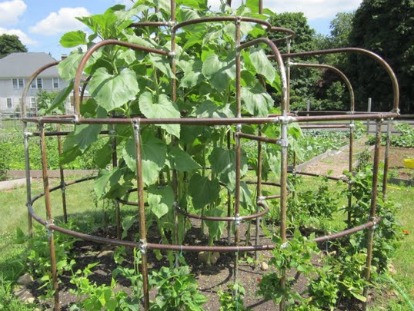
Do you want to donate your time? Do you feel like dressing up as a carrot and talking about the importance of soil? Do you have sunflowers you could bring in to a classroom and have the kids shuck the seeds?

Real Time Farms is working with several schools to highlight and share the stories of the farm fresh ingredients being served. The software we have been using with restaurants nationwide can easily be used with schools as well. One of our many dreams is to help consumers: parents, teachers, and students follow their food from plate to farm, tracing meals in dormatories and K-12 schools nationwide. Working with Food System Economic Partnership (FSEP), our own regional program (findable in the Farm to School database), we are using our software to highlight what the Ann Arbor Public Schools are serving in their lunch rooms. Over the past few years, FSEP and other Farm to School partners have worked hard to get the local produce of Ruhlig Farms and Horkey Brothers farm into the public school system.  The program’s reach has been expanding, from one local food item per week to a fresh local fruit or vegetable three days a week in the months of September and October. See what they are doing on Real Time Farms!

My scalding food memory will always be part of me, but I am happy to report that many people are working together to change “what he will eat.” Working together, we can change what our children are eating.

Chopstick Crazed,

Corinna

Posted in On the Playground (kids) | Tagged , , , , , , | Leave a comment

Check out our new “grow the guide” and “add an eatery” pages!

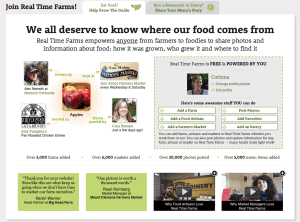
We want to know where our food comes from. The food system, as you well know, is complex. So we want our part of it to be as simple and accessible as possible.

Real Time Farms does two things simultaneously.

#1) We (as in the crowd-sourced we) document farms, artisans, and producers by taking pictures at fields and at farmers markets – to show the story behind the food on your plate. We all contribute to the dynamic database of the people who feed us – we all grow the guide.

#2) We have this rocking tool for eateries – a menu management platform that allows kitchens to use our tools to farm-link individual ingredients and then embed that code onto their own website to show the menu. Instantaneously updated, fully vibrant, no more clunky pdfs, and more economical than paying your own tech department to build the same thing. Some of us work in eateries and want to share our menu’s story.

Thank you everyone for your feedback and utilization of these pages! With your work and help, we are bringing transparency to the food system.

Real Time Farms: Know Where Your Food Comes From.

Posted in Messages From the Founders | Tagged , , | Leave a comment

Kale Chips are Sublime

Last season, I was tired of kale. Tired of sautéing leaves, tired of putting green stalks in soup, tired of the dense chewiness, tired of hearing how good it is for me (high in flavonoids, blah blah). So, come late last October, I choked down the rest of the leaves, relieved to be finished with my duty for the season.

Borden - kale chips

A farmer friend of mine told me kale would survive the winter and come back hardy and healthy in the spring if I cut off the dense stalk right at ground level. He was right. We have several thriving kale plants from last year’s stalk.

Unfortunately, the passing of months did not diminish my kale fatigue and I have not harvested much of any of this year’s leaves.

Yet here we are again, a new October, and I knew I needed something new to try to help me take my kale medicine before the frost.

So I tried a variant on a kale chips recipe I found in the world of dehydrators/raw food. I can honestly say that it was the closest I have ever come to eating a plate of food like an 18-year-old-boy eating a pizza (there was no chewing involved). I inhaled these delicate green chips.

Kale chips are crunchy, intensely subtle, salty, warm and wonderful. There is not any of the bitter flavor associated with kale when prepared this way. As an even better bonus the chips are super fast and easy.

When I did a bit more research I learned that you can bake kale chips in your oven for those who don’t have a dehydrator. Instead of dehydrating for two to three hours at 95 degrees F, you can pop them on a baking sheet for 20 minutes at 300 degrees F (or until crisp).

Here is the recipe I used for my chips.

• Cut four leaves from plant.

• Remove stem and cut into large pieces.

• Toss in a bowl with 2 tablespoons apple cider vinegar, 1 tablespoon olive oil and sea salt.

• Let sit for 10 minutes to wilt a bit from the liquid (one recipe I found said to wait an hour)

• Place in the dehydrator/baking sheet.

• When they are crispy and warm, they are finished.

• Devour them as fast as you can before your friends learn how good they are.

(I will end with a thank you to the earlier maligned plant.)

Oh kale, of cruciferous and flavonoid fame, thank you for being such a delicious chip. You pulled me in with your sturdy frame and healthy fronds, and though I strayed from eating your flesh, I am once again pulled back into the fold of loving you — with your sea salt, oil warmth beguiling me in. All hail kale!

Chopstick Crazed,

Corinna

(reposted from annarbor.com)

Posted in In the Kitchen (recipes & more) | Tagged , , , , | 1 Comment

Drake Family Farms: Where Every Goat Has a Name

This post is from one of the 16 interns in the Real Time Farms Food Warrior Summer Internship Program (our Fall 2011 Food Warriors have started and will be blogging  soon!). These interns collect data, pictures, and video on the growing practices of our nation’s farms, collect food artisans’ stories, and document farmers markets. We all deserve to know where our food comes from!

In Southern California “local” dairy generally means milk and cheese from central California – a good 400 – 500 miles from Los Angeles.  As a someone who tries to eat sustainably which, in large part, includes foods that travel a minimum amount from field to plate I find the lack of local dairy to be quite limiting.  Happily, while visiting the Altadena Urban Farmers Market this spring I came upon a small table sampling Drake Family Farms goat cheese and was surprised to discover that Drake cheese comes fresh from Ontario, California – a mere 40 miles from Los Angeles.

I recently had the privilege of visiting Drake Family Farms and learned more about truly local Southern California dairy.  As you exit the freeway in Ontario you find it hard to believe that milk and cheese could be just a few miles distant.  You are immediately confronted by the sight of fields; not of animals, but of homes.  The suburban landscape gives way to a rather odd mix of a feed store interspersed with more new tract homes, a barren field of cattle, and a strip mall of fast food joints.  And then suddenly there is a lush green lawn, a grouping of barns, and the sight of goats.

Drake Family Farms-Southern California is a newborn in the California farmscape, but has old roots.  Dan Drake, a practicing veterinarian grew up on his family’s century old goat farm in Utah.  After graduating from UC Davis and opening a veterinary practice in Southern California Dan became increasingly dissatisfied with the lack of good local dairy products in the region and decided to take the plunge of starting his own farm.   Drake Family Farms began operations on September 19, 2010 with an initial goat herd of 80 animals moved from his family’s Utah farm to Southern California.  With additional moves and births the herd is now up to approximately 200 goats.  There are room for quite a few more on the 10 acre property although Dan says that he wouldn’t feel comfortable going above about 400 goats given the quality of life that he wants to give them.

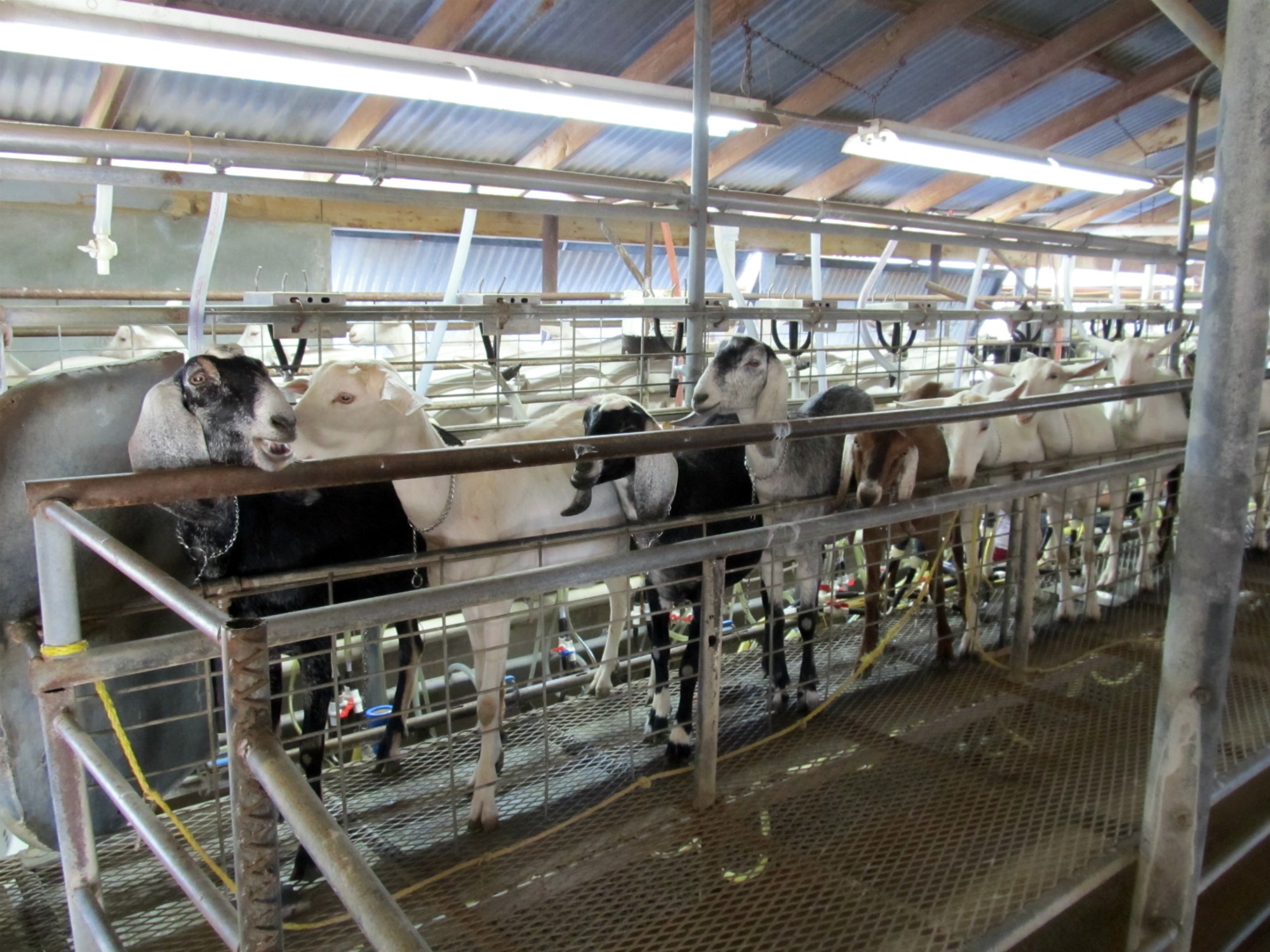
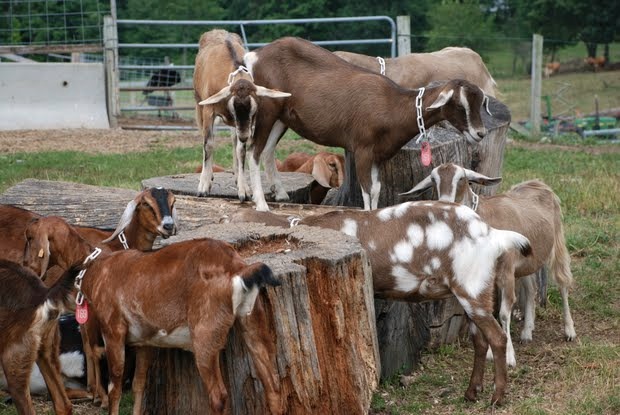
The farm is populated primarily by adult female milking goats as well as a few adult males,and quite a number of “kids” ranging in age from a few weeks to a few months old.  Drake Family Farms milks three breeds of goats, Sonnens and Alpines renowned for their prodigious milk production and Nubians known for their rich milk.  And their slogan of “Where Every Goat Has a Name” is more than a cute marketing catchphrase.  Every goat actually has a name – imprinted on a metal tag worn on a collar around the neck of each goat – and Dan remembers each and every one of them.

Talking to Dan it is apparent that the goats are not a commodity to him but a labor of love.  He spoke proudly of how last year the farm had the #3 Sonnen breed leader in the nation who produced an incredible 4,605 pounds of milk in 305 days.  When we inquired as to whether we could see her, Dan sadly replied that she had died, along with her three kids, in a complicated birth.  But there is a happy ending to this story – the mother of the breed leader is still alive and the farm had the sperm from her father.  Thus the late champion goat now has a baby brother and a sister to carry on the line.

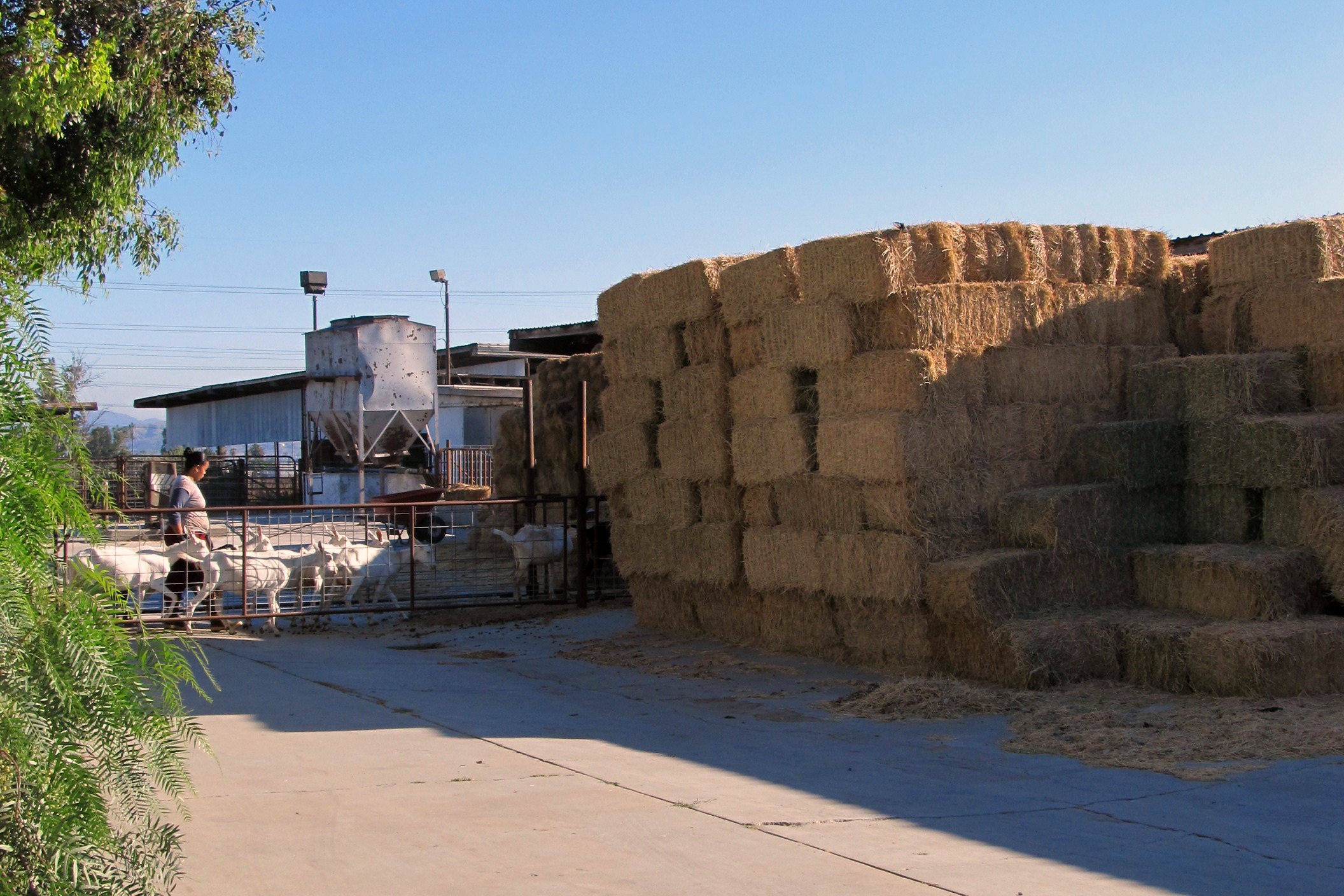
It is scorching hot out in the inland sun but in the shade of the open-air goat barns, with an afternoon breeze blowing through, it is cool and peaceful.  Many of the adults munch contentedly on hay, kids nurse and frolic and with their mothers, and a fair number of goats amble up the sides of their pens at the sight of people – eager for a scratch.  Looking at the dairy goats I am reminded far more of the social and playful nature of dogs than of cows.  Dan explains that Drake Family Farms is not organic – and never will be.  He further elaborates that organic certification forbids the use of antibiotics in milking animals and that he believes it is cruel to deprive an animal of basic care if medically indicated.  That said, the farm is, in many ways, what consumers have come to think of as “organic” – the goats are fed a simple diet of primarily hay – free from any added hormones or drugs.  For simplicity’s sake the mother goats raise and nurse their kids (in addition to being milked twice per day),  as opposed to the kids being separated from their mothers and bottle fed.  When it is time for milking the goats eagerly line up – seemingly quite comfortable with the process.

After the milk is collected the goats flow back into their barns and the milk is immediately cooled to 35 degrees using a plate cooler.  The milk is kept cold in a large holding tank.  Twice a week cheese is made.  Prior to cheese making the milk is heated to 145 degrees for 30 minutes for pasteurization.  The milk is then immediately cooled to 76 degrees and the cheese making process begins.  Cheese cultures are added and the milk is left to culture for 12 hours.  The cheese curds are then bagged and left to drain on a special cheese table.  The cheese, now fresh chevre, is finally packed as  plain chevre or mixed with other ingredients to form one of the farm’s seven signature flavors: lemon pepper, apricot & honey, herbs de Provence, garlic & onion, french herbs, and jalapeno.

Drake Family Farms goat cheese is available at select Southern California Whole Foods Markets, the Saturday Santa Monica Farmers Market, as well as in a number of local restaurants.  Drake Family Farms goat cheese isn’t cheap – nor should one expect it to be.  It is delicious, top quality, local food produced on a small family farm that, unlike industrial agriculture, receives no subsidies.  Like any small business Drake struggles with challenges such as the high cost of utilities (it takes a lot of energy to cool and then pasteurize thousands upon thousands of gallons of milk per year) and paying its workers a living wage.  As a farm Drake has the additional challenges of unpredictable factors like the weather and marauding coyotes.  Dan laments that it is approximately three times more expensive for him to run a goat farm in California versus Utah.  But Southern California is Dan’s home and so he perseveres and my taste buds are thrilled that he does.

Gina Marie Buccolo
Summer 2011 Los Angeles Food Warrior

Posted in Food Warrior Interns, On the Farm | Tagged , , , , , , , , | 3 Comments

Storing Harvest Bounty: Canning vs. Dehydrating

Last winter I received Mary Bell’s Food Drying with an Attitude: A Fun and Fabulous Guide to Creating Snacks, Meals, and Crafts – and I put it aside because I did not have a dehydrator. Like last year, I started this season with drying tomatoes in my oven, but the tomatoes take two full days to dry in the oven at 200 degrees. So I bit the bullet and bought an electric dehydrator– one built for the task.

Borden - dehydrator

Jars of dehydrated harvest bounty waiting for the winter.

I purchased the dehydrator week ago, reread all of Bell’s engaging and intriguing book, and I have not turned the machine off since. I pack hefty tomatoes and gleaming eggplants into airtight jars and debate the pros and cons of dehydrating vegetables vs. canning vegetables. Here are my thoughts so far – I look forward to hearing yours.

Dehydrating pros

• Food is considered raw when dehydrated below 105 degrees (because it maintains enzymes and nutrients that are leached by higher temperatures).

• The labor involved is minimal. I cut the vegetables at night and pack them into jars in the morning.

• The equivalent ingredients take up less room when dehydrated than when canned.

Dehydrating cons

• Dried fruit and vegetables do not last as long as canned items.

Canning pros

• The recipe is finished when you open the jar, as opposed to drying the basic ingredients, and then making a recipe in the winter. (This could also be considered a con.)

Canning cons

• The labor involved is focused, hot, and continuous. From cooking the sauce, to the hot water bath, to preparing the jars – unlike dehydrating, it does not happen while you sleep.

This last point for me is the crux of the matter. A food preservation technique creating results while I sleep is incredible. To me, that is a winning food preservation technique.

Chopstick Crazed,

Corinna

(reposted from annarbor.com)

Posted in On the Farm | Tagged , , , , , | Leave a comment

Foodshed: A Market with an Ideology

This post is from one of the 16 interns in the Real Time Farms Food Warrior Summer Internship Program (our Fall 2011 Food Warriors have started and will be blogging  soon!). These interns are collecting data, pictures, and video on the growing practices of our nation’s farms, collecting food artisans’ stories, and documenting farmers markets. We all deserve to know where our food comes from!

I was drawn to the Foodshed by their Sunday farmers market and got more than I bargained for.  I’m not talking in terms of produce or artisanal goods.  While I did walk away with one of the first melons of the season tucked under my arm, I also took away some substantial food for thought.

Foodshed differs from other markets in that it is a small indoor market open all year round, nestled in between the shops of Boerum Hill, Brooklyn.  The market is hosted by a space known as The Commons Brooklyn, a community educational center.  On Sundays, the front of the market features tables of fresh vegetables mixed with goods like Egyptian spices, honey, flour, and pasta, as would be the case in a general store or a farm stand.  A diverse collection of food artisan vendors set up shop in the back.   On Tuesdays, the Foodshed market at the Commons is open from 4pm to 8pm, for customers who want to do some market shopping after work.  The artisan vendors are only present at the market on Sundays however.  I was given more insight into how Foodshed works by talking to its enigmatic director, Mosab Qashoo.  During our conversation, he explained how Foodshed is more than just a market; he sees it as a kind of mini model of an ideal food system.

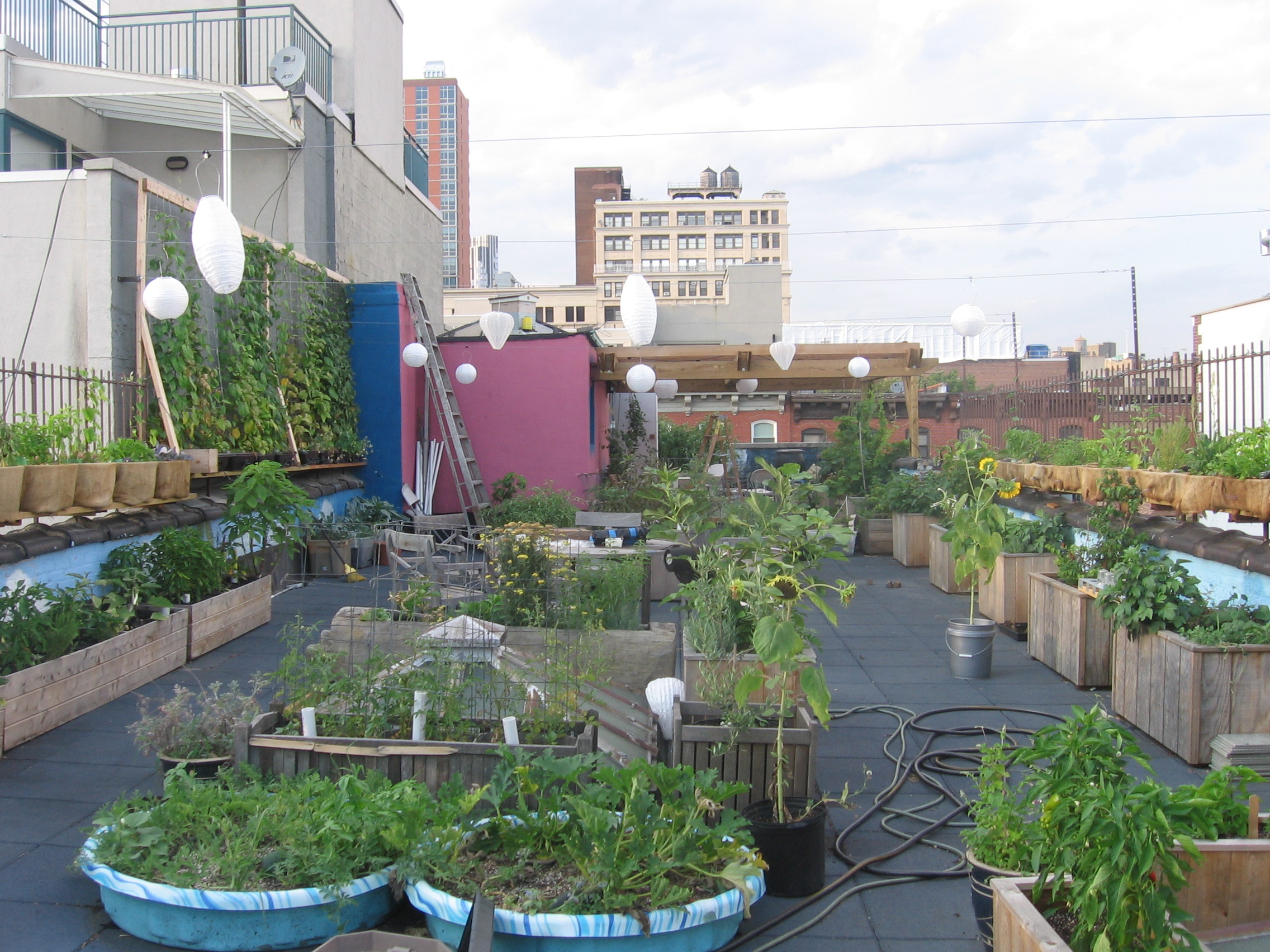
In the early morning, Mosab gets on his bicycle and gathers the produce from farmers’ markets around the city.  He gets fruits, vegetables and other goods from seventeen different local farms including J. Glebocki Farms and Cayuga Pure Organics.   Seventy five percent of the produce is Certified Organic and the rest is Certified Naturally Grown, or GAP (Good Agricultural Practices).  In effect, Foodshed is a kind of condensed farmers market for the local community.  Foodshed is all about transparency— being able to track the food directly to the source, as the food system should be.  Foodshed has direct relations with farmers and farmers’ markets where they get their products from, and does not use a middle man.  Foodshed also sells produce that is grown on their rooftop garden.  As stated earlier, Foodshed uses the environmentally friendly bicycle to gather all that they sell.  This is the same bicycle used by Earth to Kitchen which Mosab helped to create.

More importantly, Mosab sees selling responsibly raised food as a way to bring people together, an action that is universally effective.  Mosab believes that eating food is a form of trust in its source and that the exchange of good food will bring out the good in people. The potential for the creation of such human relationships can be witnessed in his interactions with customers at Foodshed.  Breaking away from our conversation to talk with his customers, Mosab smells bunches of dill and holds it to the noses of children, giving away handfuls of purslane, raspberries and dill seeds to customers.  Upon receiving a complimentary Portobello mushroom to accompany the fresh pasta she had bought, a woman turns to her husband and says, “You see, people are good.”

Mackensie Griffin

Summer 2011 New York City Food Warrior

Posted in At the Market (farmers market), Food Warrior Interns | Tagged , , , , , , , | Leave a comment

Communities Dig In To Reconnect: Teaching Through Farming

This post is from one of the 16 interns in the Real Time Farms Food Warrior Summer Internship Program (our Fall 2011 Food Warriors have started and will be blogging  soon!). These interns are collecting data, pictures, and video on the growing practices of our nation’s farms, collecting food artisans’ stories, and documenting farmers markets. We all deserve to know where our food comes from!

On my Food Warrior journey, I have experienced a new wave of “teaching through farming.” I have seen desks morph into tomato plants and notebooks into pigs. I have seen lecture halls in the shape of grassy fields and the cafeterias next to blueberry bushes. This new wave of on the farm teaching has inspired children and adults alike to travel to farms to grow, much like the plants in the fields. Founded with a mission to educate the surrounding community, these places are open to teaching anyone willing to learn.

Sprout Creek Farm in Poughkeepsie, New York, was started on the campus of a school, explains Margo, the Director. As early as the 1970’s Margo and her fellow teachers noticed that kids were becoming increasing disconnected from each other and their environment.

“Children were beginning to not eat at home very much and if they did it was fast food, because that was really big by this time. The social dimension, therefore, was beginning to change. People were less and less able to know how to converse with each other because they didn’t sit at meals and do that,” says Margo.

This lack of family interaction at the dinner table made the first crack in the social gap, that technology would only further, in children’s ability to connect with each other and the environment. In response, Sprout Creek Farm implemented educational programs for children. Sprout Creek Farm runs a variety of summer camps for children aged six to sixteen, teaching children to milk cows, taste cheese, build compost bins, and grow their own fruits and vegetables.

Another farm committed to community education is Terhune Orchards in Princeton, New Jersey. Started by Gary and Pam Mount in 1975, the Mounts and now their daughter, Tannwenn, and her husband have expanded the farm from an apple orchard, to a 185 acre farm growing over 35 different crops.

Both Gary and Tannwenn are Princeton University alums and no strangers to the benefits of education. These two could have taken a lot of different career paths, but both father and daughter felt strongly that it was important to allow the community to participate and share the farming experience with them.

Terhune Orchards now attracts about a half a million visitors every year. With a goal to help you experience the farm, they offer pick-your-own produce, a farm walking trail, community education classes, guided tours for school field trips, wagon and pony rides, and a variety of children’s programs (Read and Pick Program, Gardening Camp, and Farm Camp).

Farms are opening their (barn) doors, solidifying our relationship with the food and the earth. Not to mention, helping us all more fully enjoy the summer outdoors, surrounded by growing plants and adorable animals! Sign me up, Mom!

Emily Saltz

Summer 2011 New York City Food Warrior

Want more? Check out this episode from Perennial Plate about kids at a farm!

Posted in Food Warrior Interns, On the Farm | Tagged , , , , , , | Leave a comment

A Locavore Discussion: Why Preserve Tomatoes for the Winter?

Borden - tomato plant

Certain Op-Ed pieces stick with you. Last year I was caught by one in the New York Times, called Math Lessons for Locavores, by Stephen Budiansky. First, I felt kinship with the author when he agreed with what I learned when I did my organic berry jam cost comparison article – namely, the efficiencies involved in shipping food long distances, “adds next to nothing to the total energy bill.” Then, he goes on to posit that household energy usage is the true culprit, accounting for “32 percent of all energy use in our food system, the largest component by far.”

The Op-Ed piece concludes with the same argument I learned in high school economics; we should “grow lettuce, oranges, wheat, peppers, bananas, whatever, in the places where they grow best and with the most efficient technologies — and then pay the relatively tiny energy cost to get them to market, as we do with every other commodity in the economy.” This is his rationale for being wary of the terms “food-miles” and “sustainability” – which are rapidly joining “organic”, “natural”, and “free-range” as words that connote gold and denote tin.

He gives very convincing evidence that the energy used in transporting grapes from Chile can be less than the energy used for the extra freezer your family buys to freeze your local rhubarb. But his fallacy is assuming that we need, as a nation of Americans, to be eating those grapes in March.

When I managed the Westside Farmers’ Market, I overhead many customers ask the farmers whether they had lettuce to sell in August. Tomatoes are ripe in Michigan Augusts – lettuce is long gone.

At some point in our national assumptions, a burger became married to “lettuce and tomato.” The question, “would you like lettuce and tomato on that?” became coupled together and ingrained into our national consciousness. Therefore, when you go to the farmers market and see tomatoes, our brains look for the lettuce – “it must be here!” “how can I make a proper burger without it?”

Bananas on our breakfast cereal, apple pie in May, watermelon for the 4th of July picnic, orange juice and coffee in the mornings, chocolate for Valentines Day, lettuce with tomatoes for BLTs in March ~ many food pairings in our American culture assume cheap oil, willing trading partners, and organized large-scale transportation.Borden - dried tomatoes

Our supermarkets groan under the volume and the diversity of our food choices – during all seasons of the year. That abundance of choice and quantity is not serving us. According to a recent article in Scientific American, Americans throw away between 25% and 50% of all of the food we produce for domestic sale and consumption. A 2009 study from the National Institute of Health concluded, “US per capita food waste has progressively increased by ~50% since 1974 reaching more than 1400 kcal per person per day or 150 trillion kcal per year. Food waste now accounts for more than one quarter of the total freshwater consumption and ~300 million barrels of oil per year.”

You only throw away that which you do not value. The NIH study tells us that Americans are a spoiled nation when it comes to food. There are 6.8 billion people in the world – 1.02 billion of them are hungry.

One out of six people is hungry, yet we are overwhelmed with a relentless supply of bananas and lettuce and avocados and apples all seasons of the year. It is understandable that our national barometer for what to expect at the market has been skewed. It is understandable, and a huge tragedy, that we throw so much food away.

Why preserve tomatoes for the winter? I preserve my tomatoes for the winter to help me reset my internal barometer as for what I should expect on my burger.

Chopstick Crazed,

Corinna

(reposted from annarbor.com)

Posted in In the Kitchen (recipes & more) | Tagged , , , | Leave a comment