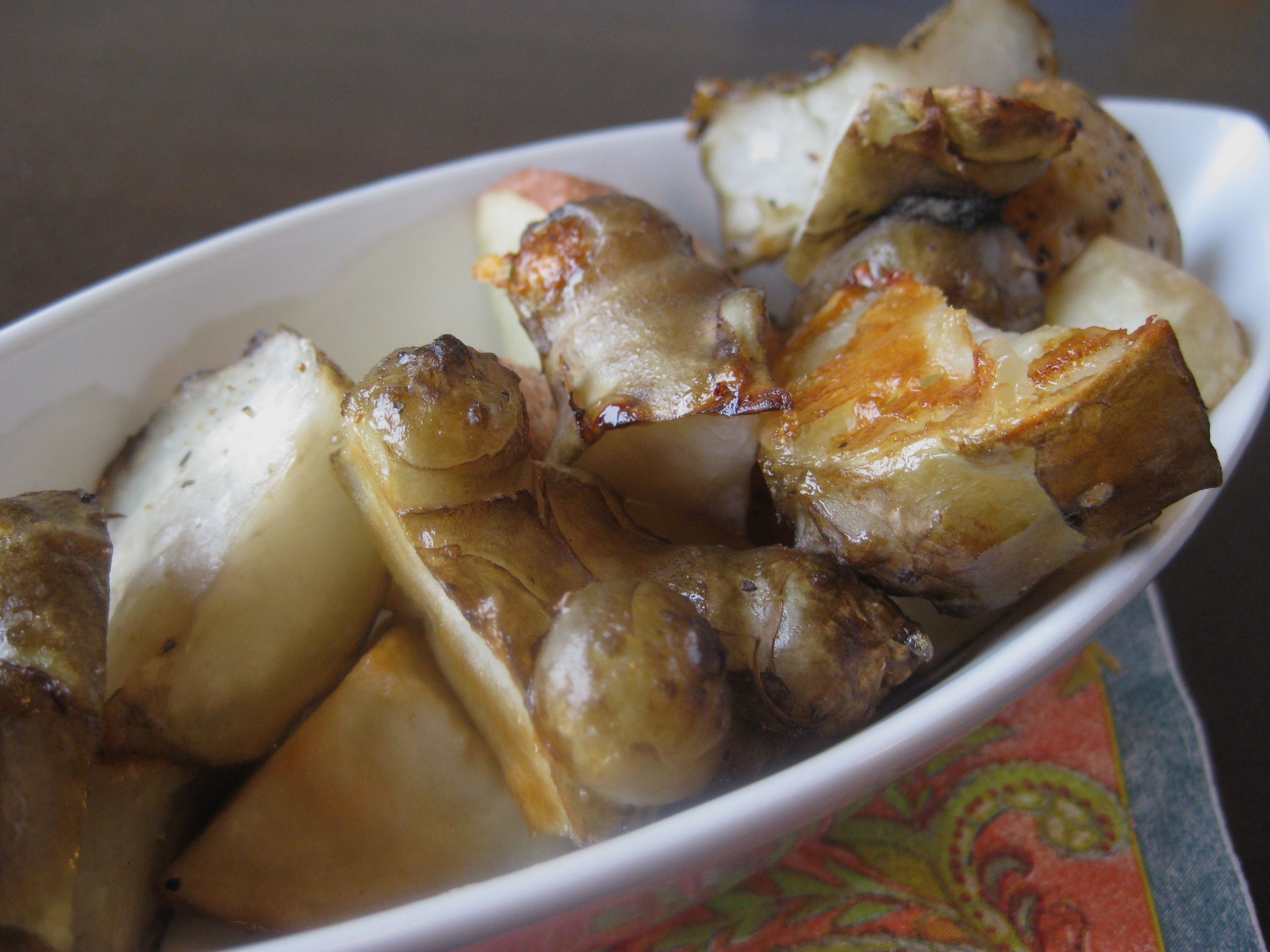
Have You Tried: Sunchokes?

A week and a few days ago, at Seattle’s University District Market, I kept seeing bins and baskets brimming with brown, bumpy things.

Odd looking vegetables.

Some signs said sunchokes. Some said jerusalem artichokes. I had to know more.

I asked the very friendly young fellow what the heck I was supposed to do with these sunjersualemchokes. He gamely responded, “Whatever you want! You don’t even have to peel them!”

It was true, I discovered, upon buying a bagful and returning home to research recipes. You can boil them, mash them, steam them, and roast them. And thank heavens, you don’t have to peel them.

Peeling them would be aggravating.

So what is a sunchoke? According to Wikipedia, a sunchoke, or jerusalem artichoke, is the tuber of a species of sunflower. Sunchokes have been cultivated by Native Americans since before European arrival and are easy to grow. They also offer lots of iron and potassium and have a similar texture to potatoes.

Did you say potatoes, Wikipedia? I love potatoes!

So I roasted my sunchokes with potatoes.

Yum.

If these are at your local market, I strongly suggest giving them a try! They are crisper and nuttier than potatoes, and definitely add something new to the table!

Your Seattle Correspondent,

Lisa

Posted in In the Kitchen (recipes & more) | Tagged , , , , , , , | Leave a comment

Coco and Lafe’s Excellent Adventures

How many farmers markets did you visit this year? Probably not as many as Coco and Lafe, the singing-songwriting duo that recently wrapped up their 2010 Get Fresh tour of 100 farmers markets. Despite traveling from coast-to-coast, they found time to share a little bit about themselves and why they think farmers markets are so special with Real Time Farms’ Director of Vegetable Outreach, Cara Rosaen.

Cara: What were you doing before leaving for this farmer’s market adventure?

Coco & Lafe: Coco took early retirement from Twinfield Union School in Vermont as a kindergarten through 12th grade music teacher. I worked for record companies most of my life, ending with a decade representing Warner Brother’s children and world music labels as their international sales manager.

Cara: What made you decide to leave what you were doing and head out on the road to play at farmers markets?

C&L: A few months before we became “empty nesters” we asked ourselves: “How are we going to top what we’ve done? How do we want to finish this life?” And the answer was clear: write and perform songs. When the younger of Lafe’s two sons graduated from High School, we put him on a plane for his next adventure and three days later we ran away from home.

We went to Boston first to break into the vibrant songwriter scene there. What we found was 500 other singer-songwriters in line ahead of us, and dozens of them were very good. We started playing on the street! There’s a whole other story there, a very fun one, but the upshot is that a farmer’s market manager approached us to play. We did, and sold CDs by the pound, and found the vendors were fascinating people and very appreciative. That manager gave us the names of other managers and voila! We had a new career.

Until it snowed. Now we follow the harvest across the country.

Cara: How did you both meet?

C&L: Coco was the lead singer in a very popular country band. When I was 16, she invited me up on stage to sing the first song I’d ever written. We didn’t become a couple then, but I lusted after her like Vegans crave eggplant and eventually…

Cara: How long do you plan on touring farmers markets?

C&L: Until the grass grows above our heads.

Cara: How has doing this shaped how you feel about eating locally?

C&L: We both were ‘co-op’ shoppers and Coco was a gardener before we started playing and promoting farmers markets. Immersing ourselves in the lives of farmers and markets revealed just how much impact a single shopper makes in a community and now we feel very passionate about the cause. It’s not just buying local and eating fresh; it’s also community and education.

Cara: What is special to you about farmers markets?

C&L: There is so much, how do you choose? The people, the festive atmosphere, community, vibrant colors and smells, the impact of buying local and eating fresh, the quality of the produce and the humor of the farmers themselves. Who knew? Try this: tell a joke to a craft or hot food vendor, and the same joke to a farmer or gardener — big difference. Don’t ask me why. Something about working in dirt makes people happy.

But our favorite moments playing markets is the kids. We give them shakers and they dance, we pull the microphone down and they sing with us, they pet Lilla our busking beagle, they put dollars in the tip jar or my hat with shy glances. They are fresh and living totally in the moment. And look what they’re eating! Strawberries! Carrots!

Cara: You’ve said there are markets out there “full of American heroes”. Can you tell us about a few American heroes you’ve met?

C&L: Stacy of Styria Bakery in Denver. With her brother and his wife, and one other partner, the five of them bake 3 to 5 thousand loaves of bread each night and sell them at 27 farmers markets each week. No restaurant sales, no retail: direct to markets only. They each work seven days a week, and two of those days are eighteen hour days. How do they have a life? The season is only May through October. They do a few events during the winter, but pretty much it’s a half year occupation, and she gushed about it. She loves it.

image

E.J. (“E Jay”) Riggen of Pleasant Valley Farms in Cleveland, Ohio. E Jay has been coming to this farmers market for 70 years: first with his grandparents, then his parents. This market still has a slaughterhouse on site, although the FDA closed it down ten years ago. The only markets he’s missed in 70 years were due to “…fighting in THE war, a brief honeymoon (his), and two weddings (not his). He’s only been to a doctor once in his life, and that was for a broken bone. He attributes his good health to fresh food and hard work.

E Jay turned 80 the week we met him, and he showed us pictures of his favorite birthday present: a friend of his let him pilot his new Cessna Twin Engine plane, including touch downs (he called them “dust offs”. It’s all E Jay wanted because he had to turn in his pilot’s license at 70.

image

David Yang of the Yang Farm in Sanger, California. This family owned and operated farm has been bringing food to markets for over 50 years, but David couldn’t tell me how long they’ve been farming this same land: “Before my dad…” How many family members? “I don’t know”, he said, “it’s a very extended family and many of them work the fruit trees in land we own in the mountains. A few dozen.”

What makes him a hero to us? The fact that he doesn’t care about numbers or think what they are doing is special. They care deeply about the quality and the variety of the produce they bring to market, and how he and his brothers and sisters know everybody’s name at 7 different markets. “We know what each one eats.” I find that eye opening, amazing, and it reassures me that the world is full of people who still take great pride in hard work with quality results.

image

Cara: How would you finish the sentence ” I eat local because….”

Lafe: …the sooner you eat it the better for you it is.
Coco: …knowing who grew it and how much they love doing it makes it taste better for me.

And lest you think that vendors at a farmers market require booths, check out this photo Coco and Lafe shared of a Vermont farmer who doesn’t rent a booth, just booth space. This is how he brings and displays his crop to the market.

image

Posted in On the Farm | Tagged , , , , , | Leave a comment

Young Foodies: Sam Schiebold

As a Graham Sustainability Scholar at the University of Michigan, 20-year-old Sam Schiebold was expected to make a personal sustainability goal, and she made it her goal to eat only locally sourced foods for the year.

Since she set her goal in September, Sam shops almost exclusively at the Ann Arbor Farmer’s Market, cooks every meal for herself, and blogs about her experience. She makes a few exceptions for bulk items like rice and flour from the People’s Food Co-op, but always searches for an easy substitute when locally-sourced staples are not available (like wheat berries for grains). She also does her best to eat foods that are as unpackaged as possible, but will make some exceptions if she gets excited about a new cool food from a small, local business (like Pilar’s Tamales).

When she is buying from a local business that sells processed foods, she will call or email them to find out where they get their ingredients from to check that it is from a nearby source. For example, she found that the Ann Arbor Tortilla Company gets their corn from 150 miles away. Right now she is really in to squash, sweet potatoes, and winter greens, so the reduction in available produce has not yet posed a problem for her. She hopes the huge hoop house movement will help her get through later winter months, and has also been canning and freezing a lot of produce. “We have lost track of the things that our grandparents used to do, like canning, because of the ease of modern society. We have lost the skills that used to be essential for survival, and now people forget there are even seasons for food,” she says.

The experience has taught her a lot about both patience and planning. “I know I’m not going to have melon until the summer, but I can have strawberries because I planned in advance and remembered to freeze them.” Over the past few months, she has grown much more appreciative of food. She prepares every meal for herself and has learned what she can eat and how to prepare it. She tries to make every meal exciting with strong aesthetic appeal because, in her mind, “the first step to a good meal is what you see.” Sam believes that food tastes better when it is fresh and local, although she admits she has no scientific evidence. “It’s just a feeling I have, but I really think that the second produce is harvested, it starts to lose nutrients and taste.”

She describes her endeavor as an “easy challenge” and says that all it really takes is making the time and the choice. “A lot of people just don’t think about it… It’s so normal not to think about it.” She doesn’t want people to feel threatened or judged for not thinking about it, and says her favorite way to show her friends that eating locally is possible is to cook for them. “I want to show people that what I’m doing is easy and tastes good.” She feels it is very important to put only positive emotions behind what she is doing. “It should not be a negative thing,” she says. “There should only be a positive connection to something that will make change, or it won’t happen.” Eating locally has become a lifestyle for Sam, and now that she knows how easy it is to eat well while doing so, she sees no reason to ever stop.

Stay Fresh,

Lindsay Partridge

Posted in Food Transparency (the issues) | Tagged , , , , , , , | 1 Comment

What’s the Difference: Turnips

While shopping at Seattle’s University District Market this past Saturday, I halted in front of a gigantic pile of root vegetables. Parsnips, rutabagas, and turnips aplenty.

Two different types of turnip.

I asked questions. That’s how this works.

First off, I’m not sure I’ve ever cooked with turnips before. I wanted some ideas. And I wanted to know, of course, what the difference is between the light gold and the white & purple turnip. What should I expect?

The nice lady at Nash’s Organic Produce told me that the golden turnips (those big guys in back) have a milder sweeter flavor and taste good raw, while the purple turnips (the turnips that are, uh, purple) have a sharper, more radish-y flavor, and are better suited to cooking. I didn’t even know you could eat turnips raw. The things you learn at your farmers’ markets! Turnips also store really well.

So I went home with my turnips. I took pictures of them.

I researched suitable recipes for them.

And I peeled them and tried side by side comparisons of the raw flavor of each type of turnip. Raw turnips have a pretty powerful taste, even the sweeter golden turnip! But the purple one was definitely sharper. Interestingly, their textures were a little different too – the golden turnip was crisper, the purple softer.

So I grated up my raw golden turnip.

And plunked it on a salad.

That’s turnip. Not cheese. Salad greens from Alm Hill Gardens. Apples from Tonnemaker. Turnips from Nash’s.

Tossed with a little oil and vinegar, a very tasty salad. The sharpness of the turnip balanced well with the sweetness of the apples, and grating the turnips adds some nice texture to the salad.

Ok, time to cook those purple guys.

Peel and slice. You can see that there is a golden turnip in here too – I had one leftover and decided to slice it up too.

Time to make turnip gratin!

I used this recipe from Epicurious, but cut in half. And with no sage. And no potatoes. I modified this recipe from Epicurious, I should say.

And it was delicious. A very good use of a turnip or two.

So! Turnips! Eat them raw if you’ve got golden ones. Otherwise, drown them in cream and cheese. I’m sure they’d be perfectly good roasted alongside some potatoes and parsnips.

Root for root vegetables! Yeah! Turnips! Wahooooo!

Your Seattle Correspondent,

Lisa

Posted in In the Kitchen (recipes & more) | Tagged , , , , , | 1 Comment

Stuffed!

I like to make pizzaa lot. But sometimes even old standbys need to be shaken up a bit, so this week instead of making pizza, I decided to make stuffed bread for a Real Time Farms (and friends) dinner.

The process of making stuffed bread starts off similarly to pizza. I began by prepping a triple batch of my go-to pizza dough recipe using one-third whole wheat flour and two-thirds all-purpose flour. While the dough was rising we prepped our ingredients. Cara washed greens from Brines Farm while I hard-boiled eggs from Our Family Farm and sliced mozzarella from Zingerman’s Creamery.

After letting the dough rise for an hour or two, I split it into two equal pieces, and rolled each piece of dough out into a long rectangular shape. One piece of dough was topped with smoked mozzarella, the hard-boiled eggs and a healthy pile of greens. The second one was topped with regular mozzarella, leftover roasted veggies mixed with black beans, and a pile of greens.

For each one, after the desired fillings are placed on the dough, start pulling together the sides of dough up over the fillings, and crimp to close and seal the bread. You can leave the stuffed bread long, in which case crimp and seal the ends, or you can turn them into rings like I did. To complete a ring shape, after you’ve crimped the length of the bread, bring the two open ends together and crimp each side to each other to form a continuous ring. Transfer it (carefully) to a baking sheet, and flip it over if you are feeling fancy to hide the seam. Poke a few small slits in the top and pop it into a preheated 350 degree oven until the bread looks deliciously golden – about 35 minutes or so, then slice into wedges and enjoy!

Locally yours,

Lindsay-Jean

Posted in In the Kitchen (recipes & more) | Tagged , , , , , | Leave a comment

Thankful for….Leftovers?!

As a vegetarian, Thanksgiving isn’t near the top of my favorite holidays. Heck, it probably doesn’t even make the top 5. Don’t get me wrong, I love getting together with family and friends, and focusing on all of the things we have to be thankful for, it’s just that food is a big part of any celebration for me, and some of the traditional Thanksgiving dishes leave me feeling a bit…meh.

Thankfully (ha) I love to cook, so I just always make sure to create additional dishes that I’m excited about eating, whether it’s a pile of roasted vegetables or a savory mushroom pie. Of course, like every other family we always have boatloads of leftovers, and how many tofurky sandwiches can you really eat?

One thing I like to do is stuff portobello mushrooms with whatever leftovers strike your fancy. Stuffing, roasted veggies, tofurky (or turkey if that’s how you roll), cheese chunks, green bean casserole, really pretty much anything from your Thanksgiving feast would be good – just maybe not the leftover pumpkin pie.

Clean your mushroom caps, fill them with your desired leftovers and pop them in the oven at about 350 degrees for about 25 minutes or until your mushrooms look deliciously done. Serve on some leftover mashed potatoes, mashed sweet potatoes, or even a little bed of greens and enjoy.

Happy Thanksgiving!

Locally yours,

Lindsay-Jean

Posted in In the Kitchen (recipes & more) | Tagged , , , , , , | Leave a comment

Turkey Talk: Need Help With Your Turkey??

If you’re like us, and like to brine it before you smoke it or roast it (for you deep fryin’ turkey lovers…this may be an unnecessary step). We loved CHOW.com’s video instructions on how to brine a turkey.

Our Gastronomic Guru, Lindsay Jean-Hard, then added in her two cents from Ree Drummond’s The Pioneer Woman’s blog, for controlling the saltiness of the bird. [This step is not meant to overwhelm, but rather for those who are seeking the holy grail of turkey this year].  We’ve had great success brining, and found it completely transforms the end product to pure, juicy warm goodness.

To Turkey Triumphs!

Cara Rosaen, Director of Vegetable Outreach.

Posted in In the Kitchen (recipes & more) | Tagged , , , , , , | Leave a comment

Have You Met: John Harnois, Keeper of the Feathered Kind?


John Harnois of Harnois Farms in Whitmore Lake, Michigan, raises all kinds of free-range poultry: turkeys, ducks, geese and chickens. But let’s face it, it’s time to talk turkey!

Real Time Farms: What’s your most hilarious encounter with a turkey?

John Harnois: Well, you know, the biggest output of turkeys is poop. Especially in the fall, when it rains, things become quite the quagmire cause they’re pooping up a storm and its raining. There is a flight incline where their yard is and they don’t want to go in, so you’re trying to maneuver in a place where you can’t. So, while trying to move these turkeys, I’ll often go sliding and land in a big puddle of mud and poop. I usually start to get mad at the turkeys but then can’t help but laugh cause they’re turkeys and you’re covered in poop!

RTF: Who would win in a leg wrestling contest between a duck and a turkey?

JH: Turkey. Have you seen a duck’s legs? They are teeny-tiny. You could use turkeys legs as a billy club. They are big, muscular, and tough. If you’re careful, you could hold a turkey by its legs, but you couldn’t do that with a duck. So a turkey would win… wings down.

John raises broad-breasted white turkeys (pictured below left) and heritage turkeys (pictured below right). Broad-breasted whites are the most commonly sold turkey and the largest. They grow very quickly and cannot reproduce on their own and so require in vitro fertilization due to their large proportions. Committed to the survival of the turkey through the maintenance of genetic diversity, John also raises an heirloom breed of turkey, the Narrangansett, known for its unparalleled flavor.

RTF: What makes your turkey special?

JH:  I don’t know. They are really flavorful, moist, and they run around outside. Until they go for ice cream, they’re well taken care of, well-loved. Why are my eggs so flavorful? I don’t know… that’s the million dollar question. If I knew what makes them so special, I could probably do an even better job of raising them. Nonetheless, I read them bedside stories, take them cups of water, tuck them in, and make sure their heads are tucked under their wings.

RTF: Why should people invest in heritage turkeys?

JH: That’s an easy one… You got to eat them to keep them alive. There are lots of strains of non-heritage breeds. If they aren’t bred, they will soon be extinct. We want to keep as good a variety of genetics in the gene pool as possible. If there is nothing to back up on, what are you going to do? You’re screwed. There won’t be any turkeys around and we’ll all be eating “tofurky” for Thanksgiving. Plus, I think they’re just better. They are expensive to raise, but they’re really, really good!

RTF: How were turkey sales this year?

JH: Not bad. We started with about 220 and we now have about a dozen left. I’m still waiting for some people to get in touch with me, but we expect to have most of them sold by Thanksgiving.

John encourages all to support their local farmers and businesses. He sincerely hopes that people appreciate what he does, and he needs to know they do. It’s a lot of work for not a lot of money, he says. “Why am I doing it?” he asks, “I need to know people care in order to continue”. He doesn’t know if he would continue if it weren’t making a difference to people. It has been a very difficult year for him and it can be very stressful—there have been truck failures and trailers not showing up when he is depending on them; Feed costs have gone up 20-30%, but it is difficult to raise prices because people might not continue to buy his poultry. “Is it worth it? Do people appreciate what I do? If not, I could have less stress and just get a job at Costco. I’d probably even make more money doing that. You have to be nuts to get into this field. It would be nice if I could just raise it and give it away, but I’m not able to do that,” he says. Nonetheless, John continues because he cares about the birds he raises and the customers he sells them to.

If you haven’t bought your turkey for Thanksgiving yet, give John a call at 734-645-0300. Harnois Farms sells only really wonderful turkeys raised by really wonderful people. And let him know you appreciate what he’s doing, lest we lose one of the best natural poultry farmers in the area to Costco!

Can’t get enough of John? Check out these great interviews in The Washtenaw VoiceWCBN-FM Ann Arbor, and Ann Arbor.com’s Farm to Fork Series.

Stay fresh,

Lindsay Partridge

Posted in On the Farm | Tagged , , , , , , , | Leave a comment

Young Foodies: Seth Teicher of Roadside Organics

Seth Teicher (see picture), a 24-year-old Michigan grad and DC resident, and his best friend, Nick Weisman, recently started Roadside Organics, a communications firm focused on amplifying and harmonizing voices of leaders in the local food movement.

It all started with Nick’s partnership with Ras Rody, a Jamaican organic farmer, roadside philosopher, and vegan chef. Nick and Ras’ collaborative efforts to create a cookbook that illuminates a lifestyle and philosophy of organic agriculture eventually led to the birth of Roadside Organics with support from Seth. The goal of Roadside Organics is to encourage open access to local, healthy, sustainable food for everyone. “The system is broken,” says Seth, “and an alternative exists.” The challenge is to bring light to this alternative. The local, slow food movement is currently characterized by farmer’s markets and white table cloth restaurants, but Seth states that “social change [in the local food movement] will occur when everyone, regardless of income or social status, can gain access to healthy, local food.”

By illuminating clients who are moving food forward, like Bev Eggleston of EcoFriendly Foods and The Neigborhood Restaurant Group’s Arcadia Center for Sustainable Food and Agriculture, Roadside Organics aims to shape the demand curve in order to bring down the price of healthy local food so that it is affordable to all. Seth acknowledges that big businesses hold much of the power in this country, so for the system to truly change, we need to get them on board. “If there is a big enough movement, big businesses will have to respond,” says Seth. He cites an example of Chipotle going to Bev Eggleston, who has been hailed the “patron saint of the local foods,” to find sustainable local pork, which Roadside Organics highlighted in a film (not yet released). “When organizations like Chipotle start sourcing pork legitimately, that’s how change happens,” Seth Explains.

On October 10th, 2010, Roadside Organics organized a local food block party in the streets of DC to raise awareness of food deserts in the city. Over 1,000 people attended the free event for speakers, performers, and locally sourced food cooked by DC chefs. The block party was Roadside Organic’s first event aimed at illuminating the intrinsic value of healthy, local food.

Seth knows the food system will not change overnight, but feels it is important to start working to fix it now. “It took fifty years to screw it up and it will take fifty years to fix it,” he says. It has a long way to go, but with continued efforts by people like Seth, such a change is possible.

Stay Fresh,

Lindsay Partridge

Posted in Food Transparency (the issues) | Tagged , , , , , , , | Leave a comment

Our Newest Customers!

We are so excited to announce that Harvest Kitchen, The Royal Park Hotel, and eat catering have all joined on to Real Time Farms! They are all really fabulous businesses that are extremely dedicated  to sourcing locally, so we’d like to briefly introduce you to each of them!

Harvest Kitchen is a prepared food CSA (Community Supported Agriculture) program in Ann Arbor, MI. They offer meal packages year round, with options for both vegetarians and omnivores that might be too busy to cook, but want to be eating delicious and healthy locally-sourced meals. Harvest Kitchen recently received a grant from the U.S. Department of Agriculture through the the Farmers Market Promotion Program. This funding will allow them to expand their business, serving even more local customers and leaving them with full happy bellies every week!

The Royal Park Hotel is a luxury hotel in Rochester, MI. Everything about The Royal Park Hotel is luxurious, top of the line, and elegant, including their catered events. They are committed to promoting sustainable agriculture by supporting and featuring regional farmers and artisanal producers, and they’d love to meet with you to create a seasonal menu for your special occasion. The Royal Park Hotel manages to making being very upscale and extremely progressive at the same time look easy! You’d never guess that they are devoted to composting, have charging stations for electric vehicles, and have earned Green Lodging Certification for their wide array of environmental initiatives.

eat is based in Ann Arbor, MI, and they provide local catering and chef services. It’s hard to say anything about them better than they’ve already said it, so in their own words, “We want the food to not only be approachable, but flavorful and exciting. Food is inherently beautiful. We do not build ‘food creations’ or make dishes up, but allow carefully-sourced ingredients full expression within authentic food traditions. Locally sourced, traditionally-made food, prepared and served with attention to detail and care creates a sense of abundance and well-being that will make every eat event truly special and uniquely yours.” Downtown Home and Garden, a hundred-year-old shop in the heart of Ann Arbor, is going to begin inviting local food carts to sell food in their back alley and urban garden, and we’ve got the inside scoop that eat will be one of them!

Many thanks to Harvest Kitchen, The Royal Park Hotel, and eat! We’re happy to have you on board as we continue to excite and educate people about where their food comes from and connect them to fresh, local sources of food.

Posted in At the Table (eateries) | Tagged , , , , , , , , | Leave a comment